Key takeaways
- Leather type: Genuine leather develops a patina and softens with use; bonded or faux upholstery holds its colour more predictably but can crack at stress points within a few years. If the chair will see daily use, the upgrade to real hide pays for itself.
- Recline mechanism: Push-back models tilt when you lean, so they need no side lever and read cleaner from the side. Lever-operated manual recliners give you more defined stops. Both avoid the cord clutter and repair costs of a motorised base.
- Clearance behind the chair: Most manual recliners want four to eight inches of wall gap when fully open. Measure before you commit, particularly in a room where the chair sits against a feature wall or window.
- Seat build: Look for high-density foam over a sinuous spring or webbed deck. Thick cushioning that sits on a thin platform will develop a hollow within a season, and no amount of good leather disguises a collapsing seat.
- Detailing that dates well: Nailhead trim, rivets and wingback shoulders are strong stylistic choices. They anchor traditional and transitional rooms beautifully, but in a minimal space a plain rolled arm ages more gracefully.
What's inside
Leather recliners have a reputation problem. For decades the category was dominated by oversized, overstuffed loungers that swallowed a room whole and clashed with everything else in it. The result is that plenty of people who genuinely want a reclining chair end up buying a static armchair instead, then spend the next five years wishing their back was supported at a different angle. The good news is that the 2026 crop has quietly narrowed its footprint, cleaned up its stitching lines, and started paying attention to proportion.
This guide looks at leather recliners through a design-first lens: how the silhouette reads from across the room, how the hide will age, and whether the mechanism earns its keep. Below you’ll find a curated shortlist, followed by a buying framework, individual assessments of the strongest options, and answers to the questions that come up most often before checkout.
As an Amazon Associate we earn from qualifying purchases.



How to Choose a Leather Recliner Chair (2026)
- Leather type: Genuine leather develops a patina and softens with use; bonded or faux upholstery holds its colour more predictably but can crack at stress points within a few years. If the chair will see daily use, the upgrade to real hide pays for itself.
- Recline mechanism: Push-back models tilt when you lean, so they need no side lever and read cleaner from the side. Lever-operated manual recliners give you more defined stops. Both avoid the cord clutter and repair costs of a motorised base.
- Clearance behind the chair: Most manual recliners want four to eight inches of wall gap when fully open. Measure before you commit, particularly in a room where the chair sits against a feature wall or window.
- Seat build: Look for high-density foam over a sinuous spring or webbed deck. Thick cushioning that sits on a thin platform will develop a hollow within a season, and no amount of good leather disguises a collapsing seat.
- Detailing that dates well: Nailhead trim, rivets and wingback shoulders are strong stylistic choices. They anchor traditional and transitional rooms beautifully, but in a minimal space a plain rolled arm ages more gracefully.
The Best Leather Recliner Chairs (2026), Reviewed
Classic Manual Recliner in Nut Brown
A restrained, traditionally proportioned recliner with padded arms and a supportive back, finished in a warm mid-brown that sits comfortably alongside oak, walnut and rattan. This is the pick for anyone who wants the function without the furniture announcing itself.
Genuine Leather Overstuffed Recliner, Dark Brown
The deeper cushioning here makes it the most enveloping option on the list, and the darker hide hides everyday marks well in a busy household. Worth noting that the generous padding adds visual bulk, so give it breathing room rather than tucking it into a tight corner.
HULALA HOME Push Back Recliner, Burgundy
Burgundy leather with nailhead trim is a deliberate statement, and it lands especially well in libraries, studies and rooms with darker paint or panelling. The push-back action keeps the profile uninterrupted by a side lever, and the thick cushioned seat holds its shape under regular use.
Genuine Leather Wingback Push Back Recliner, Brown
The wingback shoulders give this one genuine head and neck support, which most recliners in this price bracket skip. It doubles convincingly as an accent chair when closed, so it works in a formal sitting room where a visible recliner would otherwise feel out of place.
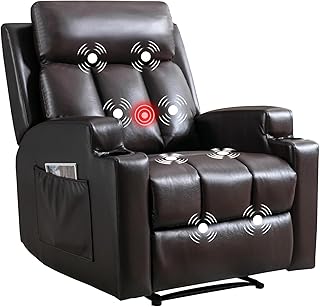
Manual Recliner with Massage and Heat, Dark Brown
Heat and vibration massage plus two cup holders and a side pocket make this the most feature-dense chair here, and the breathable upholstery helps on longer sittings. The trade-off is a slightly more functional look, so it suits a media room or den better than a formal living space.
Frequently Asked Questions
Is genuine leather worth the extra cost?
For a chair you’ll use most days, yes. Real hide breathes better, resists tearing, and improves in character over time, whereas bonded surfaces tend to flake at the seat edge and headrest once the topcoat wears through.
How much space does a recliner need?
Plan for the chair’s closed depth plus roughly 12 to 18 inches of total travel when reclined, including wall clearance. Confirm the specific dimensions on the listing, as footprints vary noticeably between overstuffed and wingback shapes.
Do manual recliners last longer than powered ones?
Generally, yes. Fewer electrical components means fewer failure points, and there’s no motor or transformer to source years later. Push-back designs are the simplest of all.
How do I care for leather upholstery?
Dust weekly, wipe spills promptly with a damp cloth, and condition two or three times a year. Keep the chair out of direct sunlight, which fades and dries hide faster than daily use ever will.
Final Thoughts
For most rooms, the Classic Manual Recliner in Nut Brown is the easiest chair to live with, balancing comfort against a silhouette that doesn’t dominate. Choose the Genuine Leather Wingback Push Back Recliner if you want proper head support and a piece that reads as an accent chair, or the Manual Recliner with Massage and Heat if you’re outfitting a dedicated media room and want every comfort feature in one seat.