Key takeaways
- Measure the vertical opening first: Slide the sash fully open and record the clear height and width. Casement-style units need roughly 23 to 24 inches of height and about 15 inches of width — a difference of half an inch decides whether the unit installs or gets returned.
- Match BTUs to square footage, not ambition: Around 5,000 BTU handles a 150 sq. ft. bedroom, 10,000 BTU covers roughly 450 sq. ft., and 12,000 BTU reaches 550 sq. ft. Oversizing cools fast, cycles off early, and leaves the room clammy.
- Check whether a slider kit is required: U-shaped saddle units are engineered for up-and-down sashes. In a horizontal slider they need a reinforced adapter kit to bridge the opening and carry the load — confirm compatibility with your specific model before buying.
- Prioritize inverter compressors for quiet rooms: Inverter models modulate output instead of slamming on and off, which is why the best of them land near 32 dB. In open-plan living areas and bedrooms, that difference is the whole experience.
- Plan the seal, not just the unit: Budget for weatherstripping, a sash lock, and insulating foam for the gap above the unit. A well-sealed install also keeps the window secure — an important consideration for ground-floor and rental apartments.
What's inside
Horizontal sliding windows are one of those architectural details that look effortless and behave stubbornly. Slide the sash aside and you get a tall, narrow opening — the exact inverse of what a conventional window air conditioner was built for. The result is a familiar summer scene: a boxy unit propped at an angle, foam board wedged along the frame, and a room that never quite cools. Renters in mid-century apartments and owners of newer builds with wide-format glazing run into the same wall.
This guide is organized around fit first, performance second — because a unit that seals cleanly will always outperform a more powerful one that doesn’t. Below you’ll find casement-style units designed for vertical openings, U-shaped saddle models that sit over the sill for near-silent operation, the adapter kit that makes saddle installs possible in a slider, and a compact conventional option for tight spaces. Measurements, noise, and install realities are covered for each.
As an Amazon Associate we earn from qualifying purchases.


How to Choose a/an Air Conditioner For Horizontal Sliding Window (2026)
- Measure the vertical opening first: Slide the sash fully open and record the clear height and width. Casement-style units need roughly 23 to 24 inches of height and about 15 inches of width — a difference of half an inch decides whether the unit installs or gets returned.
- Match BTUs to square footage, not ambition: Around 5,000 BTU handles a 150 sq. ft. bedroom, 10,000 BTU covers roughly 450 sq. ft., and 12,000 BTU reaches 550 sq. ft. Oversizing cools fast, cycles off early, and leaves the room clammy.
- Check whether a slider kit is required: U-shaped saddle units are engineered for up-and-down sashes. In a horizontal slider they need a reinforced adapter kit to bridge the opening and carry the load — confirm compatibility with your specific model before buying.
- Prioritize inverter compressors for quiet rooms: Inverter models modulate output instead of slamming on and off, which is why the best of them land near 32 dB. In open-plan living areas and bedrooms, that difference is the whole experience.
- Plan the seal, not just the unit: Budget for weatherstripping, a sash lock, and insulating foam for the gap above the unit. A well-sealed install also keeps the window secure — an important consideration for ground-floor and rental apartments.
The Best Air Conditioner For Horizontal Sliding Window (2026)s Reviewed
Perfect Aire 10,000 BTU Casement Window Air Conditioner
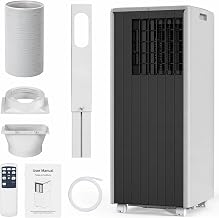
This is the most direct answer to the horizontal slider problem: a tall, narrow chassis at 23.5 by 14.75 inches that slots into a vertical opening without improvisation, cooling up to 450 sq. ft. The Follow Me remote reads temperature at your position rather than at the unit, which meaningfully evens out larger or awkwardly shaped rooms.
Midea 12,000 BTU U-Shaped Window Air Conditioner
The U-shaped design puts the compressor outside the sash line, so the glass closes through the middle of the unit and blocks most of the noise — genuinely quiet enough for a bedroom. With 550 sq. ft. of coverage, inverter control, and Alexa and Google support, it’s the strongest all-round performer here, provided you pair it with the correct sliding window kit.
ZAFRO U-Shaped Inverter Window Air Conditioner
At a rated 32 dB, this is the pick for anyone who works or sleeps in the same room they’re cooling, and the app, voice, and remote control trio makes it easy to live with. Note the ratings carefully: 10,000 BTU ASHRAE equals 6,200 BTU DOE, so treat it as a small-to-medium room unit.
COWSAR 12,000 BTU U-Shaped Window Air Conditioner
A saddle-mount unit that leans practical — 550 sq. ft. of cooling, a 24-hour timer, and cool, dehumidify, and fan modes in one straightforward package. Worth a look if you want U-shaped quiet and dehumidification without paying for a full smart-home feature set.
Soleus Air Sliding Window Kit
The unglamorous piece that makes the whole approach work: a reinforced aluminum frame that adapts a Soleus over-the-sill unit to a horizontal slider. It’s model-specific and sold without the air conditioner, so buy it alongside a compatible Soleus saddle unit rather than hoping it fits something else.
Frequently Asked Questions
Will a standard window air conditioner fit a horizontal slider?
Not without modification. Wide, short units like the Frigidaire 5,000 BTU are built for double-hung windows, though they can work in a slider with a custom-built plywood or acrylic surround. For a clean install, choose a casement-style or saddle unit instead.
Do U-shaped units really need a special kit?
Yes, in a horizontal slider. The U-shape relies on a sash closing vertically through the unit, so an adapter kit is needed to create that geometry and support the weight safely.
How much cooling capacity do I actually need?
Roughly 20 BTU per square foot, adjusted upward for west-facing glass, high ceilings, or top-floor rooms. Check DOE ratings where listed, since they run lower than ASHRAE figures for the same unit.
Can I install one of these myself?
Casement units are typically a one-person job with a drill. Saddle-mount models are heavier and hang partly outside the window, so recruit a second set of hands and confirm your sill can take the load.
Final Thoughts
For a true drop-in fit with no adapters, the Perfect Aire 10,000 BTU casement unit remains the cleanest solution for horizontal sliders. If quiet operation and efficiency matter more and you’re willing to add a slider kit, the Midea 12,000 BTU U-Shaped model is the most capable choice here, with the ZAFRO inverter close behind for smaller rooms where 32 dB is worth every dollar.