Key takeaways
- Vertical vs. mobile: Wall systems win back floor space and keep long-handled tools visible; stacking towers and rolling totes win when the work moves — between rooms, up to a rental, out to the driveway. Most well-planned garages end up running one of each.
- Load rating, not shelf count: A rack advertising a dozen hooks means little if the track buckles under a folded chair and two ladders. Look for a stated maximum load (450 lb is a genuinely serious number) and confirm you’re anchoring into studs, not drywall alone.
- Modularity that’s actually cross-compatible: Stacking platforms only pay off if the boxes you buy in 2029 still click onto the base you buy now. Established ecosystems — VERSASTACK, FLEX STACK PACK, Stack N Roll — have longer runways than one-off designs.
- Wheels and handles for your real terrain: Small hard casters are fine on sealed concrete and miserable on gravel, thresholds, or a lawn. All-terrain wheels plus a telescoping handle are the difference between wheeling a load and dragging it.
- Small-parts strategy: Screws, anchors, and bolts sabotage every system that ignores them. Budget for dedicated bins — wall-mounted rails keep hardware sorted at eye level and off the bench surface you actually need.
What's inside
The garage has quietly become the last unstyled room in the house. We spend months choosing a sofa profile or a cabinet pull, then let a pile of cordless drills, half-empty screw jars, and a rake with a broken handle colonize the corner by the door. The result is a space that works against you: you can’t park cleanly, you can’t find the 10mm socket, and you can’t shake the feeling that the room is leaking chaos into the rest of the home.
This guide treats tool storage the way we’d treat any other furniture decision — as a question of proportion, material honesty, and how a piece behaves over a decade of use. Below are six systems worth building a workspace around, from wall-mounted tracks that clear the floor entirely to modular stacks that roll from bench to truck bed. We’ve flagged what each one does best, who it suits, and the specs that actually matter once the novelty wears off.
As an Amazon Associate we earn from qualifying purchases.


How to Choose a Tool Storage Systems (2026)
- Vertical vs. mobile: Wall systems win back floor space and keep long-handled tools visible; stacking towers and rolling totes win when the work moves — between rooms, up to a rental, out to the driveway. Most well-planned garages end up running one of each.
- Load rating, not shelf count: A rack advertising a dozen hooks means little if the track buckles under a folded chair and two ladders. Look for a stated maximum load (450 lb is a genuinely serious number) and confirm you’re anchoring into studs, not drywall alone.
- Modularity that’s actually cross-compatible: Stacking platforms only pay off if the boxes you buy in 2029 still click onto the base you buy now. Established ecosystems — VERSASTACK, FLEX STACK PACK, Stack N Roll — have longer runways than one-off designs.
- Wheels and handles for your real terrain: Small hard casters are fine on sealed concrete and miserable on gravel, thresholds, or a lawn. All-terrain wheels plus a telescoping handle are the difference between wheeling a load and dragging it.
- Small-parts strategy: Screws, anchors, and bolts sabotage every system that ignores them. Budget for dedicated bins — wall-mounted rails keep hardware sorted at eye level and off the bench surface you actually need.
The Best Tool Storage Systems (2026)s Reviewed
Wallmaster Garage Wall Mount Tool Rack
Two 48-inch tracks with six repositionable hooks and a 450 lb ceiling — this is the most efficient square-foot-per-dollar upgrade in the category, and the sliding hooks mean you can re-space it when the tool collection changes. It’s the piece to install first, because everything you hang here is floor space you get back.
FLEX STACK PACK 3-Drawer Tool Box (FS1105)
The three-drawer format solves the deep-tote problem: nothing gets buried, and you can see a full drawer’s contents without excavating. The grey-and-black finish reads more studio than site, which matters if the box lives somewhere visible.
BLACK+DECKER Stackable Storage System, 3-Piece
A sensible starter stack — small box, deep toolbox, and rolling tote — that covers hand tools, bulkier power tools, and transport in one purchase. Best suited to homeowners and apartment DIYers who want a complete setup without committing to a full pro ecosystem.
Keter Stack N Roll Modular System, 3-Piece
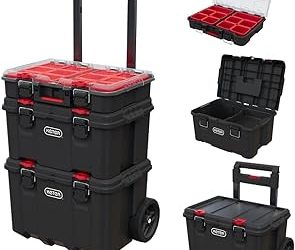
Keter’s weatherproof construction and all-terrain wheels make this the pick for anyone whose projects happen outdoors — garden beds, fence lines, unfinished basements. The telescoping handle keeps a loaded stack manageable over uneven ground, where smaller casters typically stall.
CRAFTSMAN VERSASTACK XL Rolling Tower (CMST60420)
Four pieces, one tall footprint: this is the closest thing to a proper tool chest that still rolls out the door with you. Worth the investment if you’re already in the VERSASTACK ecosystem or expect to keep expanding.
Frequently Asked Questions
Do wall-mounted racks need to hit studs?
Yes, for anything holding real weight. Locate studs, use the supplied lag hardware, and treat drywall anchors as a supplement rather than a substitute. A 450 lb rating assumes proper anchoring.
Are stacking systems from different brands compatible?
Generally no. VERSASTACK, FLEX STACK PACK, and Stack N Roll each use proprietary latching, so pick a platform before you buy your third box.
Can these live outside or in an unheated garage?
Weatherproof-rated resin systems like Keter’s handle damp and temperature swings well. Non-rated boxes should stay under cover — moisture finds hinges and latches first.
How do I organize screws and small hardware?
Rail-mounted bin systems are the cleanest answer: hardware stays sorted, visible, and off the work surface, and individual bins lift out to carry to the job.
Final Thoughts
If you’re building from scratch, pair the Wallmaster wall rack with the CRAFTSMAN VERSASTACK XL tower — one clears the floor, the other gives you a mobile, expandable core. For outdoor-heavy work or a garage that never quite gets sealed, the Keter Stack N Roll is the more durable choice, and the wall-mounted bin rails tie the whole system together for pennies.