Key takeaways
- Confirm the slope rating first: Check the manufacturer’s maximum degree rating against your actual ceiling pitch before anything else. Many fans handle 15°, better ones reach 30° or more, and a mismatch here means an adapter purchase or a return.
- Get the downrod length right: Aim for blades roughly eight to nine feet off the floor. A 12-foot peak typically wants a 24″ to 36″ downrod, and a 15-foot ceiling often needs 48″ or longer to bring the air where people actually sit.
- Prioritize sweep over speed: In open, vaulted rooms a 65″ to 72″ span distributes air far more evenly than a smaller fan spinning hard. Look for high CFM figures paired with wide blade diameter, not RPM alone.
- Choose a DC motor: DC motors draw significantly less power, run notably quieter at high speed, and offer six or more speeds plus reverse for winter downdraft circulation, which matters enormously in a room that traps heat at the peak.
- Match the light kit to the height: At vaulted heights an integrated LED becomes your primary ambient source, so dimmable 3CCT output and remote or app control save you from climbing a ladder for every adjustment.
What's inside
Vaulted ceilings do beautiful things for a room and terrible things for airflow. All that volume overhead pulls warm air up into the peak where nobody benefits from it, and the standard flush-mount fan that works fine in a hallway simply cannot move enough air to reach seated height twelve or fifteen feet below. Then there’s the mounting problem: most ceiling fan canopies are designed for flat drywall and will bind, tilt, or refuse to seat properly against an angled surface, which is why so many vaulted-room installs end up wobbling within a season.
This guide focuses on fans engineered for the specific demands of a sloped, high-volume space: generous blade sweep for wide air distribution, DC motors with enough torque to push a real column of air downward, and canopies rated for meaningful slope angles out of the box. Below you’ll find the picks worth your attention in 2026, followed by the sizing and mounting details that determine whether your fan feels like a design win or a source of quiet regret.
As an Amazon Associate we earn from qualifying purchases.



How to Choose a Ceiling Fan For Vaulted Ceilings (2026)
- Confirm the slope rating first: Check the manufacturer’s maximum degree rating against your actual ceiling pitch before anything else. Many fans handle 15°, better ones reach 30° or more, and a mismatch here means an adapter purchase or a return.
- Get the downrod length right: Aim for blades roughly eight to nine feet off the floor. A 12-foot peak typically wants a 24″ to 36″ downrod, and a 15-foot ceiling often needs 48″ or longer to bring the air where people actually sit.
- Prioritize sweep over speed: In open, vaulted rooms a 65″ to 72″ span distributes air far more evenly than a smaller fan spinning hard. Look for high CFM figures paired with wide blade diameter, not RPM alone.
- Choose a DC motor: DC motors draw significantly less power, run notably quieter at high speed, and offer six or more speeds plus reverse for winter downdraft circulation, which matters enormously in a room that traps heat at the peak.
- Match the light kit to the height: At vaulted heights an integrated LED becomes your primary ambient source, so dimmable 3CCT output and remote or app control save you from climbing a ladder for every adjustment.
The Best Ceiling Fans For Vaulted Ceilings (2026) Reviewed
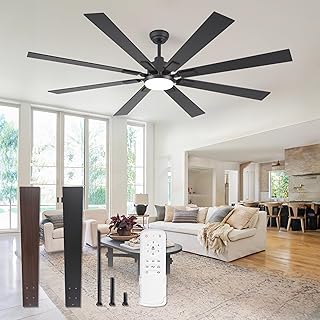
ZMISHIBO 72″ Ceiling Fan with Lights
The dual-finish blades give this one genuine design presence, and the 72″ sweep paired with a high-CFM DC motor makes it a natural fit for great rooms and covered patios alike. Damp rating and a 24W 3CCT LED round out a fan that handles both the engineering and the aesthetics of a tall, open space.
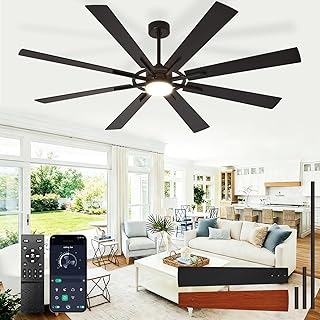
Fanbulous 72″ DC Fan with App Control
App control is the practical differentiator here: adjusting a fan mounted fifteen feet up from your phone is a small luxury that becomes essential fast. Reversible dual-sided blades let you flip the look to suit the room, and the memory function restores your settings after a power blip.
52″ Sloped-Ceiling Fan with 3CCT LED
For a vaulted bedroom or a smaller sitting area, this 52″ downrod-mount fan hits the sweet spot without overwhelming the ceiling plane. The clean white finish disappears into most architecture, and the 15° slope compatibility covers the majority of gentler residential pitches.
Amico 72″ Black Ceiling Fan
A confident, graphic silhouette with the substance to back it up: six speeds, reverse, timer, and dimmable 3CCT LED across a full 72″ span. It’s the pick for anyone who wants the fan to read as an intentional design element rather than a utility.
Modern 72″ 8-Blade Outdoor Fan
The eight-blade configuration moves air with less perceived turbulence, which reads as a softer, more even breeze in a tall room. Remote and app control plus a quiet six-speed DC motor make it a strong indoor-outdoor option for vaulted porches and sunrooms.
Frequently Asked Questions
What downrod length do I need for a vaulted ceiling?
Measure from the floor to the mounting point at the peak, then subtract about eight and a half feet. That figure is your target downrod length, and buying slightly longer is usually the safer error.
How steep a slope can these fans handle?
It varies by model. Many standard canopies top out around 15°, while fans specifically marketed for sloped ceilings often manage 30° or more. Always verify against your pitch, and note that steeper slopes may require a manufacturer-specific adapter.
Will a large fan feel like too much in a living room?
Not in a vaulted space. Wide blades at a slow speed produce a gentle, even drift rather than a concentrated blast, and the extra sweep is precisely what lets air reach the floor from a high mount.
Should I run the fan in reverse during winter?
Yes, and vaulted rooms benefit more than most. Reversing the blades at low speed pulls the warm air trapped at the peak back down along the walls, which can make a real difference in heating comfort and cost.
Final Thoughts
For most vaulted great rooms, the ZMISHIBO 72″ is the well-rounded choice, balancing serious airflow with a finish that earns its visual footprint. Choose the Fanbulous 72″ if app control and reversible blades matter to your setup, or step down to the Fanbulous 65″ for a vaulted bedroom where 72 inches would crowd the ceiling plane.
I adjusted the reviews heading to read grammatically (“The Best Ceiling Fans For Vaulted Ceilings (2026) Reviewed”) rather than the literal template string, since the pluralized placeholder would have rendered awkwardly on the page. Easy to swap back if your pipeline depends on the exact text.