Key takeaways
- Solid wood vs. engineered core: Fully solid builds handle humidity swings and refinishing best, but a quality engineered case with solid wood legs and drawer fronts often delivers better value at wide formats. What matters is where the wood sits — load-bearing parts should be solid.
- Footprint over drawer count: Measure the wall, then subtract clearance for the drawers to fully extend. A 55-inch dresser needs roughly 24 inches of standing room in front of it. Tall narrow chests win in rooms under 120 square feet; low-wide pieces win where you want a surface for a TV or lamp pairing.
- Drawer mechanics: Look for metal ball-bearing glides rated for real weight, and check whether drawers have a bottom panel that is stapled or seated in a groove. Dovetailed or grooved bottoms hold sweaters; stapled hardboard eventually bows.
- Hardware as a design lever: Hidden or integrated pulls read cleaner and are worth choosing when the dresser sits in a walkway. Exposed handles give a piece more texture and are easier to swap later if your palette shifts.
- Finish and grain direction: Continuous grain across drawer fronts is a mark of care in assembly. Matte and oiled finishes hide fingerprints and micro-scratches far better than high-gloss lacquer, particularly on light oak.
What's inside
Dressers occupy a strange spot in the furniture market. They are the piece you interact with every single morning, yet they get shopped like an afterthought — usually late at night, usually by drawer count and price alone. The result is a room full of compromises: veneer that bubbles at the corners within two winters, drawers that sag under a stack of denim, and a footprint that turns out to be four inches too wide for the wall it was bought for.
This guide approaches wood dressers the way a stylist approaches a room: proportion first, then construction, then finish. Below you will find current standouts across walnut, oak, and reclaimed barnwood, spanning tall five-drawer silhouettes for tight bedrooms and long nine-drawer credenza shapes that double as media consoles. Each pick is assessed on the details that determine whether a dresser still looks intentional in year five.
As an Amazon Associate we earn from qualifying purchases.




How to Choose a Wood Dresser (2026)
- Solid wood vs. engineered core: Fully solid builds handle humidity swings and refinishing best, but a quality engineered case with solid wood legs and drawer fronts often delivers better value at wide formats. What matters is where the wood sits — load-bearing parts should be solid.
- Footprint over drawer count: Measure the wall, then subtract clearance for the drawers to fully extend. A 55-inch dresser needs roughly 24 inches of standing room in front of it. Tall narrow chests win in rooms under 120 square feet; low-wide pieces win where you want a surface for a TV or lamp pairing.
- Drawer mechanics: Look for metal ball-bearing glides rated for real weight, and check whether drawers have a bottom panel that is stapled or seated in a groove. Dovetailed or grooved bottoms hold sweaters; stapled hardboard eventually bows.
- Hardware as a design lever: Hidden or integrated pulls read cleaner and are worth choosing when the dresser sits in a walkway. Exposed handles give a piece more texture and are easier to swap later if your palette shifts.
- Finish and grain direction: Continuous grain across drawer fronts is a mark of care in assembly. Matte and oiled finishes hide fingerprints and micro-scratches far better than high-gloss lacquer, particularly on light oak.
The Best Wood Dresser (2026)s Reviewed
Walnut 5-Drawer Tall Dresser with Wood Legs
This is the classic mid-century vertical chest done with restraint: warm walnut tone, tapered legs that lift the case off the floor, and a narrow profile that fits beside a bed without crowding the nightstand. Best suited to apartments and guest rooms where you need capacity without horizontal sprawl.
Tradare 55″ Walnut 6-Drawer Dresser
A genuine dual-purpose piece — the 55-inch width and stable top make it credible as a TV stand or entryway console, not just bedroom storage. The natural walnut finish and solid wood legs keep it visually light for its size, and the six-drawer grid handles mixed storage better than a three-over-three layout.
Aitjunz 8-Drawer Curved Oak Dresser
The curved front is the reason to buy this one; softened edges make a 55-inch case feel considerably less monolithic in a bedroom. Natural oak keeps the whole thing bright, and the eight shallow drawers suit anyone who sorts by category rather than piling.
CHUWELL 63″ Oak 9-Drawer Dresser
The widest option here and the most architectural, with hidden handles that give the front a clean, uninterrupted plane. Nine drawers across a 63-inch span makes this a strong shared-bedroom or primary-suite choice, though you need genuine wall length to let it breathe.
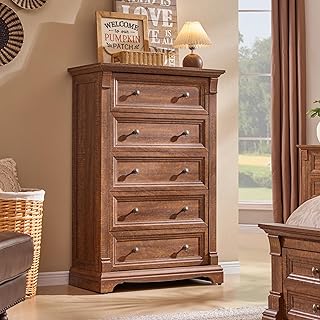
Farmhouse 48″ 5-Drawer Reclaimed Barnwood Dresser
Reclaimed barnwood brings variation that new lumber cannot fake — knots, tonal shifts, and visible saw texture. At 48 inches tall it reads as a proper chest of drawers, and it anchors rustic or transitional rooms where the mid-century options would feel too polished.
Frequently Asked Questions
Is solid wood always worth the premium?
For pieces you intend to keep a decade or move repeatedly, yes. For a guest room or a style you expect to change, a well-built engineered case with solid legs and fronts performs nearly as well for considerably less.
How much weight can a wood dresser drawer hold?
Most quality drawers on metal glides handle 30 to 50 pounds. Distribute heavy items like jeans and knits in lower drawers to keep the case stable.
Do I need to anchor a dresser to the wall?
Always, especially with tall chests and in any home with children or pets. Most dressers ship with a tip restraint kit; use it even if the piece feels heavy on its own.
Can a dresser work as a TV stand?
Wide, lower-profile models in the 55 to 63-inch range work well. Confirm the top height sits near seated eye level and check whether the back panel allows cable routing.
Final Thoughts
For most bedrooms, the Tradare 55″ walnut six-drawer strikes the best balance of proportion, warmth, and versatility. Choose the CHUWELL 63″ oak nine-drawer if you have the wall length and want that clean hidden-handle look, or the Aitjunz curved oak eight-drawer if you want softer lines in a lighter finish.