Key takeaways
- Check your school’s cubic-foot cap: Most residence halls limit fridges to somewhere between 3.0 and 4.5 cubic feet, and some cap amperage too. Confirm the policy before you buy, because a returned appliance is a miserable first week.
- Decide whether you need a real freezer: A separate second door holds ice cream and frozen meals properly. A single-door unit with an internal chiller compartment will keep things cold but not reliably frozen, which is fine if you mainly store drinks and leftovers.
- Measure clearance, not just the fridge: Compressors need two to three inches of breathing room at the back and sides, and the door needs a full swing radius. Sketch it against your desk and bed placement first, and look for reversible doors if the outlet is on the wrong wall.
- Listen for the noise floor: In a room where you also sleep and study, compressor cycling matters more than peak cooling. Thermoelectric personal fridges run nearly silently; compressor models are more powerful but audible, so aim for units rated in the low 40-decibel range.
- Treat the finish as furniture: A mint retro shell reads as intentional decor; brushed stainless disappears into a neutral scheme; matte black grounds a darker palette. Since this is likely the largest hard-surfaced object you’ll bring, pick a color you actually want to look at.
What's inside
Dorm rooms are the ultimate exercise in editing. You get roughly 100 square feet, a roommate with their own vision, and a lease that ends in May, which means every object has to earn its footprint. A mini fridge is one of the few pieces that genuinely pulls its weight, but it’s also the one most likely to end up humming loudly under a lofted bed, frosting over by October, or clashing with everything else in the room.
This guide approaches dorm refrigeration the way we’d approach any small-space furnishing decision: as a question of proportion, finish, and daily function rather than raw specs. Below you’ll find our picks for 2026, from retro two-door models that double as a design anchor to slim personal coolers that live on a desk. We’ve also broken down the buying criteria that actually matter once the boxes are unpacked and move-in day is over.
As an Amazon Associate we earn from qualifying purchases.


🛒 Best Price Today on Amazon
Prime members get fast, free shipping on everything above, plus member-only deals. New members get a 30-day free trial — cancel anytime.
How to Choose a Mini Fridge For Dorms (2026)
- Check your school’s cubic-foot cap: Most residence halls limit fridges to somewhere between 3.0 and 4.5 cubic feet, and some cap amperage too. Confirm the policy before you buy, because a returned appliance is a miserable first week.
- Decide whether you need a real freezer: A separate second door holds ice cream and frozen meals properly. A single-door unit with an internal chiller compartment will keep things cold but not reliably frozen, which is fine if you mainly store drinks and leftovers.
- Measure clearance, not just the fridge: Compressors need two to three inches of breathing room at the back and sides, and the door needs a full swing radius. Sketch it against your desk and bed placement first, and look for reversible doors if the outlet is on the wrong wall.
- Listen for the noise floor: In a room where you also sleep and study, compressor cycling matters more than peak cooling. Thermoelectric personal fridges run nearly silently; compressor models are more powerful but audible, so aim for units rated in the low 40-decibel range.
- Treat the finish as furniture: A mint retro shell reads as intentional decor; brushed stainless disappears into a neutral scheme; matte black grounds a darker palette. Since this is likely the largest hard-surfaced object you’ll bring, pick a color you actually want to look at.
The Best Mini Fridge For Dorms (2026)s Reviewed
Frigidaire EFR840 Retro Mini Fridge with Freezer (Mint)
At 3.2 cubic feet with two true doors, this is the rare dorm fridge that functions as a design statement rather than an eyesore, and the rounded retro shell in mint photographs beautifully against white cinderblock. The side-mounted bottle opener is a gimmick that turns out to be genuinely useful, and the separate freezer compartment holds a pint of ice cream without turning the whole cabinet into a snowdrift.
EUHOMY 3.2 Cu. Ft. Mini Fridge with Freezer
EUHOMY’s two-door model is the pragmatist’s choice: adjustable glass shelving, a crisper drawer, and a freezer that actually freezes, all inside a squared-off black cabinet that recedes visually. Temperature control is more granular than most competitors at this size, which matters if you’re storing anything beyond soda.
Frigidaire EFR321-AMZ 3.1 Cu. Ft. Stainless Mini Fridge
The Platinum Series finish is the closest thing to a grown-up appliance in this category, and brushed stainless has the advantage of pairing with literally any room scheme your roommate brings. It’s a single-door unit with an internal chiller, so treat it as a beverage-and-leftovers fridge rather than a freezer substitute.
2.6 Cu. Ft. Compact Fridge with Freezer (Black)
If your hall enforces a tight size cap or you’re squeezing a fridge into a shared closet nook, this smaller footprint solves the problem without dropping to desktop capacity. Low noise output and energy efficiency are the headline strengths here, and the flat matte face keeps it from visually crowding a narrow room.
Frigidaire EFMIS171 Retro Personal Fridge (Pink)
This six-can thermoelectric cooler is essentially a desk accessory, with a carrying handle and both AC and DC adapters so it moves from dorm to car to library without ceremony. It’s near-silent and adorable in pink, but understand the tradeoff: it chills relative to ambient temperature rather than holding a set point, so it’s for drinks and snacks, not dairy.
Frequently Asked Questions
What size mini fridge is allowed in most dorms?
The common ceiling is around 3.5 to 4.5 cubic feet, which is why so many dorm-targeted models land at 3.1 or 3.2. Always verify with your specific residence hall, since some campuses restrict amperage or ban personal fridges entirely in rooms with provided units.
Can two roommates share one mini fridge?
A 3.2 cubic foot two-door model is workable for two people if you divide shelves and skip bulk groceries. Below three cubic feet, sharing gets frustrating fast, and a second personal cooler for drinks is often the better answer than upsizing.
Is a skincare fridge worth the space?
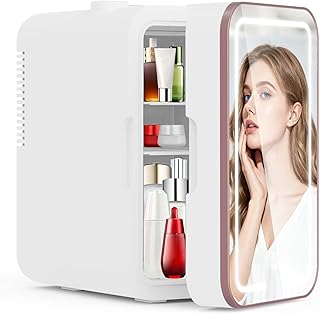
If you’re storing serums, sheet masks, or eye creams, a dedicated 6-liter unit like the YLFU with its dimmable LED mirror keeps products at a stable cool temperature without competing with food for shelf space. It’s a niche purchase, but it doubles as a vanity light, which earns it a spot on a crowded desk.
How do I keep a dorm fridge from smelling?
Wipe spills immediately, keep an open box of baking soda in the back corner, and defrost the freezer compartment once per semester. Manual-defrost units ice up quickly in humid rooms, and trapped frost is the usual source of that stale-fridge odor.
Final Thoughts
For most students, the Frigidaire EFR840 is the pick we’d make ourselves: real freezer capacity, a color story worth building a room around, and a footprint that clears typical hall restrictions. Choose the EUHOMY 3.2 Cu. Ft. if you’d rather have flexible interior storage and precise temperature control than retro styling, and add the Frigidaire EFMIS171 personal fridge if you want cold drinks within arm’s reach of your desk without giving up another square foot of floor.