Key takeaways
- Read the BTU rating twice: ASHRAE and DOE figures describe the same machine differently. A unit listed at 12,000 BTU ASHRAE may be 8,000 BTU DOE, and DOE is the more conservative real-world number. Compare like with like before assuming one model is larger than another.
- Size to the room, not the square footage claim: High ceilings, west-facing glass, and kitchen heat all push you up a tier. A 450 sq. ft. rating suits a shaded bedroom; a sun-filled great room of the same size wants 12,000 to 14,000 BTU.
- Plan the window run before you buy: Self-evaporating still means vented. Measure the distance from your intended placement to the nearest operable window and check whether the included kit fits casement, slider, or double-hung frames.
- Treat sleep mode as a real spec: Compressor noise is the reason these units get exiled to guest rooms. Look for a dedicated quiet or sleep setting that dims the display and steps the fan down, not just a low fan speed.
- Decide how much app you want: Wi-Fi and voice control genuinely help if the unit cools a room you enter at the end of the day. If you’d rather not add another device to your network, a 24-hour timer and a decent remote cover the same ground.
What's inside
Portable air conditioners have a reputation problem in design-minded homes, and most of it comes down to the bucket. Older units pulled moisture out of the air and then asked you to babysit a reservoir, which meant a plastic box parked mid-room with a towel underneath it. Self-evaporating models changed that math: they recycle condensate through the condenser and push most of it out the exhaust hose as vapor, so the unit stays put and the floor stays dry. What’s left to evaluate is everything a curator actually cares about — footprint, finish, noise at night, and whether the controls are worth living with.
This guide covers the self-evaporating portable ACs worth considering in 2026, from compact 8,000 BTU units for a single bedroom to 14,000 BTU floor-standing models sized for open-plan living areas. Below you’ll find the current picks, a short framework for matching capacity to your space, honest notes on each unit’s strengths, and answers to the questions that come up after the box is opened.
As an Amazon Associate we earn from qualifying purchases.


How to Choose a Self-Evaporating Portable Air Conditioner (2026)
- Read the BTU rating twice: ASHRAE and DOE figures describe the same machine differently. A unit listed at 12,000 BTU ASHRAE may be 8,000 BTU DOE, and DOE is the more conservative real-world number. Compare like with like before assuming one model is larger than another.
- Size to the room, not the square footage claim: High ceilings, west-facing glass, and kitchen heat all push you up a tier. A 450 sq. ft. rating suits a shaded bedroom; a sun-filled great room of the same size wants 12,000 to 14,000 BTU.
- Plan the window run before you buy: Self-evaporating still means vented. Measure the distance from your intended placement to the nearest operable window and check whether the included kit fits casement, slider, or double-hung frames.
- Treat sleep mode as a real spec: Compressor noise is the reason these units get exiled to guest rooms. Look for a dedicated quiet or sleep setting that dims the display and steps the fan down, not just a low fan speed.
- Decide how much app you want: Wi-Fi and voice control genuinely help if the unit cools a room you enter at the end of the day. If you’d rather not add another device to your network, a 24-hour timer and a decent remote cover the same ground.
The Best Self-Evaporating Portable Air Conditioners of 2026, Reviewed
DREO 515S Portable Air Conditioner
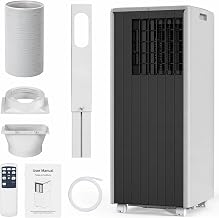
The 515S is the most considered object in this group: a slim white tower with a clean control face, app and voice control, and drainage-free operation rated at 12,000 BTU ASHRAE (8,000 BTU DOE). It handles a mid-size bedroom or home office quietly enough to keep on overnight, and the vertical proportions read more like an air purifier than an appliance.
14,000 BTU 3-in-1 Portable Air Conditioner
This is the capacity pick, rated for rooms up to 700 sq. ft. with cooling, fan, and dehumidifier modes plus auto swing louvers to spread air across a wide space. Choose it for open-plan living areas or converted attics where a smaller unit will simply run continuously without catching up.
Antarctic Star 10,000 BTU Portable Air Conditioner
A well-balanced middle option with five modes, a child lock, and coverage to 450 sq. ft., which makes it a sensible choice for family bedrooms and shared offices. The auto swing and remote handle day-to-day adjustments without a phone in the loop.
12,000 BTU Smart Portable Air Conditioner
Rated to 600 sq. ft. with auto evaporation, a silent sleep mode, and energy-saving operation, this one lands between bedroom-scale and living-room-scale. The included ventilation kit and remote make setup straightforward in a standard double-hung window.
DREO 318S Portable Air Conditioner
The compact sibling to the 515S, at 8,000 BTU ASHRAE (5,000 BTU DOE), built for a single bedroom, nursery, or small studio. It keeps the same drainage-free design, app and voice control, and low-profile silhouette in a smaller footprint.
Frequently Asked Questions
Do self-evaporating units ever need draining?
In most conditions, no. In sustained high humidity, some models fill faster than they can evaporate and will pause and prompt you to drain. Most include a continuous drain port you can route to a floor drain if that becomes routine.
Does it still need a window?
Yes. Self-evaporating refers to moisture handling, not heat. Every unit here exhausts hot air through a hose to a window or vent, and skipping that step means the room gets warmer, not cooler.
How loud are they in practice?
Expect roughly the volume of a box fan with an intermittent compressor cycle underneath. Sleep modes reduce both, and placing the unit against a wall rather than in a corner cuts down on reflected noise.
Can one unit cool two rooms?
Only with an open doorway, similar ceiling heights, and capacity to spare. A 14,000 BTU model can carry a living room into an adjoining dining area; it won’t cool around a corner or up a staircase.
Final Thoughts
For most rooms, the DREO 515S is the pick worth spending on — quiet, app-controlled, and designed to be looked at rather than hidden. Step up to the 14,000 BTU 3-in-1 if you’re cooling an open-plan space up to 700 sq. ft., or down to the DREO 318S for a single bedroom where footprint and overnight noise matter more than raw output.