Key takeaways
- Fin count and footprint: More fins mean more radiating surface and gentler, steadier output. A 7-fin unit like the Amazon Basics model suits a bedroom or study; larger multi-fin radiators hold heat longer in open-plan or high-ceilinged spaces. Measure the wall gap before you commit, and allow clearance on all sides.
- Control type: Mechanical dual knobs are tactile, intuitive, and nearly failure-proof. Digital thermostats with remotes and eco modes, as on the DREO, hold a tighter temperature band and cost less to run over a season. Choose based on how much you want to think about the heater once it’s placed.
- Safety architecture: Treat tip-over shutoff and overheat protection as non-negotiable, and look for third-party certification such as ETL listing. If children or pets share the room, a child lock and cool-touch housing move from nice-to-have to essential.
- Thermostat behavior over peak wattage: Nearly every model here draws 1500W at maximum. What separates them is cycling: a responsive thermostat and multiple heat stages keep the room even instead of swinging between stuffy and chilly.
- Finish and mobility: Matte black reads intentional against dark walls and wood; white disappears into trim and plaster. Either way, insist on smooth-rolling casters and a cord-storage channel so the unit can be repositioned without dragging a tangle behind it.
What's inside
Radiant heat is the quiet luxury of home comfort. Nobody photographs their space heater, yet the wrong one undoes a room in seconds: a hair-dryer roar behind the sofa, a plasticky burnt-dust smell in a room you just repainted, a glowing orange grille that fights every other material choice you made. Oil-filled radiators solve this differently. Instead of blasting air, they warm sealed thermal fluid inside steel fins, then release that heat slowly and silently into the room, holding warmth even after the element cycles off. For anyone furnishing a bedroom, reading nook, or converted home office, that behavior matters more than raw wattage.
This guide looks at oil-filled radiators through a furnishing lens rather than a spec-sheet one: how they sit in a room, how they sound at 2 a.m., how the controls feel in your hand, and which safety features actually earn their place. Below, we compare six current models from PELONIS, Amazon Basics, DREO, and CAYNEL, then break down what to prioritize in 2026 and answer the questions buyers ask most.
As an Amazon Associate we earn from qualifying purchases.



How to Choose an Oil-Filled Space Heater (2026)
- Fin count and footprint: More fins mean more radiating surface and gentler, steadier output. A 7-fin unit like the Amazon Basics model suits a bedroom or study; larger multi-fin radiators hold heat longer in open-plan or high-ceilinged spaces. Measure the wall gap before you commit, and allow clearance on all sides.
- Control type: Mechanical dual knobs are tactile, intuitive, and nearly failure-proof. Digital thermostats with remotes and eco modes, as on the DREO, hold a tighter temperature band and cost less to run over a season. Choose based on how much you want to think about the heater once it’s placed.
- Safety architecture: Treat tip-over shutoff and overheat protection as non-negotiable, and look for third-party certification such as ETL listing. If children or pets share the room, a child lock and cool-touch housing move from nice-to-have to essential.
- Thermostat behavior over peak wattage: Nearly every model here draws 1500W at maximum. What separates them is cycling: a responsive thermostat and multiple heat stages keep the room even instead of swinging between stuffy and chilly.
- Finish and mobility: Matte black reads intentional against dark walls and wood; white disappears into trim and plaster. Either way, insist on smooth-rolling casters and a cord-storage channel so the unit can be repositioned without dragging a tangle behind it.
The Best Oil-Filled Space Heaters of 2026, Reviewed
DREO Oil Filled Radiator Heater
The most considered design of the group, pairing a digital thermostat, four modes, a 24-hour timer, and remote control with a genuinely quiet cabinet. The grey finish and child lock make it the easiest pick for a shared living room or a home office you actually work in all day.
Pelonis Oil Filled Radiator Heater (2025 Upgraded)
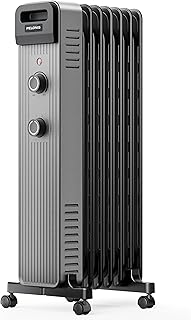
Pelonis refined the fundamentals here: three heating modes, a responsive adjustable thermostat, and steady radiant warmth without the click-and-clunk of cheaper units. In black, it holds its own next to darker furniture instead of looking like borrowed equipment.
PELONIS Radiator Heater for Large Space
The dual-knob version is for people who want heat, not a menu. It ramps a large room reliably at 1500W, includes tip-over protection, and stays quiet enough for a bedroom, with no display glow to dim at night.
Amazon Basics Portable Oil Radiator Heater
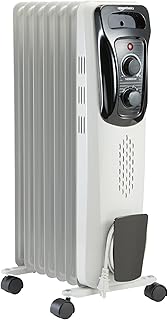
Seven oil-filled steel fins, three heat settings, and ETL-certified safety in a compact 25-inch white cabinet, at the most accessible price point here. It’s the smart choice for a guest room, nursery-adjacent hallway, or any space that needs supplemental heat only a few months a year.
CAYNEL Space Oil Filled Radiator Heater
A tidy black column with a 24-hour timer, adjustable thermostat, and three modes, tuned for rooms where silence is the priority. It suits smaller home offices and studies better than large open floors.
Frequently Asked Questions
Are oil-filled heaters cheaper to run than fan heaters?
At the same wattage they consume the same electricity, but oil-filled models keep radiating after the element cuts out, so a well-set thermostat spends less total time at full draw. Eco modes and timers compound that saving.
Do I ever need to refill the oil?
No. The thermal fluid is permanently sealed at the factory and never burns off or needs topping up. If a unit leaks, it’s a defect, not maintenance.
Is it safe to leave one running overnight?
Models with overheat protection, tip-over shutoff, and certified construction are designed for extended use, and many owners run them on low all night. Keep them on a hard, level floor, well clear of bedding and curtains, and plugged directly into a wall outlet rather than an extension cord.
How large a room can one heat?
A 1500W radiator comfortably supplements a well-insulated room of roughly 150 to 300 square feet. It’s designed to take the edge off a space, not replace central heating in a drafty or uninsulated one.
Final Thoughts
For most homes, the DREO is the one worth stretching for: the digital thermostat, remote, and child lock make it feel like a fixture rather than an appliance. The 2025 upgraded Pelonis is the balanced middle choice for a main living space, and the Amazon Basics 7-fin radiator remains the sensible pick for guest rooms and occasional-use corners.