Key takeaways
- Know which physics you are buying: Evaporative coolers add moisture and lower air temperature by a handful of degrees in dry, ventilated rooms. Compressor units genuinely refrigerate but always need an exhaust path, even a sliding door gap or a wall vent.
- Match capacity to the actual footprint: A 12,000 BTU rating covers roughly 450 to 550 sq ft, while 8,000 BTU suits bedrooms and offices near 350 sq ft. Oversizing a compressor unit leads to clammy short-cycling, not faster cooling.
- Check your local humidity first: Above roughly 60% relative humidity, evaporative cooling loses most of its effect. Dry climates in the Southwest and Mountain West are where these units earn their keep.
- Plan for water, either direction: Coolers need refilling and ice pack rotation; compressor units need self-evaporating drainage or occasional tank emptying. Neither is maintenance-free, so pick the chore you will actually do.
- Look at the object, not just the spec sheet: Slim towers around 25 inches tall disappear beside a nightstand. Boxier compressor units read as appliances, so consider sightlines, caster marks on hardwood, and where the remote will live.
What's inside
Renters, loft dwellers, and anyone with casement windows, fixed glass, or a landlord who says no to hardware run into the same wall every summer: the room gets hot, and there is nowhere to put an exhaust hose. Add in home offices carved out of walk-in closets, converted garages, and bedrooms where the only window sits behind a built-in wardrobe, and the standard cooling playbook stops working. The confusion gets worse online, where “ventless” gets stamped on machines that quietly ship with a window kit in the box.
This guide sorts the category honestly. There are two genuinely different machines competing for the same search: evaporative coolers, which need zero venting and work by moving air across a water-chilled medium, and compressor-based portable air conditioners, which actually drop the temperature but need somewhere to send heat. Below you will find the strongest picks in both camps, a buying framework that keeps expectations realistic, and answers to the questions that decide which type belongs in your room.
As an Amazon Associate we earn from qualifying purchases.


How to Choose a Ventless Air Conditioner No Window (2026)
- Know which physics you are buying: Evaporative coolers add moisture and lower air temperature by a handful of degrees in dry, ventilated rooms. Compressor units genuinely refrigerate but always need an exhaust path, even a sliding door gap or a wall vent.
- Match capacity to the actual footprint: A 12,000 BTU rating covers roughly 450 to 550 sq ft, while 8,000 BTU suits bedrooms and offices near 350 sq ft. Oversizing a compressor unit leads to clammy short-cycling, not faster cooling.
- Check your local humidity first: Above roughly 60% relative humidity, evaporative cooling loses most of its effect. Dry climates in the Southwest and Mountain West are where these units earn their keep.
- Plan for water, either direction: Coolers need refilling and ice pack rotation; compressor units need self-evaporating drainage or occasional tank emptying. Neither is maintenance-free, so pick the chore you will actually do.
- Look at the object, not just the spec sheet: Slim towers around 25 inches tall disappear beside a nightstand. Boxier compressor units read as appliances, so consider sightlines, caster marks on hardwood, and where the remote will live.
The Best Ventless Air Conditioner No Window (2026)s Reviewed
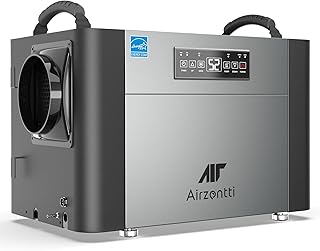
12,000 BTU Portable Air Conditioner (550 Sq. Ft.)
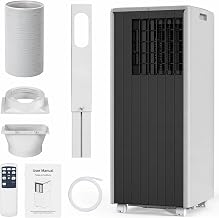
This is the pick when you need real refrigeration and can improvise an exhaust route through a sliding door, transom, or wall vent, since self-evaporating operation handles most condensate without a drain pan routine. The 3-in-1 cooling, fan, and dehumidifying modes make it a year-round unit rather than a summer-only one.
SereneLife 8,000 BTU with WiFi
Smart control is the differentiator here: app scheduling plus a 24-hour timer means the bedroom is already cool before you walk in, which matters more than raw output in a 350 sq ft space. Treat it as a single-room specialist and give it a proper exhaust path to see its rated performance.
Windowless Evaporative Cooler with 70° Oscillation
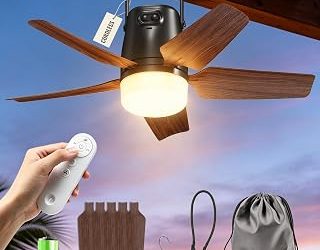
Fully vent-free and genuinely simple, this one relies on four ice packs and a 7-hour timer to push cooled, oscillating air across a desk or seating area. In dry conditions it is a legitimate comfort upgrade; in humid coastal air, expect a very good fan.
25.3″ Windowless Evaporative Cooler, 90° Oscillation
The slimmest option in this roundup, with a tower profile that suits tight bedrooms and a 90-degree sweep that covers more of the room than most compact coolers. Three speeds, four modes, and a low-noise setting make it the better choice for sleeping spaces.
Shinco 12,000 BTU (7,500 BTU SACC)
The dual rating is a mark of transparency: SACC reflects real-world output, so plan around 450 sq ft rather than the headline number. Solid remote, 24-hour timer, and reliable dehumidifier mode make it a dependable workhorse for a den or bonus room.
Frequently Asked Questions
Do truly ventless air conditioners exist?
Not in the refrigeration sense. Any unit that removes heat must send it somewhere. Evaporative coolers are the only genuinely vent-free option, and they cool by adding humidity rather than removing heat.
How much cooling can I expect from an evaporative unit?
In dry air, a drop of several degrees at the airflow path is typical, and the moving air makes it feel cooler still. Results shrink sharply as humidity climbs.
Can I vent a portable AC without a window?
Yes, through a sliding door channel, a dryer-style wall vent, a drop ceiling, or a sealed panel in a transom. Any of these beat running a compressor unit unvented, which warms the room.
Are these loud enough to disturb sleep?
Compressor units run noticeably louder because of the compressor and fan together. Slim evaporative towers with dedicated quiet modes are the safer bedroom choice.
Final Thoughts
If your room has any exhaust route at all, the 12,000 BTU portable with self-evaporating operation delivers the most real cooling, with the Shinco 12,000 BTU close behind and more honest about its effective coverage. For spaces with no opening whatsoever, the 25.3″ windowless evaporative cooler is the pick worth making, provided your climate is on the dry side.