Key takeaways
- Downrod length: Aim to land the blades 8 to 9 feet off the floor. As a rough guide, add roughly 6 inches of downrod for every foot of ceiling above nine feet. A fan flush-mounted to a 14-foot ceiling will do almost nothing for the people below it.
- Blade span over blade count: Diameter is the single biggest lever on air movement. For rooms over 400 square feet with tall ceilings, start at 65 inches and go up. Eight-blade designs help with quiet operation and visual mass, but span does the heavy lifting.
- DC or PMSM motor: Direct-current and permanent-magnet synchronous motors pull far less power than traditional AC units, run noticeably quieter, and give you six speeds instead of three. On a fan this size, that low setting matters — it’s the one you’ll actually use most.
- CFM, not marketing adjectives: Look for the airflow figure in cubic feet per minute. Residential large fans typically land between 5,000 and 9,000 CFM; industrial HVLS models climb past 28,000. Match the number to the volume of the room, not its floor area.
- Wet or damp rating: Covered patios, three-season porches, and gazebos need at least a damp rating. Sealed motor housings and anodized or powder-coated aluminum blades resist warping in humidity where MDF blades sag.
What's inside
Vaulted ceilings sell a house. They also swallow airflow. A fan sized for an eight-foot room, hung fifteen feet up, becomes decorative sculpture: it spins, the blades look busy, and nothing actually reaches the sofa. The physics are unforgiving. Air moves in a column, that column loses velocity over distance, and a 44-inch blade span simply doesn’t generate enough of it to travel down a two-story great room and circulate back up.
The fix is span and torque, not speed. Large-diameter fans turning slowly move dramatically more air than small ones spinning fast, which is why HVLS (high volume, low speed) designs migrated from warehouses into open-plan homes over the last few years. This guide covers what to look for in downrods, motor type, and CFM, then walks through the fans worth your attention in 2026 — from a 65-inch farmhouse piece that suits a two-story living room to a 120-inch industrial giant for shops and barns.
As an Amazon Associate we earn from qualifying purchases.


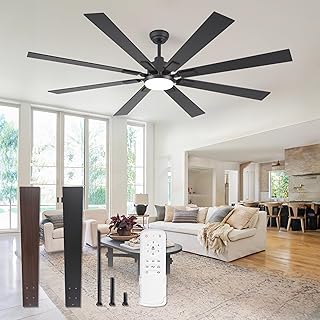
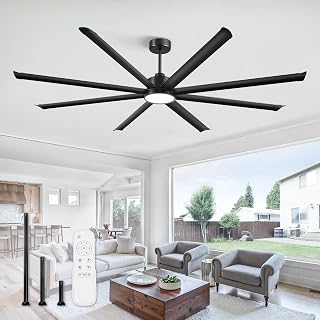
How to Choose a Ceiling Fan For High Ceilings (2026)
- Downrod length: Aim to land the blades 8 to 9 feet off the floor. As a rough guide, add roughly 6 inches of downrod for every foot of ceiling above nine feet. A fan flush-mounted to a 14-foot ceiling will do almost nothing for the people below it.
- Blade span over blade count: Diameter is the single biggest lever on air movement. For rooms over 400 square feet with tall ceilings, start at 65 inches and go up. Eight-blade designs help with quiet operation and visual mass, but span does the heavy lifting.
- DC or PMSM motor: Direct-current and permanent-magnet synchronous motors pull far less power than traditional AC units, run noticeably quieter, and give you six speeds instead of three. On a fan this size, that low setting matters — it’s the one you’ll actually use most.
- CFM, not marketing adjectives: Look for the airflow figure in cubic feet per minute. Residential large fans typically land between 5,000 and 9,000 CFM; industrial HVLS models climb past 28,000. Match the number to the volume of the room, not its floor area.
- Wet or damp rating: Covered patios, three-season porches, and gazebos need at least a damp rating. Sealed motor housings and anodized or powder-coated aluminum blades resist warping in humidity where MDF blades sag.
The Best Ceiling Fan For High Ceilings (2026)s Reviewed
65″ Farmhouse Ceiling Fan with Textured Glass Shade
The most livable pick here for a standard two-story living room — eight dual-finish blades and a textured glass shade give it real presence without reading as industrial. Both 6-inch and 12-inch downrods ship in the box, and the E26 base means you choose your own bulb temperature rather than living with a fixed LED.
AA-Orion 120″ HVLS Industrial Ceiling Fan
At ten feet across and over 28,000 CFM, this is genuine warehouse equipment: a PMSM motor moving air across a barn, gym, or open shop on speeds so low the blades barely seem to turn. Overkill for a house, exactly right for a 20-foot ceiling above a concrete floor.
TCL 72″ Large Ceiling Fan with Lights
TCL’s take is the cleanest modern silhouette of the group — matte white, eight slim dual-side blades, and a dimmable LED with three color temperatures that remembers your last setting instead of resetting to daylight every time. A strong choice for a bright, minimal great room.
ZMISHIBO 72″ Damp-Rated Ceiling Fan in Black
Built for covered outdoor space, where a black finish and dual-tone blades hold up visually against timber and stone. The DC motor is genuinely quiet on low, and the 24W tri-color LED handles ambient patio lighting without needing a separate fixture.
ZMISHIBO 96″ Ceiling Fan with Aluminum Blades
The sweet spot between residential and industrial — eight reversible aluminum blades on a quiet DC motor, damp rated, with integrated tri-color lighting most 96-inch fans skip. Ideal for a tall garage, workshop, or gazebo where you still want the space to feel finished.
Frequently Asked Questions
How long should my downrod be?
Subtract 9 feet from your ceiling height, then subtract the fan body height (usually 10 to 14 inches). A 16-foot ceiling generally needs a 60- to 72-inch downrod. Buy longer than you think; a fan hung too high is a permanent disappointment.
Do I need a sloped ceiling adapter?
Most large fans handle pitches up to about 15 or 20 degrees out of the box. Steeper vaults require a canopy rated for the angle, so check the spec before ordering rather than after.
Should the fan reverse in winter?
Yes, and it matters more with high ceilings than anywhere else. Warm air stratifies at the peak; running the fan in reverse on low pulls it back down without creating a draft, which noticeably cuts heating load in a two-story room.
Are large fans loud?
Not if the motor is DC or PMSM and the downrod is properly tightened. Most reported noise in big fans traces back to loose mounting hardware or an under-torqued canopy, not the motor itself.
Final Thoughts
For most homes with vaulted or two-story ceilings, the 65″ farmhouse fan with its textured glass shade delivers the best balance of airflow, finish, and installation flexibility. If your room leans modern and open, the TCL 72″ is the more refined silhouette, and for tall garages, shops, or barns where volume is the whole problem, the AA-Orion 120″ HVLS is the only one on this list built at that scale.