Key takeaways
- Wattage versus enclosed volume: A sealed, insulated crawl space or well house often needs only 600W to hold above freezing, while a vented or oversized cavity benefits from 1500W. Oversizing wastes energy and short-cycles the thermostat; undersizing means the heater runs continuously and never catches up.
- Thermostat type and range: Look for a unit whose low setting reaches down near 40°F rather than topping out at room comfort. Digital dual-screen displays let you see set point and actual temperature at a glance, which matters when you’re crouched in a headlamp beam and want to leave quickly.
- Housing and moisture tolerance: Crawl spaces are humid by definition. All-metal or powder-coated steel bodies handle condensation and knocks far better than thin plastic shells, and a stay-cool exterior reduces risk where insulation or vapor barrier sits close by.
- Unattended-use safety hardware: Tip-over auto shutoff, overheat protection, and a grounded three-prong plug are the baseline. This heater will run for weeks without anyone looking at it, so treat any missing safety feature as a disqualifier rather than a compromise.
- Circuit load and placement: A 1500W heater draws roughly 12.5 amps and should have a dedicated 15- or 20-amp circuit with no extension cord. Position it on a firm, level surface, clear of joists, wiring, and stored material, with airflow toward the most vulnerable pipe runs.
What's inside
Every considered home has an underside nobody photographs. Beneath the wide-plank floors and the carefully layered rugs sits a low, damp cavity where copper lines run and insulation sags, and in January that cavity decides whether your winter is quiet or catastrophic. A burst supply line under a finished floor is not a plumbing bill; it’s a gut renovation you didn’t budget for. The frustrating part is that most homeowners only think about crawl space heat after the first freeze has already done its work.
The fix is unglamorous and cheap: a compact, thermostatically controlled heater that idles through mild weather and wakes up when the temperature drops toward freezing. This guide covers what actually matters in that category for 2026 — wattage matched to enclosed volume, thermostat accuracy versus a vague dial, housing materials that survive humidity, and the safety hardware you should treat as non-negotiable in an unattended space. Below are the models worth your attention, from purpose-built freeze-protection units to metal-bodied utility heaters that pull double duty in a garage or workshop.
As an Amazon Associate we earn from qualifying purchases.


How to Choose a Crawl Space Heater With Thermostat (2026)
- Wattage versus enclosed volume: A sealed, insulated crawl space or well house often needs only 600W to hold above freezing, while a vented or oversized cavity benefits from 1500W. Oversizing wastes energy and short-cycles the thermostat; undersizing means the heater runs continuously and never catches up.
- Thermostat type and range: Look for a unit whose low setting reaches down near 40°F rather than topping out at room comfort. Digital dual-screen displays let you see set point and actual temperature at a glance, which matters when you’re crouched in a headlamp beam and want to leave quickly.
- Housing and moisture tolerance: Crawl spaces are humid by definition. All-metal or powder-coated steel bodies handle condensation and knocks far better than thin plastic shells, and a stay-cool exterior reduces risk where insulation or vapor barrier sits close by.
- Unattended-use safety hardware: Tip-over auto shutoff, overheat protection, and a grounded three-prong plug are the baseline. This heater will run for weeks without anyone looking at it, so treat any missing safety feature as a disqualifier rather than a compromise.
- Circuit load and placement: A 1500W heater draws roughly 12.5 amps and should have a dedicated 15- or 20-amp circuit with no extension cord. Position it on a firm, level surface, clear of joists, wiring, and stored material, with airflow toward the most vulnerable pipe runs.
The Best Crawl Space Heater With Thermostat (2026)s Reviewed
600W Utility Heater with Dual-Screen Display
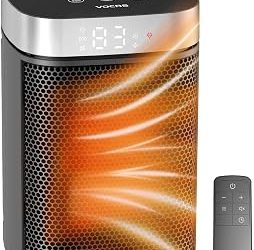
This is the most purpose-fit option here: modest 600W output, a thermostat calibrated for freeze protection rather than comfort, and a dual-screen readout that shows both target and ambient temperature. For a sealed crawl space or well house, it’s the efficient, set-and-forget choice.
600W Pump House Heater with Thermostat
A stripped-back alternative built around one job — holding a small utility volume above freezing without drama. Its built-in thermostat maintains a steadier baseline than dial-only units, making it a sensible pick for pump houses and tight, insulated cavities where 1500W would be overkill.
Comfort Zone 1500W Milkhouse Utility Heater
The all-metal milkhouse format has survived decades in barns and workshops for good reason: it’s serviceable, stable, and indifferent to rough conditions. Two heat settings plus a fan-only mode and a tip-over switch make it a strong choice for larger or partially vented crawl spaces.
Shinic 1500W Milkhouse Heater
Similar architecture with a stay-cool metal housing and layered overheat and tip-over protection, which is exactly what you want in a space you rarely inspect. Its dual-purpose nature means it moves easily to a garage or greenhouse once winter breaks.
Dura Heat EUH1465 Forced Air Heater
The ceramic element and pivoting base let you aim 5,120 BTU directly at exposed pipe runs instead of heating dead air, covering up to 250 square feet. The steel body and safety shutoff hold up well, though the yellow shell makes no attempt at subtlety.
Frequently Asked Questions
What temperature should I set for freeze protection?
Around 40 to 45°F is standard. That leaves a buffer above freezing without paying to heat unconditioned space, and it accounts for cold pockets near vents and rim joists that sit below whatever the thermostat reads.
Is 600W really enough for a crawl space?
In a sealed, insulated crawl space with a vapor barrier, usually yes. If your space is vented, uninsulated, or unusually large, step up to 1500W or run two smaller units at opposite ends rather than pushing one heater past its limits.
Can I leave one of these running all winter?
Yes, that’s the intended use, provided it’s on a dedicated grounded circuit, plugged directly into a wall receptacle, sitting level, and clear of insulation or stored items. Skip extension cords entirely and inspect the unit once a month.
Should I insulate and seal instead of adding heat?
Do both, in that order. Air sealing, a vapor barrier, and pipe insulation cut the work your heater has to do, which lowers running cost and makes a small thermostatic unit fully sufficient.
Final Thoughts
For most sealed crawl spaces, the 600W Utility Heater with Dual-Screen Display is the smartest buy — right-sized, readable, and built for exactly this job. If your space is larger or vented, the Comfort Zone 1500W Milkhouse offers durable all-metal capacity, while the Dura Heat EUH1465 earns its place when you need to aim heat straight at vulnerable pipe runs.