Key takeaways
- Power source realism: Electric heaters are the safest indoor choice but a 1500W unit eats roughly 12.5 amps, which is most of a 15-amp circuit. If you’re dry camping without a generator or a substantial battery bank, propane radiant is the practical path.
- Non-negotiable safety hardware: Insist on tip-over shutoff and overheat protection. For any propane unit, low-oxygen sensor (ODS) shutoff is essential, and you still need a working carbon monoxide detector and cracked ventilation.
- Wattage staging: A switchable 750W/1500W design is worth more in a camper than raw output. Low mode lets you hold temperature overnight without tripping a shared campground breaker.
- Footprint and stability: Measure your actual clear floor space, then add clearance on every side. Low, wide bases resist rocking in a trailer far better than tall tower profiles, and top-mounted air intakes stay clear of dust and bedding.
- Sleep-friendly controls: An accurate thermostat, a 12-hour timer, dimmable display, and remote control mean you cycle heat rather than manually babysitting it, which is the difference between rest and 3 a.m. thermostat fiddling.
What's inside
A camper interior is a study in constraint. Every cubic foot has a job, surfaces sit close together, and the thin shell that makes towing easy also lets warmth escape by two in the morning. That’s the real problem shoppers run into: the heater that felt cozy in a spare bedroom becomes a fire-hazard-shaped obstacle in a 90-square-foot space, or it draws more amperage than a 30-amp pedestal wants to give, or it roars loudly enough to drown out the rain you drove out there to hear.
This guide approaches camper heat the way we’d approach any small-space object: fit first, then behavior, then aesthetics. Below you’ll find electric ceramic units built for shore power, propane radiant heaters for boondocking off-grid, and one purpose-built marine-and-RV design that solves the tip-over problem structurally rather than with an afterthought switch. We cover sizing, safety hardware, noise, and the ventilation rules that genuinely matter.
As an Amazon Associate we earn from qualifying purchases.



How to Choose a/an Space Heater For Camper (2026)
- Power source realism: Electric heaters are the safest indoor choice but a 1500W unit eats roughly 12.5 amps, which is most of a 15-amp circuit. If you’re dry camping without a generator or a substantial battery bank, propane radiant is the practical path.
- Non-negotiable safety hardware: Insist on tip-over shutoff and overheat protection. For any propane unit, low-oxygen sensor (ODS) shutoff is essential, and you still need a working carbon monoxide detector and cracked ventilation.
- Wattage staging: A switchable 750W/1500W design is worth more in a camper than raw output. Low mode lets you hold temperature overnight without tripping a shared campground breaker.
- Footprint and stability: Measure your actual clear floor space, then add clearance on every side. Low, wide bases resist rocking in a trailer far better than tall tower profiles, and top-mounted air intakes stay clear of dust and bedding.
- Sleep-friendly controls: An accurate thermostat, a 12-hour timer, dimmable display, and remote control mean you cycle heat rather than manually babysitting it, which is the difference between rest and 3 a.m. thermostat fiddling.
The Best Space Heater For Camper (2026)s Reviewed
Xtreme Heaters Boat Cabin RV Space Heater
This is the one engineered for the environment rather than adapted to it: a low-profile, stable base, quiet top-air intake, tip-over and overheat shutoffs, and 750/1500W settings with a generous six-foot cord. If you want a heater that reads as marine-grade equipment instead of household appliance, this is the pick.
Mr. Heater 9,000 BTU Portable Buddy
The reference standard for off-grid warmth, running radiant propane heat with ODS and tip-over shutoff, and multiple output levels for a well-insulated camper. Ventilate deliberately, keep a CO detector active, and never leave it running while you sleep.
DREO Portable Space Heater with 70° Oscillation
Fast PTC ceramic heat, five modes, ECO thermostat control, a 12-hour timer, and genuinely quiet operation make this the most livable shore-power option here. The oscillation is the quiet star, spreading warmth across a galley and dinette instead of cooking one shin.
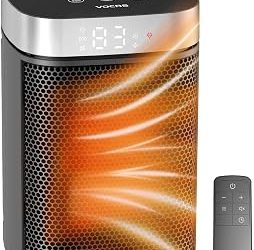
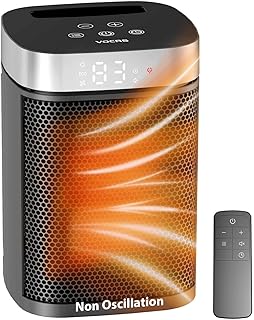
VOCRS 1500W PTC Electric Heater
A compact, tidy-looking unit with thermostat, remote, 12-hour timer, plus Eco and fan modes, which makes it useful in shoulder season when you want air movement more than heat. Its small footprint suits vans and teardrops where floor real estate is measured in inches.
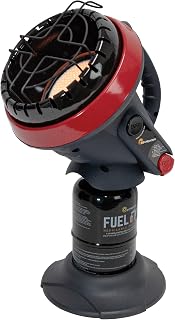
Mr. Heater 3,800 BTU Little Buddy
The minimalist propane option: one output level, a one-pound cylinder, and a small circular footprint that takes up almost nothing. It’s best as backup heat or for brief takeoff-the-chill sessions in a truck camper, with the same ventilation and CO monitoring discipline.
Frequently Asked Questions
Is it safe to run a propane heater inside a camper?
Only with active ventilation, a functioning carbon monoxide alarm, and while you’re awake. Indoor-safe rated propane heaters include oxygen-depletion shutoffs, but they still consume oxygen and produce moisture, so crack a window and a roof vent.
What size heater does a camper need?
A rough baseline is 10 watts per square foot in a moderately insulated space, so most travel trailers are well served by a single 1500W electric unit. Extreme cold or poor insulation is where propane’s higher BTU output earns its place.
Can I leave a space heater running overnight?
Electric ceramic heaters with thermostat, tip-over, and overheat protection are the only reasonable candidates, plugged directly into an outlet with clearance on all sides. Never sleep with a combustion heater running.
Will a 1500W heater trip campground power?
It can, particularly on 30-amp service alongside a coffee maker or microwave. Run 750W mode when sharing a circuit and stagger high-draw appliances.
Final Thoughts
For most campers on shore power, the Xtreme Heaters RV unit is the smartest structural choice and the DREO oscillating ceramic is the most comfortable everyday companion. When you’re off-grid and outlets aren’t part of the conversation, the Mr. Heater Portable Buddy remains the dependable answer, used with the ventilation and CO monitoring it demands.