Key takeaways
- Measure depth before anything else: A cabinet at 9 to 10 inches deep stores shoes on a tilt and preserves your walkway; 12 to 15 inches lets shoes sit flat but eats hallway clearance. Anything under 36 inches of remaining passage will feel tight.
- Treat pair counts as a ceiling, not a promise: Manufacturer numbers assume flat, low-profile shoes. Boots, high-tops, and men’s size 12s cut real capacity by roughly a third, so buy one tier more than you think you need.
- Match the front to your habits: Flip-down drawers tilt open with a nudge and are ideal for daily rotation in tight spaces. Hinged or barn doors need swing clearance but handle bulky and irregular footwear far better.
- Look for adjustable shelves and ventilation: Removable or repositionable shelves are what make a cabinet work across seasons, and perforated backs or vent holes prevent the trapped, damp smell that closed storage otherwise creates.
- Check the build and the anchor hardware: Engineered wood with a thick laminate is the practical standard here; what matters more is whether the piece ships with a wall anchor kit, especially for tall units in homes with kids or pets.
What's inside
The entryway is the smallest room in most homes that isn’t actually a room, and it absorbs the most traffic. Shoes accumulate there in layers: the pair you wore yesterday, the pair you keep meaning to put away, the seasonal boots that never made it to the closet. Open racks promise a fix but rarely deliver one, because a rack just organizes the visual noise instead of removing it. What most entryways actually need is a closed-front cabinet shallow enough to live against a wall without narrowing the walkway.
This guide looks at six freestanding shoe cabinets that hold real capacity behind doors or flip-down fronts, sized for narrow halls, apartment landings, and mudroom corners. I’ve weighed footprint against pair count, looked at which designs swallow tall boots and which choke on anything above an ankle sneaker, and flagged the finish and construction details that separate a piece you’ll keep from one you’ll replace in two years.
As an Amazon Associate we earn from qualifying purchases.


How to Choose a Shoe Cabinet For Entryway (2026)
- Measure depth before anything else: A cabinet at 9 to 10 inches deep stores shoes on a tilt and preserves your walkway; 12 to 15 inches lets shoes sit flat but eats hallway clearance. Anything under 36 inches of remaining passage will feel tight.
- Treat pair counts as a ceiling, not a promise: Manufacturer numbers assume flat, low-profile shoes. Boots, high-tops, and men’s size 12s cut real capacity by roughly a third, so buy one tier more than you think you need.
- Match the front to your habits: Flip-down drawers tilt open with a nudge and are ideal for daily rotation in tight spaces. Hinged or barn doors need swing clearance but handle bulky and irregular footwear far better.
- Look for adjustable shelves and ventilation: Removable or repositionable shelves are what make a cabinet work across seasons, and perforated backs or vent holes prevent the trapped, damp smell that closed storage otherwise creates.
- Check the build and the anchor hardware: Engineered wood with a thick laminate is the practical standard here; what matters more is whether the piece ships with a wall anchor kit, especially for tall units in homes with kids or pets.
The Best Shoe Cabinets For Entryway (2026) Reviewed
BORNOON 3-Drawer Hidden Shoe Cabinet
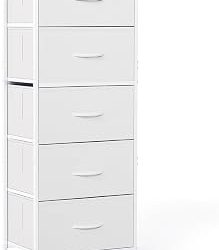
At 9.45 inches deep and 47 inches tall, this is the clearest answer for a genuinely narrow hall, going vertical instead of wide and keeping the whole footprint under a foot. The three flip-down drawers give it a flush, cabinet-like face in white, though the tilt storage means it favors sneakers and flats over boots.
Large 3-Door Cabinet in Vintage Brown
The most capacity on this list by a wide margin, with a 47-inch span, adjustable shelves, and a stated 30 to 35 pairs, which makes it a credible small-family or shared-household solution. Ventilation holes are built into the design, and the low, wide profile also works as a console for keys and mail.
Vlsrka 3-Door 4-Tier Shoe Cabinet
A restrained black finish with clean lines that reads more furniture than utility, handling around 20 pairs across four adjustable tiers. It’s the pick if your entryway opens directly into a living space and you want the storage to disappear into the room’s palette.
Decofy 47.2″ Walnut Flip-Down Cabinet
Four flip-down drawers and three adjustable levels in a warm walnut tone, combining the tight footprint of a tilt-front design with more configurability than most. The extra drawer over comparable units makes it the better flip-front option for households with more than two people.
Homleke Farmhouse Barn-Door Shoe Cabinet
Raised wood legs and sliding-style barn doors give this one the most deliberate design point of the group, and the elevated base leaves room to tuck slippers underneath. Three adjustable shelves across four tiers means it also accommodates ankle boots, which flip-drawer cabinets generally won’t.
Frequently Asked Questions
How deep should an entryway shoe cabinet be?
Nine to ten inches suits tight hallways and relies on angled storage; twelve inches or more lets shoes sit flat. Measure your hallway and subtract the cabinet depth, aiming to leave at least 36 inches of clear passage.
Will tall boots fit in a shoe cabinet?
Only in cabinets with removable or fully adjustable shelves. Look for units where you can pull a shelf entirely to create one double-height compartment, which is far more useful than any advertised pair count.
Do closed shoe cabinets hold odor?
They can, which is why ventilation holes or a perforated back panel matter. A cedar block or activated charcoal sachet inside handles the rest, and letting damp shoes dry before storing them prevents most of the problem.
Do these cabinets need to be anchored to the wall?
Any unit taller than about 40 inches should be, particularly flip-front designs where an open drawer shifts weight forward. Most ship with anti-tip hardware; use it.
Final Thoughts
For most narrow entryways, the BORNOON 3-drawer cabinet is the sharpest fit, disappearing into the wall at under ten inches deep. Households with real volume should go straight to the Large 3-Door cabinet in vintage brown for its 30-plus pair capacity, while the Homleke farmhouse barn-door unit is the one to choose when the piece has to earn its place visually as well as functionally.