Key takeaways
- Compressor or freezer bowl: Built-in compressor models chill on demand, so you can churn twice in an afternoon with no forward planning. Freezer-bowl machines cost far less and store smaller, but they tie you to a 12 to 24 hour pre-chill and one batch per cycle.
- Footprint and orientation: Upright vertical designs claim less counter depth than horizontal units, which matters under standard 18-inch upper cabinets. Measure clearance for the lid swing, not just the base.
- Batch size against household size: A 1 to 1.5 quart bowl serves two to four people and fits a normal freezer drawer. Jump to 2.1 quarts only if you host or you are feeding a full family, because leftover homemade ice cream degrades faster than commercial pints.
- Finish and visual weight: Brushed stainless disappears into most contemporary kitchens; glossy colored plastic reads as a small appliance and wants a cabinet home. Decide up front whether this lives out or stays hidden.
- Cleanup reality: Removable canisters and dishwasher-safe paddles decide whether you make dessert on a Tuesday. Fixed bowls that require hand-washing around a motor housing are the single most common reason these machines go unused.
What's inside
A kitchen that looks composed and a kitchen that lives well are two different projects, and frozen dessert is where the gap usually shows. Most home cooks buy an ice cream maker in July, discover the freezer bowl needs a full day of chilling before it will do anything, and quietly retire the thing to the top shelf beside the bread machine. The failure is rarely the recipe. It is the friction between wanting dessert now and a machine that demands you plan for it yesterday.
This guide looks at ice cream makers the way we look at any object that has to earn counter or cabinet space: footprint, materials, how it behaves on a weeknight, and whether it still feels good to use in year three. Below are the machines worth owning in 2026, sorted by how they actually fit into a home rather than by spec sheet volume, plus a short framework for deciding which category suits your kitchen before you commit.
As an Amazon Associate we earn from qualifying purchases.



How to Choose a/an Ice Cream Maker For Home Use (2026)
- Compressor or freezer bowl: Built-in compressor models chill on demand, so you can churn twice in an afternoon with no forward planning. Freezer-bowl machines cost far less and store smaller, but they tie you to a 12 to 24 hour pre-chill and one batch per cycle.
- Footprint and orientation: Upright vertical designs claim less counter depth than horizontal units, which matters under standard 18-inch upper cabinets. Measure clearance for the lid swing, not just the base.
- Batch size against household size: A 1 to 1.5 quart bowl serves two to four people and fits a normal freezer drawer. Jump to 2.1 quarts only if you host or you are feeding a full family, because leftover homemade ice cream degrades faster than commercial pints.
- Finish and visual weight: Brushed stainless disappears into most contemporary kitchens; glossy colored plastic reads as a small appliance and wants a cabinet home. Decide up front whether this lives out or stays hidden.
- Cleanup reality: Removable canisters and dishwasher-safe paddles decide whether you make dessert on a Tuesday. Fixed bowls that require hand-washing around a motor housing are the single most common reason these machines go unused.
The Best Ice Cream Maker For Home Use (2026)s Reviewed
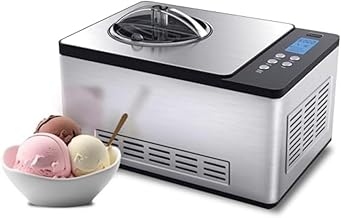
Whynter ICM-201SB Automatic 2.1 Qt.
This is the one we recommend to people who want to stop thinking about logistics: the built-in compressor means no pre-freezing, the LCD display and timer give you real control over texture, and the stainless housing is restrained enough to leave on an open shelf. At 2.1 quarts it is the most genuinely useful capacity for a household that entertains.
4-in-1 Compressor Ice Cream Maker, 1.0 Qt.
A compact vertical body and a compressor in the same machine is a rare combination, and this one adds yogurt, gelato, sorbet and soft-serve modes without ballooning in size. The single-quart bowl is the tradeoff, but for a small kitchen or an apartment it is the most sensible compressor unit on this list.
Whynter ICM-200LS 2.1 Qt.
Essentially the ICM-201SB’s close sibling, with the same no-pre-freeze compressor, LCD panel and timer in a slightly different shell. Buy whichever of the two is better priced when you shop; the churning performance and dense, scoopable results are equivalent.
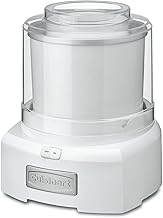
Cuisinart ICE-21P1ES, 1.5 Qt.
The value benchmark, and still the right answer for occasional makers: a double-insulated freezer bowl, an easy-lock lid, and finished ice cream in about twenty minutes once the bowl is cold. Keep the bowl in the freezer permanently and the pre-chill requirement mostly stops mattering.
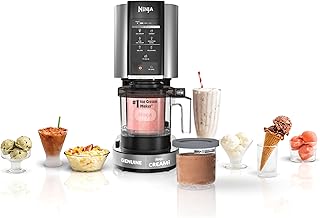
Ninja CREAMi NC301, 7-in-1
The CREAMi works differently, shaving a solidly frozen base into ice cream, sorbet or a milkshake rather than churning liquid, which makes it exceptionally good at high-protein and low-sugar formulas. Plan on freezing a pint overnight, and expect a machine that looks like an appliance rather than a countertop object.
Frequently Asked Questions
Is a compressor model worth the extra cost?
If you make frozen desserts more than a few times a season, yes. Removing the pre-freeze step is the difference between a machine you use and one you store.
How long does homemade ice cream keep?
Best within a week, and noticeably better in the first two days. Store it in a shallow, airtight container with parchment pressed to the surface to limit ice crystals.
Why is my ice cream icy instead of creamy?
Usually too little fat or sugar, or a base that was not thoroughly chilled before churning. Cool your custard overnight and churn only until it holds soft peaks.
Where should these machines live in a kitchen?
Compressor units are heavy and awkward to lift, so give them a permanent home at counter height or in a deep base cabinet. Freezer-bowl models store almost anywhere, since the bowl stays in the freezer anyway.
Final Thoughts
For most homes, the Whynter ICM-201SB is the buy: no planning, real capacity, and a finish that holds up visually on the counter. Choose the 4-in-1 Compressor model if space is tight and you still want churn-on-demand, or the Cuisinart ICE-21P1ES if you want to test the habit before investing in a compressor.