Key takeaways
- Loft and gap depth: Measure the void between your lower back and the chair while seated in your usual position. Recliners typically need 4 to 5 inches of cushion depth. Anything under 3 inches will disappear into the upholstery and do nothing.
- Foam density over foam volume: High-resilience memory foam holds its curve through hours of pressure. Cheap shredded fill or low-density polyurethane compresses within weeks, which is why a cushion that felt supportive in month one feels like a pillow by month three.
- Width that matches the seat back: A 20-inch-wide cushion spreads load across the whole lumbar region and resists twisting. Narrow contoured pillows built for task chairs tend to slide sideways every time the recliner shifts.
- Cover material as a design decision: Corduroy, boucle, and woven textiles sit comfortably in a living room. Athletic mesh and black nylon signal home office. Choose the one that reads correctly in the room, and confirm the cover unzips for washing.
- Attachment strategy: Adjustable straps work well on chairs with a defined back panel. On overstuffed recliners, a heavier cushion with a grippy backing often stays put better than any strap system.
What's inside
Recliners are engineered for lounging, not for lumbar geometry. That deep, generous seat back that looks so inviting in a showroom tends to curve away from the body right where the spine needs contact, leaving a hollow between your waistband and the upholstery. Sit there for an hour with a book or a long film and the lower back quietly flattens out, the pelvis rolls back, and you stand up stiff. It is the single most common complaint we hear about otherwise beautiful reclining furniture, and it has almost nothing to do with the quality of the chair.
The fix is a properly sized lumbar cushion, and the operative word is sized. Most cushions on the market are built for desk chairs, which means they are too thin and too narrow to fill a recliner’s gap. This guide focuses on what actually works in a reclining seat: depth, foam density, cover materials that read as furniture rather than office supply, and strap systems that survive the mechanics of a chair that moves. Below are the picks worth your attention this year, followed by a buying framework and answers to the questions that come up most.
As an Amazon Associate we earn from qualifying purchases.


How to Choose a Lumbar Support Cushion For Recliner Chair (2026)
- Loft and gap depth: Measure the void between your lower back and the chair while seated in your usual position. Recliners typically need 4 to 5 inches of cushion depth. Anything under 3 inches will disappear into the upholstery and do nothing.
- Foam density over foam volume: High-resilience memory foam holds its curve through hours of pressure. Cheap shredded fill or low-density polyurethane compresses within weeks, which is why a cushion that felt supportive in month one feels like a pillow by month three.
- Width that matches the seat back: A 20-inch-wide cushion spreads load across the whole lumbar region and resists twisting. Narrow contoured pillows built for task chairs tend to slide sideways every time the recliner shifts.
- Cover material as a design decision: Corduroy, boucle, and woven textiles sit comfortably in a living room. Athletic mesh and black nylon signal home office. Choose the one that reads correctly in the room, and confirm the cover unzips for washing.
- Attachment strategy: Adjustable straps work well on chairs with a defined back panel. On overstuffed recliners, a heavier cushion with a grippy backing often stays put better than any strap system.
The Best Lumbar Support Cushion For Recliner Chair (2026)s Reviewed
HOMBYS Extra Large Memory Foam Lumbar Support Pillow
At 20 by 13.5 by 5 inches, this is the cushion most clearly designed for the problem recliners create, filling a deep gap without forcing you into an unnaturally upright posture. The dense memory foam core holds shape through extended reading sessions, and the muted grey cover blends into most neutral seating schemes.
Large Memory Foam Back Support Cushion with Washable Cover
A broad, ergonomically shaped block that works equally well in a recliner, on a sofa, or in an oversized gaming chair, with enough surface area to support the entire lower back rather than a single vertebral segment. The machine-washable cover is the practical differentiator here, particularly in households with pets or daily use.
HIGOGOGO Tufted Corduroy Back Support Cushion
The most design-forward option in this group, with tufted corduroy in a warm brown that looks intentional rather than orthopedic. Supportive enough for extended sitting while reading as a decorative accent cushion, which makes it the right pick for a living room where nothing should look medical.
Everlasting Comfort Original Lumbar Support Pillow
A well-executed contoured pillow with reliable memory foam and a strap system that adjusts across a wide range of chair backs. It is thinner than the recliner-specific options, so it suits shallower gaps and people who move it between a recliner, a car seat, and a desk chair.
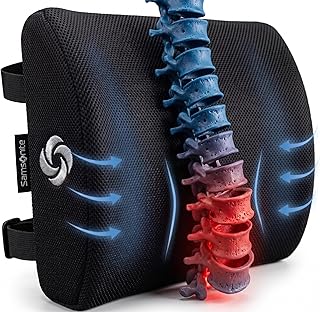
Samsonite Memory Foam Lumbar Support Pillow
Clean construction, consistent foam quality, and a restrained profile that works in a recliner positioned near a workspace. Best for smaller frames or chairs where a 5-inch cushion would push you too far forward.
Frequently Asked Questions
Where exactly should the cushion sit?
Position the thickest part at the natural inward curve of your lower back, roughly level with your belt line. Too high and it pushes your shoulders forward; too low and it tilts the pelvis instead of supporting it.
Will a lumbar cushion work with the recliner reclined?
Yes, though the effective gap changes as the back tilts. A wider, denser cushion adapts across positions better than a small contoured one, which tends to migrate as the mechanism moves.
How thick is too thick?
If the cushion pushes your torso forward enough that your head no longer rests against the headrest, it is oversized for your chair. Drop down an inch or two in depth.
How long does a good cushion last?
Expect two to four years of daily use from a high-density memory foam cushion. When it no longer rebounds to full shape overnight, the support is gone regardless of how the cover looks.
Final Thoughts
For most recliners, the HOMBYS extra-large cushion is the safest match on pure dimensions, filling the deep gap that causes the problem in the first place. If the chair sits in a room where appearance matters as much as support, the HIGOGOGO corduroy cushion delivers both, and the Everlasting Comfort pillow remains the most versatile choice for anyone who wants one cushion to move between a recliner, a car, and a desk.