Key takeaways
- Seat angle and height range: Look for a seat pitched around 20 to 30 degrees and a height range that lets your desk surface land near elbow level. A chair that only adjusts in one plane will fight your desk instead of working with it.
- Cushion depth and density: Shin pads take real pressure, so thin foam becomes obvious within an hour. Moulded foam at roughly three to four inches holds its shape far better than loose padding that compresses flat by month three.
- Backrest or open frame: A backrest suits long sessions and mixed tasks, giving you somewhere to reset between focused blocks. Open rocking frames encourage more active movement, which is better for shorter, high-energy stretches.
- Casters versus rockers: Brake casters win on hard floors and tight desk setups where you need to reposition and then stay put. Curved wood rockers add subtle motion and read as furniture rather than office equipment.
- Frame material and weight rating: Steel frames carry more load and feel more planted; bentwood frames look warmer in a living space. Check the stated capacity, and treat a multi-year warranty as a signal about how the maker expects the joints to hold up.
What's inside
The kneeling chair has quietly become one of the most interesting pieces of furniture in the modern home office, and also one of the most misunderstood. Most people arrive at it the same way: a full day at a desk, a low ache across the lower back, and a growing suspicion that the padded task chair they inherited from an old job is part of the problem. Kneeling chairs answer that by opening the hip angle and tipping the pelvis forward, so the spine stacks closer to its natural curve instead of collapsing into a slouch. The catch is that the category is crowded with near-identical frames at wildly different levels of build quality, and the wrong one will feel like a punishment rather than a fix.
This guide looks at kneeling chairs the way a designer would: how the piece sits in a room, how the materials age, and how the geometry actually behaves over an eight-hour day. Below you’ll find the models worth considering in 2026, plus a short framework for matching seat angle, cushion depth, and back support to the way you actually work.
As an Amazon Associate we earn from qualifying purchases.


How to Choose an Office Kneeling Chair (2026)
- Seat angle and height range: Look for a seat pitched around 20 to 30 degrees and a height range that lets your desk surface land near elbow level. A chair that only adjusts in one plane will fight your desk instead of working with it.
- Cushion depth and density: Shin pads take real pressure, so thin foam becomes obvious within an hour. Moulded foam at roughly three to four inches holds its shape far better than loose padding that compresses flat by month three.
- Backrest or open frame: A backrest suits long sessions and mixed tasks, giving you somewhere to reset between focused blocks. Open rocking frames encourage more active movement, which is better for shorter, high-energy stretches.
- Casters versus rockers: Brake casters win on hard floors and tight desk setups where you need to reposition and then stay put. Curved wood rockers add subtle motion and read as furniture rather than office equipment.
- Frame material and weight rating: Steel frames carry more load and feel more planted; bentwood frames look warmer in a living space. Check the stated capacity, and treat a multi-year warranty as a signal about how the maker expects the joints to hold up.
The Best Office Kneeling Chairs of 2026, Reviewed
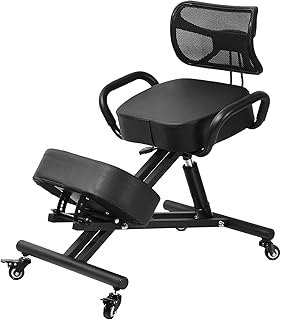
Ergonomic Kneeling Chair with Brake Casters
This is the cleanest expression of the basic idea: an angled seat, thick moulded foam on both pads, and brake casters that let you roll into position and lock down. It’s the pick if you want honest posture correction without a backrest tempting you to lean.
Linen Kneeling Chair with Backrest
The linen upholstery is what sets this one apart, giving it a softer, more residential look that holds up in a room where the desk shares space with the sofa. The backrest and brake wheels make it the most versatile option here for people who alternate between typing, reading, and calls.
Adjustable Kneeling Chair with 5-Year Warranty
Independently adjustable seat and knee pads mean you can dial in the angle rather than accepting whatever the factory chose, which matters enormously if you’re taller or shorter than average. A 250-pound rating and a five-year warranty put this among the more confidently built frames in the category.
Easyego Kneeling Chair in Gray
The bentwood rocking frame is genuinely attractive, with a gentle forward-and-back motion that keeps your hips from locking into one position. Choose this if you want the piece to look intentional in an open-plan space and you’re comfortable without a backrest.
Kneeling Chair with Back Support and 4″ Cushion
The four-inch cushion and lumbar support make this the most forgiving entry point for anyone easing into a kneeling posture after years in a conventional chair. Height adjustment is straightforward, and the proportions suit shared spaces like meeting rooms and reception areas.
Frequently Asked Questions
Do kneeling chairs actually help back pain?
They can reduce lumbar compression by keeping the pelvis tilted forward, which discourages slouching. They work best as one part of a setup that also includes correct desk height and regular movement, not as a standalone cure.
How long should I sit in one each day?
Start with 30 to 60 minute stretches and build gradually. Most people settle into using a kneeling chair for part of the day and switching to a standing desk or conventional chair for the rest.
Will it hurt my knees or shins?
Your weight should rest mostly on your seat and shins, not your kneecaps. If your knees ache, the seat is likely too low or too shallow in angle, and thicker moulded foam will help considerably.
Does a backrest defeat the purpose?
Not at all. A backrest gives you a place to rest during breaks without abandoning the open hip angle, which makes longer workdays realistic.
Final Thoughts
If you want one chair to handle a full working day, the Linen Kneeling Chair with Backrest offers the best balance of support, mobility, and a look that belongs in a home rather than an office park. For adjustability and long-term confidence, the Adjustable Kneeling Chair with its five-year warranty is the smarter investment, while the Easyego rocking model remains the one to choose when the design has to earn its place in the room.