Key takeaways
- Within a mile or two of salt air, prioritize stainless or coated hardware and plan to rinse the blades quarterly. Salt, not water, is what kills outdoor fans.
- Check that the mounting box is rated for fan support, not just fixture support. A standard ceiling box will not hold a 60-inch fan’s dynamic load.
- Buy remote or app control if the fan sits over a seating area with no nearby wall. Retrofitting a wall control on a covered porch is more work than it sounds.
- Wobble almost always traces to unbalanced blades or a loose downrod pin, not a defective motor. Tighten first, then use a balance kit.
What's inside
An outdoor ceiling fan does quiet, unglamorous work: it drops the perceived temperature on a covered porch by several degrees, keeps mosquitoes from settling, and makes a screened room usable in August instead of ornamental. The catch is that “outdoor” is a loose term in this category. Plenty of fans wear the label while carrying hardware that corrodes the first humid season, or a housing rated for a garage but not for wind-driven rain. Choosing well is less about horsepower and more about matching the fixture to the specific exposure above your head.
This guide walks through the four decisions that actually determine whether a fan lasts: the moisture rating, the blade span relative to your ceiling and square footage, the motor type, and whether you want integrated light at all. Along the way we point to a handful of models that represent the categories cleanly, from a 72-inch aluminum workhorse to a plug-in caged fan for a gazebo with no wiring. By the end you should be able to shortlist in about five minutes.
Our Recommended Picks
As an Amazon Associate we earn from qualifying purchases.




Start With the Moisture Rating, Not the Look
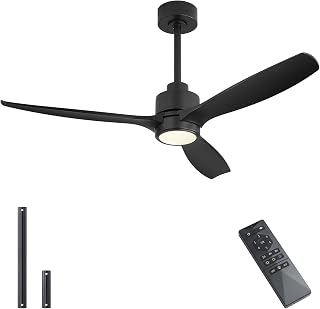
UL listings split outdoor fans into two tiers. Damp rated fans belong under full cover, where humidity and splash are expected but direct rain is not: deep porches, breezeways, carports, three-season rooms. Wet rated fans have sealed motor housings and weather-sealed blades built to take rainfall, spray, and hosing down. Pergolas, uncovered decks, poolside overhangs, and coastal exposures all need wet rated. If you are working with an exposed or partially shielded spot, something like the WINGBO 48″ wet rated fan with sealed ABS blades is the safer specification, since ABS will not warp or delaminate the way even treated wood eventually can. For a genuinely dry, roofed porch, damp rated models such as the 65-inch smart outdoor fan or the 52-inch solid wood fan in dark walnut open up more design range.
Size the Sweep to the Room, Then Check Airflow
Blade span sets the shape of the airflow; CFM sets its force. A useful rule: up to 100 square feet takes 42 to 48 inches, 100 to 250 square feet takes 52 to 60 inches, and anything beyond that wants 60 inches or more, or two fans spaced evenly. Large porches and garages benefit from long sweeps because they move a broad, gentle column of air rather than a narrow blast, which is why the Minislak 72-inch eight-blade fan suits open bays and long outdoor rooms. For a mid-size patio where you still want real push, the Ohniyou 60-inch pairs 6,800 CFM with a 35 dB noise floor, a combination that used to require choosing one or the other. And when there is no junction box to work with, the addlon 20-inch caged plug-in fan hangs from a hook and covers a seating nook or gazebo corner without an electrician.
DC and BLDC Motors Are Now the Default
Older AC fans run three fixed speeds and draw considerably more power. DC and BLDC motors deliver six or more speeds, use roughly 60 to 70 percent less electricity at comparable airflow, start and stop smoothly, and reverse direction with a button instead of a sliding switch. They also run markedly quieter, which matters outdoors where you are usually trying to hear conversation or crickets rather than a hum. Every fan worth shortlisting in 2026 uses one. Reversibility deserves a specific mention: summer downdraft cools skin directly, while winter updraft pulls warm air off the ceiling of an enclosed porch and redistributes it.
Decide on Light Deliberately
Integrated light is convenient but rarely flattering on a porch, where a single bright source overhead flattens everything below it. If you already have sconces, string lights, or a lantern, a fanless model keeps the ceiling visually calm and reduces the number of sealed components exposed to weather. If the fan will be your only fixture, look for 3CCT selectable color temperature and dimming so you can run 3000K at low output in the evening rather than one fixed 5000K setting. The WINGBO offers both. Also confirm downrod compatibility before you buy: blades should sit at least 7 feet above the floor and roughly 8 to 10 inches below the ceiling, and sloped or vaulted ceilings need a longer rod plus a canopy rated for the angle.
Tips
- Within a mile or two of salt air, prioritize stainless or coated hardware and plan to rinse the blades quarterly. Salt, not water, is what kills outdoor fans.
- Check that the mounting box is rated for fan support, not just fixture support. A standard ceiling box will not hold a 60-inch fan’s dynamic load.
- Buy remote or app control if the fan sits over a seating area with no nearby wall. Retrofitting a wall control on a covered porch is more work than it sounds.
- Wobble almost always traces to unbalanced blades or a loose downrod pin, not a defective motor. Tighten first, then use a balance kit.
Frequently Asked Questions
Can I install a damp rated fan on an uncovered patio?
No. Direct rain will reach the motor housing and void the warranty, and the corrosion timeline is short. Use a wet rated fan in any spot where rain can land on the blades.
How many blades do I actually need?
Blade count affects sound and aesthetics more than output. Three-blade designs move air efficiently with slightly more audible airflow; five to eight blades run smoother and quieter at the same CFM. Judge by rated airflow, not blade count.
Is a smart or app-controlled fan worth it outdoors?
It is if the fan runs on a schedule, such as a screened porch you want cooled before dinner. Voice control through Alexa also helps when your hands are full. Otherwise a good remote is plenty.
What CFM should I target?
Aim for 4,000 to 5,000 CFM on a modest covered porch and 6,000 or more for large or partly open spaces where breeze dissipates quickly.
Conclusion
Get the moisture rating right, size the sweep to the space, insist on a DC or BLDC motor, and treat integrated light as an option rather than a given. Do that and the rest is preference: aluminum and industrial scale for big open bays, sealed ABS for weather-exposed spots, wood for warmth on a finished porch, and a plug-in caged fan when running wire is not on the table.