Key takeaways
- Match span to room volume, not floor area: Under 300 square feet, a 52 to 60-inch fan is plenty. Great rooms, gyms, and gazebos over 600 square feet benefit from a 72-inch fan or larger, and shops with 14-foot ceilings are where 96 and 120-inch spans earn their keep.
- Insist on a DC motor: DC fans draw roughly 60 to 70 percent less power than comparable AC units, run measurably quieter, and unlock six-speed control plus true reversibility for winter downdraft circulation.
- Check blade material and count: Extruded aluminum blades resist warping in humid or unheated spaces. Three wide blades tend to move air aggressively with less mass; eight narrower blades distribute it more evenly at lower speed.
- Confirm the wet or damp rating: Covered porches and carports need a damp-rated housing at minimum. Anything exposed to direct rain requires a wet rating, and no downrod kit changes that.
- Plan the downrod before you buy: Blades should sit 8 to 10 feet off the floor for peak efficiency. Fans that ship with multiple downrod lengths save you a second order and an awkward install day.
What's inside
Air movement is the one comfort variable most homeowners underestimate. A 44-inch fan can look perfect over a dining table and still leave a great room feeling stagnant in August, because the number that actually matters is CFM: cubic feet of air moved per minute. Rooms with vaulted ceilings, open-plan kitchens that bleed into living space, covered patios, three-car garages, and converted warehouse lofts all share the same problem. Their volume outpaces what a standard fan was engineered to handle, so the fan spins, the room stays warm, and the thermostat drops another two degrees.
This guide focuses on fans built for volume rather than decoration. Every pick below pushes serious airflow through a brushless DC motor, which is the shift that redefined this category: more torque at lower RPM, meaning you get high CFM without the drone and wobble that plagued older AC-motor industrial fans. We cover span, blade material, mounting depth, lighting flexibility, and where each fan actually belongs, from a 96-inch aluminum eight-blade sweep for a shop bay to a 52-inch dual-finish fan that can carry a modern bedroom on its own.
As an Amazon Associate we earn from qualifying purchases.




How to Choose a High CFM Ceiling Fan (2026)
- Match span to room volume, not floor area: Under 300 square feet, a 52 to 60-inch fan is plenty. Great rooms, gyms, and gazebos over 600 square feet benefit from a 72-inch fan or larger, and shops with 14-foot ceilings are where 96 and 120-inch spans earn their keep.
- Insist on a DC motor: DC fans draw roughly 60 to 70 percent less power than comparable AC units, run measurably quieter, and unlock six-speed control plus true reversibility for winter downdraft circulation.
- Check blade material and count: Extruded aluminum blades resist warping in humid or unheated spaces. Three wide blades tend to move air aggressively with less mass; eight narrower blades distribute it more evenly at lower speed.
- Confirm the wet or damp rating: Covered porches and carports need a damp-rated housing at minimum. Anything exposed to direct rain requires a wet rating, and no downrod kit changes that.
- Plan the downrod before you buy: Blades should sit 8 to 10 feet off the floor for peak efficiency. Fans that ship with multiple downrod lengths save you a second order and an awkward install day.
The Best High CFM Ceiling Fans (2026) Reviewed
120-Inch Extra Large Industrial Ceiling Fan
This is the commercial-grade answer for spaces where ordinary fans simply give up: six silver aluminum heavy-duty blades on a quiet DC reversible motor, with three downrods included so you can dial in height across a shop, garage, or deep patio. At ten feet of sweep it destratifies air rather than just stirring it, which is exactly what a high-bay ceiling needs.
ZMISHIBO 96-Inch Ceiling Fan with Lights
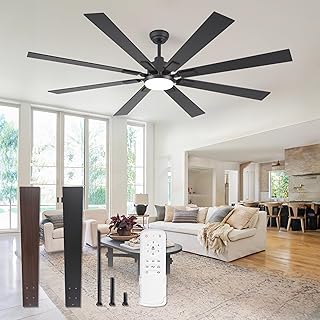
The strongest all-rounder here, pairing an industrial-grade DC motor and eight reversible aluminum blades with an integrated 3CCT light, so a garage or gazebo gets airflow and usable illumination from one box. Damp-rated construction and six speeds make it equally credible over a living room seating group.
60-Inch 7400+ CFM Ceiling Fan
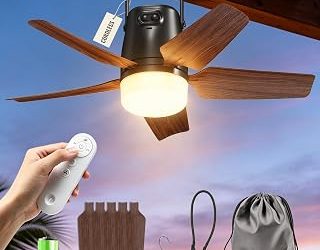
A precise fit for standard-ceiling rooms that still need real throughput. Three blades on a noiseless reversible DC motor deliver over 7,400 CFM with 3 CCT lighting, a timer, and a mute remote, making it a smart pick for bedrooms and patios where sound matters as much as circulation.
Ohniyou 96-Inch Industrial Ceiling Fan
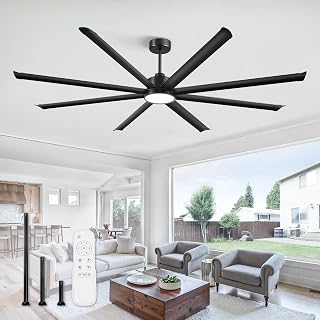
Stripped of a light kit and finished in matte black, this eight-blade aluminum fan is purpose-built for shops, warehouses, and home gyms with separate overhead lighting. App and remote control add scheduling convenience you rarely see at this scale.
ZMISHIBO 72-Inch Ceiling Fan with Lights
The sweet spot for covered outdoor living and tall great rooms. Dual-finish blades and a 24W 3 CCT LED keep it visually refined, while the damp-rated DC motor moves enough air to make a screened patio usable in peak summer.
Frequently Asked Questions
How much CFM do I actually need?
As a working benchmark, aim for 4,000 to 5,000 CFM in a bedroom, 6,000 to 8,000 in a living room, and 12,000 or more in shops, gyms, and high-ceiling great rooms. Ceiling height matters as much as square footage.
Are large fans noticeably louder?
Not with modern DC motors. A 96-inch fan moves its air volume at low RPM, so it typically runs quieter than a small AC fan straining at top speed. Most perceived noise comes from loose mounting hardware or an undersized junction box.
Should I run the fan in reverse during winter?
Yes. Reverse the blades and use speed one or two to pull warm air down from the ceiling without creating a draft. In rooms with vaulted ceilings this alone can shave a few degrees off your heating setpoint.
Can I install a 96 or 120-inch fan myself?
Only if the electrical box is rated for fan support and you have help handling the blades. Fans at this scale carry real weight and demand precise balancing, so a licensed electrician is the safer call.
Final Thoughts
For large shops, garages, and high-bay spaces, the 120-Inch Extra Large Industrial Ceiling Fan delivers the most air per dollar, with the Ohniyou 96-Inch as the cleaner black-finish alternative where lighting is already handled. If you want one fan that covers airflow and ambient light in a living room, gazebo, or patio, the ZMISHIBO 96-Inch is the most versatile pick of the group.