Key takeaways
- Match span to square footage: A 42-inch fan suits bedrooms and kitchens up to roughly 144 sq ft, while 52 inches covers living rooms and primary suites. Oversizing a small room creates noticeable draft; undersizing a large one just stirs the ceiling.
- Check your ceiling height first: Standard downrod mounts need 8 feet or more to keep blades safely above head height. Anything lower calls for a low-profile flush mount, which hugs the canopy and reclaims several critical inches.
- Read CFM, not blade count: Airflow is a function of motor torque and blade pitch. Five blades tend to run quieter with less wobble, but the CFM rating on the box is the number that tells you how much air actually moves.
- Decide on light before you buy: Integrated LED kits are sealed units — convenient, but not swappable. If the room already has recessed cans or good lamp coverage, a no-light fan gives you a cleaner silhouette and one less thing to fail.
- Confirm the pull chain and wall control: Most pull-chain fans wire to a single switch, with speed set at the chain and direction at the motor housing. If you want independent switching for fan and light, plan for a two-wire run before drywall goes up.
What's inside
Somewhere along the way, the ceiling fan became a gadget. Pair it to an app, sync it to a hub, hunt for the remote that fell behind the nightstand again — and eventually pay to replace a receiver that failed long before the motor did. For plenty of homes, that’s a solution to a problem nobody had. A wall switch and a pull chain still do the job with fewer moving parts, and they keep working when the batteries die, the Wi-Fi drops, or a guest can’t figure out which button does what.
This guide gathers the pull-chain fans worth installing in 2026 — the ones with real motor quality behind them, not just stripped-down price leaders. You’ll find 52-inch workhorses for open living areas, low-profile flush mounts for tight ceilings, and a few options with integrated LED light kits if the room has no other fixture. Below the picks, there’s a short buying framework covering blade span, mounting height, airflow numbers, and the finishes that actually age well.
As an Amazon Associate we earn from qualifying purchases.


How to Choose a Ceiling Fan Without Remote (2026)
- Match span to square footage: A 42-inch fan suits bedrooms and kitchens up to roughly 144 sq ft, while 52 inches covers living rooms and primary suites. Oversizing a small room creates noticeable draft; undersizing a large one just stirs the ceiling.
- Check your ceiling height first: Standard downrod mounts need 8 feet or more to keep blades safely above head height. Anything lower calls for a low-profile flush mount, which hugs the canopy and reclaims several critical inches.
- Read CFM, not blade count: Airflow is a function of motor torque and blade pitch. Five blades tend to run quieter with less wobble, but the CFM rating on the box is the number that tells you how much air actually moves.
- Decide on light before you buy: Integrated LED kits are sealed units — convenient, but not swappable. If the room already has recessed cans or good lamp coverage, a no-light fan gives you a cleaner silhouette and one less thing to fail.
- Confirm the pull chain and wall control: Most pull-chain fans wire to a single switch, with speed set at the chain and direction at the motor housing. If you want independent switching for fan and light, plan for a two-wire run before drywall goes up.
The Best Ceiling Fans Without Remote (2026) Reviewed
Hunter Builder Elite 52-Inch, Brushed Nickel
This is the one I point people toward when the room already has lighting and the fan just needs to move air quietly. The WhisperWind motor is genuinely unobtrusive at low speed, and the brushed nickel finish sits comfortably against both warm wood and cooler modern palettes.
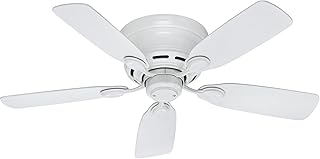
Hunter Builder 42-Inch Low Profile, New Bronze
A flush-mount build with an LED kit, sized for bedrooms, kitchens, and anywhere the ceiling sits at eight feet or just under. New Bronze reads warmer and softer than oil-rubbed finishes, which helps it disappear into transitional and farmhouse-leaning rooms.
Hunter Anisten 44-Inch, Fresh White
The 44-inch span is an underrated middle ground — more reach than a 42 without dominating a mid-size bedroom. Fresh White on a standard downrod mount is close to invisible on a white ceiling, and bulbs are included, so it’s a same-day install.
Honeywell Glen Alden 52-Inch, Oil Rubbed Bronze
Strong value in a low-profile 52-inch package, with five reversible blades that let you flip between two wood tones depending on the room. The motor stays quiet at mid speeds, and it’s a sensible pick for a den, guest room, or finished basement where budget matters more than pedigree.
Hunter Builder Deluxe 52-Inch, New Bronze
Essentially the Builder Elite with a light kit added, making it the practical choice for a room with no existing overhead fixture. Standard mount and 52-inch blades give it real presence over a sectional or a king bed.
Frequently Asked Questions
Can I add a remote to a pull-chain fan later?
Often yes — universal receiver kits fit inside most canopies, provided there’s clearance. Check the fan’s housing depth and confirm the kit’s wattage limits before ordering.
Are pull-chain fans more reliable?
They have fewer failure points. No receiver board, no pairing memory, no battery-dependent handset — just a switch and a mechanical pull. That simplicity is the main reason they tend to outlast their electronics-heavy counterparts.
How do I switch the fan for winter?
Look for a small toggle on the motor housing. Flipping it reverses blade direction, pushing warm air down from the ceiling instead of creating a downdraft. Run it on low during heating season.
Do I need a special electrical box?
Yes — a fan-rated box is required to support the weight and vibration. A standard lighting box isn’t sufficient, even for a lightweight low-profile model.
Final Thoughts
For most rooms, the Hunter Builder Elite 52-inch is the clean, quiet default when lighting is already handled, while the Builder Deluxe covers the same ground with an LED kit built in. If your ceiling sits low, the Hunter Builder 42-inch low-profile flush mount is the one that solves the clearance problem without giving up motor quality.