Key takeaways
- Amperage rating: Most window units pull 10–15 amps. Choose a protector rated at least 15A, ideally 20A, so you’re never running at the ceiling — this gives you headroom and prolongs the protector’s lifespan.
- Joule rating or surge absorption: Higher joules (or kA absorption in HVAC-specific units) means more capacity before the protector sacrifices itself. For a window AC, look for at least 1,000 joules or 10kA absorption to handle moderate lightning-induced surges.
- Voltage protection threshold (VPT): This is the voltage at which the protector clamps. Anything below 400V clamping on a 120V circuit is ideal. Brownout protectors that cut power during sustained low-voltage events are especially valuable for compressor longevity.
- Outlets and form factor: A single-outlet plug-in is cleanest for a dedicated AC circuit, while multi-outlet strips work if you’re co-locating a fan or dehumidifier. Consider whether wide spacing is needed for bulky AC plugs.
- Certifications and indicator lights: ETL or UL listing confirms third-party testing. LED indicators that confirm protection status and ground presence save you from guessing whether the unit is actually doing its job.
What's inside
Window air conditioners draw a lot of power, and every summer a surprising number of units die — not from heat, but from voltage spikes and brownouts. If you’ve ever watched your AC flicker off during a storm or heard it struggle back to life after a brief outage, you already know the damage that inconsistent power can cause to compressors and control boards. The cost of a good surge protector is a fraction of a single service call.
This guide walks you through six solid options tailored for window AC units in 2026, ranging from dedicated HVAC surge suppression to heavy-duty power strips built for high-draw appliances. You’ll also find a quick buying checklist and answers to the most common questions homeowners ask before pulling the trigger.
As an Amazon Associate we earn from qualifying purchases.

![[ETL Listed] BSEED Surge Protector, Surge Protector Outlet for Home Appliances, Power Surge Protector Suit for Refrigerator, TV, Computer and Freezer, Adjustable Voltage Regulator, 120V,1800W, 2 Pack](https://m.media-amazon.com/images/I/61XN30awMoL._AC_UY218_.jpg)


How to Choose a Surge Protector For Window Air Conditioner (2026)
- Amperage rating: Most window units pull 10–15 amps. Choose a protector rated at least 15A, ideally 20A, so you’re never running at the ceiling — this gives you headroom and prolongs the protector’s lifespan.
- Joule rating or surge absorption: Higher joules (or kA absorption in HVAC-specific units) means more capacity before the protector sacrifices itself. For a window AC, look for at least 1,000 joules or 10kA absorption to handle moderate lightning-induced surges.
- Voltage protection threshold (VPT): This is the voltage at which the protector clamps. Anything below 400V clamping on a 120V circuit is ideal. Brownout protectors that cut power during sustained low-voltage events are especially valuable for compressor longevity.
- Outlets and form factor: A single-outlet plug-in is cleanest for a dedicated AC circuit, while multi-outlet strips work if you’re co-locating a fan or dehumidifier. Consider whether wide spacing is needed for bulky AC plugs.
- Certifications and indicator lights: ETL or UL listing confirms third-party testing. LED indicators that confirm protection status and ground presence save you from guessing whether the unit is actually doing its job.
The Best Surge Protector For Window Air Conditioner (2026)s Reviewed
Zuomeng HVAC Surge Protector 20kA
Built specifically for HVAC equipment rather than adapted from a general-purpose strip, this unit mounts near your condenser or window unit and delivers 20kA of surge absorption with three-layer protection. Dual LED indicators make it easy to confirm status at a glance, and the 120/240VAC compatibility means it covers both standard and higher-voltage setups without confusion.
BSEED Surge Protector Outlet 120V 1800W (2 Pack)
These compact plug-in protectors are a smart buy if you’re guarding both a window AC and another appliance on a different circuit. The adjustable voltage regulation actively monitors incoming power and disconnects during dangerous brownouts or surges, which matters for compressor health. Getting two units in one package makes the per-outlet cost very competitive.
Heavy-Duty 20A 4400W Surge Protector for Appliances
Rated at a serious 20 amps and 4,400 watts, this smart circuit plug can handle the biggest window units on the market and still have reserve capacity. The built-in outlet saver design lets you share the wall outlet without blocking adjacent sockets, and the 140-joule rating is backed by overload and voltage protection that responds quickly to anomalies.
CCCEI Heavy Duty Surge Protector Power Strip
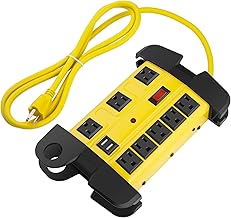
If your window AC shares garage or workshop space with other tools, this 6-foot metal-bodied strip with six wide-spaced AC outlets earns its keep. The yellow industrial finish is more than aesthetic — the rugged housing resists impacts, and the grounded plug and ETL listing provide peace of mind in demanding environments where cheaper strips would fail prematurely.
BSEED Surge Protector for Refrigerator 1875W
Originally designed for refrigerators but perfectly suited to window ACs, this single-outlet plug-in provides multi-function protection including voltage brownout cutoff at 15A / 125V. The wall-mount option keeps it flush against the outlet rather than dangling behind furniture, and the compact body doesn’t block a second receptacle on a duplex outlet.
Frequently Asked Questions
Can I use a regular power strip for my window air conditioner?
A standard power strip without surge protection or proper amperage ratings creates a real risk. Window ACs demand sustained high current that cheap strips aren’t engineered for — they can overheat, fail to trip during a surge, or violate building code if the circuit is dedicated. Always use a protector rated for at least 15 amps and clearly listed for appliance use.
How many joules do I need for a window AC surge protector?
For a window unit, the joule rating matters less than the clamping voltage and response time, but you still want a meaningful baseline. Anything above 1,000 joules handles everyday power fluctuations well. If you live in an area with frequent lightning storms, push toward higher ratings or choose an HVAC-specific unit like the Zuomeng that measures absorption in kiloamps.
Do brownout protectors actually help my air conditioner?
Yes. During a brownout, voltage drops below the compressor’s operating threshold, and the motor draws excessive current trying to compensate. This overheats the windings and is one of the leading causes of premature AC failure. A brownout protector like the BSEED units detects low voltage and cuts power before damage occurs, then restores it when safe levels return.
Should I install the surge protector at the outlet or at the breaker panel?
For a window AC unit, a plug-in protector at the outlet is the practical choice — it’s portable, easy to inspect, and requires no electrician. Whole-panel protectors at the breaker box offer broader coverage for the entire home but protect against different failure modes. For the specific investment of a window AC, a quality outlet-level protector gives you the most direct protection per dollar.
Final Thoughts
For most households, the Zuomeng HVAC Surge Protector stands out as the purpose-built option with serious surge absorption, while the BSEED 1800W 2-Pack offers the best value if you want to protect multiple appliances on a budget. If your window unit is one of the larger, higher-draw models, the Heavy-Duty 20A 4400W gives you the amperage headroom to match.