Key takeaways
- Load rating: Look for explicit “fan rated” marking and a stated weight ceiling. Most residential fans land between 15 and 50 pounds, but heavy chandelier-style fans with integrated lighting can push past 70, so buy headroom rather than exactly what you need today.
- New work vs. old work: If your ceiling is already finished, you need an old-work brace that expands between joists through the existing opening. Cutting drywall to reach a joist is a repair job you’ll regret; a retrofit brace turns a two-day patch into a twenty-minute install.
- Joist span and adjustability: Framing isn’t always 16 inches on center. A brace that telescopes across a 16 to 24 inch range covers older homes, remodels, and anything with blocking in the way.
- Depth and knockouts: Shallow half-inch pans are fine for lightweight fixtures, but fan wiring plus a mounting ball needs room. Depth-adjustable boxes let you set the face flush with the finished ceiling, and multiple knockouts give you clean cable entry from any direction.
- Location and listing: Damp or wet locations call for weatherproof PVC and a cULus or UL listing for that environment. Sloped ceilings need a box designed for angled mounting, not a flat pan you fight with shims.
What's inside
The ceiling fan you fell in love with at the showroom is only as good as the two-dollar bracket holding it to your joists. It’s the least glamorous decision in the entire room, and it’s the one that determines whether your fixture spins quietly for fifteen years or develops a wobble that drives you slowly insane. Standard round pans, the kind installed by the thousand in tract homes, are rated for light fixtures only. Hang a 45-pound fan from one and you’re relying on drywall screws to defy physics.
This guide sorts through the fan-rated boxes actually worth installing in 2026, from adjustable braces that slide into place through an existing hole to weatherproof PVC housings built for covered porches. We’ve weighed load ratings, retrofit versus new-construction workflow, and the small design details, depth adjustment, knockout count, sloped-ceiling compatibility, that separate a clean flush mount from a canopy that never quite sits right.
As an Amazon Associate we earn from qualifying purchases.


How to Choose a/an Electrical Box For Ceiling Fan (2026)
- Load rating: Look for explicit “fan rated” marking and a stated weight ceiling. Most residential fans land between 15 and 50 pounds, but heavy chandelier-style fans with integrated lighting can push past 70, so buy headroom rather than exactly what you need today.
- New work vs. old work: If your ceiling is already finished, you need an old-work brace that expands between joists through the existing opening. Cutting drywall to reach a joist is a repair job you’ll regret; a retrofit brace turns a two-day patch into a twenty-minute install.
- Joist span and adjustability: Framing isn’t always 16 inches on center. A brace that telescopes across a 16 to 24 inch range covers older homes, remodels, and anything with blocking in the way.
- Depth and knockouts: Shallow half-inch pans are fine for lightweight fixtures, but fan wiring plus a mounting ball needs room. Depth-adjustable boxes let you set the face flush with the finished ceiling, and multiple knockouts give you clean cable entry from any direction.
- Location and listing: Damp or wet locations call for weatherproof PVC and a cULus or UL listing for that environment. Sloped ceilings need a box designed for angled mounting, not a flat pan you fight with shims.
The Best Electrical Box For Ceiling Fan (2026)s Reviewed
Southwire MSBFAN Depth-Adjustable Fan Box
The most versatile pick here, with a 50-pound fan and 75-pound fixture rating plus a depth adjustment that lets you dial the face flush against any drywall thickness. If you’re installing in new construction or a gutted ceiling and want one box that handles both a fan now and a heavy pendant later, this is the safe default.
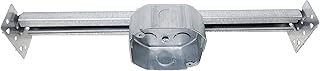
RACO RETRO-BRACE 936 Old Work Fan Box
Purpose-built for the retrofit scenario most people are actually in: existing ceiling, existing hole, no interest in patching drywall. The brace expands across 16 to 24 inch joist spacing, supports 35 to 70 pounds depending on configuration, and the 1.5-inch depth gives fan wiring somewhere to live.
Hubbell-Bell PRCF57550GY Outdoor Fan Box
The one to specify for covered patios, porches, and three-season rooms. Weatherproof PVC construction, cULus listing, three included reducer bushings, and a 45-degree mount option that solves sloped porch ceilings without improvised shimming.
RACO 8293 4-Inch Round Ceiling Pan
A half-inch-deep pan with five bottom knockouts, ideal as a light-fixture box or paired with a separate support brace carrying the mechanical load. Understand its role: this is a wiring enclosure, not a standalone fan mount.
Fan Brace Electrical Box and Support Bar
A straightforward box-and-bar combination that covers both new installs and remodel work, transferring fan weight directly to the framing rather than the ceiling surface. Good value when you’re outfitting several rooms at once.
Frequently Asked Questions
Can I hang a ceiling fan from a regular light fixture box?
No. Standard boxes aren’t rated for the dynamic load and vibration a spinning fan produces, and code requires a listed fan-rated outlet box or brace. Swapping the box is non-negotiable, even if the existing one feels solid.
Do I need to cut into my ceiling to install one?
Not with an old-work brace. It feeds through the existing opening, expands until the ends bite into the joists, and tightens from below, leaving your drywall intact.
How much weight should the box support?
Match or exceed your fan’s shipping weight with margin. A 50-pound rating comfortably covers the majority of residential fans; oversized or chandelier-fan hybrids need a 70-pound-class brace.
Are metal or PVC boxes better?
Metal is the standard for interior fan mounting. Reach for PVC when the location is damp or wet and you need corrosion resistance and a matching listing.
Final Thoughts
For most homes, the Southwire MSBFAN is the box to buy when the ceiling is open and the RACO RETRO-BRACE 936 is the answer when it isn’t. If your fan is going anywhere weather can reach it, the Hubbell-Bell PRCF57550GY is the only one of the three built for the job.