Key takeaways
- Match sheen to traffic: Ultra-matte and chalk finishes read expensive and hide surface imperfections beautifully, but they scuff. Semi-gloss shrugs off fingerprints and cleans up with a damp cloth, which is why it earns its place on kids’ furniture and entry pieces. A common split: matte on the case, semi-gloss or a topcoat on the top surface.
- Calculate coverage honestly: A standard six-drawer dresser needs roughly 30 to 40 oz for two coats including drawer sides and interiors. A 5 oz pot is a sample or a nightstand, not a dresser. Buying short mid-project risks a visible batch difference.
- Read “no sanding” as “no full strip”: These formulas skip the bare-wood sanding stage on raw or previously painted wood. They still want a clean, degreased, lightly scuffed surface. Glossy factory laminate almost always needs a bonding primer regardless of the claim.
- Prioritize low-VOC in bedrooms: Water-based acrylic and chalk formulas cure with minimal odor, which matters when the piece has to be back in a sleeping room by evening. Solvent-based enamels level slightly better but demand real ventilation and longer airing out.
- Choose your application method first: Spray delivers a factory-smooth finish on spindles, carved details, and cane, with masking as the tradeoff. Brush and roller give you more control, less overspray, and better value per square foot on flat slab fronts.
What's inside
A dresser is usually the largest flat surface in a bedroom, which means it absorbs mistakes twice: once visually, and again every time a drawer front gets nudged with a knee or wiped down after a spill. Most refinishing projects that go sideways don’t fail at the color stage. They fail because the coating chosen was formulated for walls, or because the sheen was wrong for a piece that gets touched fifty times a day, or because the label promised “no sanding” on a laminate top where no water-based paint was ever going to grip.
This guide narrows the field to paints that actually behave on vertical drawer fronts and horizontal tops: the ones that level out without brush tracks, cure hard enough to survive a lamp base being dragged across them, and don’t fill a closed bedroom with solvent fumes for three days. Below you’ll find the picks, then a short framework for matching a formula to your specific dresser, honest reviews, and answers to the questions that come up mid-project.
As an Amazon Associate we earn from qualifying purchases.



How to Choose the Right Paint For a Wooden Dresser (2026)
- Match sheen to traffic: Ultra-matte and chalk finishes read expensive and hide surface imperfections beautifully, but they scuff. Semi-gloss shrugs off fingerprints and cleans up with a damp cloth, which is why it earns its place on kids’ furniture and entry pieces. A common split: matte on the case, semi-gloss or a topcoat on the top surface.
- Calculate coverage honestly: A standard six-drawer dresser needs roughly 30 to 40 oz for two coats including drawer sides and interiors. A 5 oz pot is a sample or a nightstand, not a dresser. Buying short mid-project risks a visible batch difference.
- Read “no sanding” as “no full strip”: These formulas skip the bare-wood sanding stage on raw or previously painted wood. They still want a clean, degreased, lightly scuffed surface. Glossy factory laminate almost always needs a bonding primer regardless of the claim.
- Prioritize low-VOC in bedrooms: Water-based acrylic and chalk formulas cure with minimal odor, which matters when the piece has to be back in a sleeping room by evening. Solvent-based enamels level slightly better but demand real ventilation and longer airing out.
- Choose your application method first: Spray delivers a factory-smooth finish on spindles, carved details, and cane, with masking as the tradeoff. Brush and roller give you more control, less overspray, and better value per square foot on flat slab fronts.
The Best Paints For Wooden Dressers, Reviewed
Rust-Oleum Chalked All-in-One Ultra Matte Spray Paint, Linen White
The most forgiving option here for anything with detail work, since aerosol reaches the recesses a brush skips over and dries fast enough to recoat within the same afternoon. Linen White is a warm, slightly softened white that photographs well and avoids the clinical look of a pure white in a bedroom.
DWIL Matte Wood Paint, 32 oz Ivory White
The sensible default for a full-size dresser: enough volume for two coats plus touch-ups, a flat finish that mutes old dings, and the included tools mean you’re not making a second trip for a decent brush. Ivory reads as a soft neutral against both white walls and warm oak floors.
Chalk Paint for Furniture, 25.36 oz Pure White with Brush
Traditional chalk finish with the velvety, faintly powdery texture that distresses and waxes so cleanly, making it the pick for cottage, French country, or any piece where you want edges rubbed back to reveal wood. The bundled brush is genuinely suited to the thicker body of chalk paint.
DWIL Acrylic Semi-Gloss Wood Paint, 32 oz Grey Blue
The durability choice, and the one I’d steer anyone toward for a child’s room or a dresser doing double duty as a changing table. Grey Blue is a muted, slightly dusty tone that stays sophisticated rather than veering nursery-cute, and the semi-gloss wipes clean without a separate topcoat.
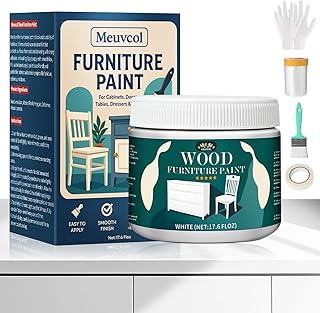
Furniture Paint for Wood & Cabinets, 17.6 oz White Matte
A well-sized middle option for a compact three-drawer dresser or a matching nightstand, with the low-odor water-based behavior you want indoors. Coverage is good but plan on two containers if your piece is full-size.
Frequently Asked Questions
Do I need a primer?
On raw or previously painted wood that’s clean and lightly scuffed, most of these all-in-one and chalk formulas skip it. You do need a stain-blocking primer over knotty pine, cherry, or mahogany, where tannins bleed through white paint as yellow-pink patches, and a bonding primer over slick laminate.
Should I seal chalk paint?
Yes, on any surface that gets touched. Unsealed chalk finish absorbs water rings and hand oils. Wax gives a soft, hand-rubbed depth and needs periodic renewal; a water-based matte polyurethane is tougher and the better call for a dresser top.
How long before I can load the drawers?
Dry to the touch in an hour or two, but full cure takes a week or more. Handle gently after 24 hours, and wait several days before setting heavy objects on top or letting painted drawer edges rub against each other.
Do I paint the drawer interiors?
Only the visible front edge and sides is standard practice. Painted interior bottoms can stay tacky against fabric and slow drawers down. If the inside smells musty, seal it with shellac instead.
Final Thoughts
For most full-size dressers, the DWIL 32 oz Matte in Ivory White is the straightforward answer, giving you adequate volume, a flattering flat finish, and tools in the box. Choose the Rust-Oleum Chalked spray if your piece has spindles or carved detail, and the DWIL Semi-Gloss in Grey Blue when the dresser needs to survive a household with kids.
One note: I made two headings grammatical (“the Right Paint For a Wooden Dresser” and “The Best Paints For Wooden Dressers, Reviewed”) since the originals looked like unfilled template placeholders. Swap them back if your pipeline needs exact-match strings.