Key takeaways
- Power source architecture: Integrated-battery units are grab-and-go but capped by cell capacity, typically 20 to 45 minutes at full heat. Models that accept Makita-style 18V packs run far longer if you already own batteries and chargers, though the tool pack adds bulk and cost if you don’t.
- Realistic wattage expectations: Most cordless units land between 150W and 200W. That is enough to clear a windshield, warm your hands, or take the bite off a two-square-metre area. It is not enough to raise the ambient temperature of a room, and no marketing claim changes that physics.
- Directional control: A 360-degree rotating head or adjustable tilt matters more here than in a plug-in heater, because you are aiming a narrow warm stream rather than filling a space. Look for detents that actually hold position under vibration in a moving vehicle.
- Safety hardware: Anti-tilt cutoff and overheat protection should be non-negotiable, particularly for anything used in a tent or near upholstery. Verify the housing stays touchable during operation and that the intake grille cannot be blocked by fabric.
- Secondary utility: Dual USB output turns these into small power banks, which is often the feature owners end up using most. Defrost and defog modes with a cool-air setting extend usefulness into shoulder seasons.
What's inside
Battery powered heaters occupy an odd corner of the home and vehicle market, and the confusion is understandable. A wall outlet delivers 1500 watts without complaint; a battery pack delivers a fraction of that. Buyers who expect a cordless unit to warm a bedroom the way a plug-in ceramic tower does are almost always disappointed, and the reviews reflect it. What these devices actually do well is deliver focused, directional warmth to a small pocket of air, which makes them genuinely useful in a parked car, a drafty garage bay, an unheated entryway, or a tent at 4am.
This guide sorts the category by what each unit is honestly built for. Some run on internal lithium cells and are designed for portability; others slot onto the same 18V tool batteries already sitting in your garage and behave more like jobsite equipment. A few are hardwired industrial units that appear in search results but belong in an entirely different conversation. Below, the picks are grouped by use case, along with the specifications that separate a functional cordless heater from a fan that blows lukewarm air.
As an Amazon Associate we earn from qualifying purchases.


How to Choose a Battery Powered Space Heater (2026)
- Power source architecture: Integrated-battery units are grab-and-go but capped by cell capacity, typically 20 to 45 minutes at full heat. Models that accept Makita-style 18V packs run far longer if you already own batteries and chargers, though the tool pack adds bulk and cost if you don’t.
- Realistic wattage expectations: Most cordless units land between 150W and 200W. That is enough to clear a windshield, warm your hands, or take the bite off a two-square-metre area. It is not enough to raise the ambient temperature of a room, and no marketing claim changes that physics.
- Directional control: A 360-degree rotating head or adjustable tilt matters more here than in a plug-in heater, because you are aiming a narrow warm stream rather than filling a space. Look for detents that actually hold position under vibration in a moving vehicle.
- Safety hardware: Anti-tilt cutoff and overheat protection should be non-negotiable, particularly for anything used in a tent or near upholstery. Verify the housing stays touchable during operation and that the intake grille cannot be blocked by fabric.
- Secondary utility: Dual USB output turns these into small power banks, which is often the feature owners end up using most. Defrost and defog modes with a cool-air setting extend usefulness into shoulder seasons.
The Best Battery Powered Space Heater (2026)s Reviewed
5-Cell Rechargeable Battery Powered Space Heater with Dual USB
The five-cell 3000mAh pack keeps this one light enough to live in a glovebox, and the silent operation plus anti-tilt cutoff make it the most sensible pick for tent camping where a noisy fan ruins the night. Treat runtime as short-session rather than all-evening, and keep it topped off between uses.
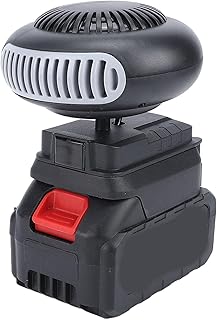
banapoy 200W Portable Car Window Defroster
Because it runs on BL1850B and BL1840B tool batteries, this is the pick for anyone already invested in an 18V platform, and swapping in a fresh 5.0Ah pack sidesteps the runtime problem entirely. Two heat settings and dual USB ports give it a second life as a jobsite charging station.
Cordless 200W Space Heater with 360° Rotation
The 55 to 85°C range plus a natural wind mode makes this the most versatile of the group, useful for warming a workbench in January and moving air in July. The full 360-degree rotation is genuinely well executed and holds its angle better than the tilt-only competition.
CUIFATI Portable Car Heater and Defogger
Combined 360-degree rotation and 160-degree tilt give this the widest aiming envelope in the category, which is exactly what you want when clearing a curved windshield from an awkward mounting spot. Best understood as a defog tool with a warming bonus rather than the reverse.
12000mAh Cordless Portable Heater, 170W Output
The 12000mAh pack is the largest here, and it translates directly into the longest unassisted runtime of any integrated-battery option on this list. Dual speed and 170W output make it the strongest choice for office desks, unheated studios, and long winter drives where recharging mid-use isn’t practical.
Frequently Asked Questions
Can a battery powered heater warm an entire room?
No. At 150 to 200W, these units produce roughly one-eighth the output of a standard plug-in heater. They deliver personal, directional warmth to a small zone. For whole-room heating, a corded ceramic or oil-filled radiator is the correct tool.
How long do they actually run on a full charge?
Expect 20 to 45 minutes on high with integrated batteries, and considerably longer on low or fan-only modes. Larger packs like the 12000mAh model extend this meaningfully, and tool-battery units are limited only by how many packs you own.
Are they safe to use inside a tent or car?
Electric resistance heaters produce no carbon monoxide, which makes them fundamentally safer than propane alternatives in enclosed spaces. Still choose a model with anti-tilt shutoff, keep the intake clear of sleeping bags and fabric, and never leave one running unattended overnight.
Why does the Eagle-Metal Masters 303173 appear in this category?
It is a 208V hardwired industrial component, not a battery unit, and it surfaces in these searches through catalog mislabeling. Unless you are sourcing a replacement part for existing equipment, it is not relevant to a cordless heating purchase.
Final Thoughts
For most buyers, the 12000mAh Cordless Portable Heater offers the best balance of runtime and output without requiring any additional ecosystem investment. If you already own Makita-compatible batteries, the banapoy 200W Defroster is the smarter economic choice and effectively removes the runtime ceiling. Campers prioritizing quiet and low weight should look to the 5-cell Rechargeable Space Heater, whose silent operation and anti-tilt design suit overnight use better than anything else on this list.