Key takeaways
- Loops over knots: Daisy-chain webbing with sewn loops gives you dozens of fixed anchor points, so you adjust sag by moving a carabiner instead of retying. It’s the single biggest upgrade you can make to a hang.
- Working load, not breaking strength: Look for a stated capacity with real margin above your body weight — 400 lbs is a sensible floor, and heavier ratings matter if two people share the hammock.
- Strap width and stretch: Wider polyester webbing spreads pressure across bark and resists the slow droop that ruins a hang by hour two. Avoid nylon rope that creeps under sustained load.
- Length for your space: Mature trees, porch columns, and wide-set posts need 10 to 20 feet per side. Short straps force a steep, uncomfortable hang and put strain on your hardware.
- Hardware that stays quiet: Wiregate or D-shaped aluminum carabiners keep weight down and won’t rattle or rust. Matte black finishes read cleaner against neutral exteriors than bright anodized colors.
What's inside
Anyone who has spent twenty minutes wrestling rope around a tree trunk knows the real problem with hammocks: the hang is harder than the lounging. Knots slip under load, cinch tight and refuse to release, or bite into bark until the tree pays for your afternoon. And the classic answers — the bowline, the taut-line hitch, the trucker’s hitch — all demand muscle memory you probably don’t have on hand when the guests are already outside with drinks.
This guide takes a practical view of the hammock knot question for 2026: which suspension systems actually replace knot-tying, which ones deserve a spot on a considered patio or sunroom, and what to look for in webbing, loops, and hardware. We’ve weighed load ratings, adjustability, tree impact, and how the whole assembly looks when it’s part of a room rather than a campsite.
As an Amazon Associate we earn from qualifying purchases.


How to Choose a Hammock Knot (2026)
- Loops over knots: Daisy-chain webbing with sewn loops gives you dozens of fixed anchor points, so you adjust sag by moving a carabiner instead of retying. It’s the single biggest upgrade you can make to a hang.
- Working load, not breaking strength: Look for a stated capacity with real margin above your body weight — 400 lbs is a sensible floor, and heavier ratings matter if two people share the hammock.
- Strap width and stretch: Wider polyester webbing spreads pressure across bark and resists the slow droop that ruins a hang by hour two. Avoid nylon rope that creeps under sustained load.
- Length for your space: Mature trees, porch columns, and wide-set posts need 10 to 20 feet per side. Short straps force a steep, uncomfortable hang and put strain on your hardware.
- Hardware that stays quiet: Wiregate or D-shaped aluminum carabiners keep weight down and won’t rattle or rust. Matte black finishes read cleaner against neutral exteriors than bright anodized colors.
The Best Hammock Knots (2026) Reviewed
MalloMe Hammock Straps for Trees
A genuinely versatile hanging kit that works for hammocks, porch swings, and chairs alike, with adjustable loops that let you dial in the ideal 30-degree sag without a single knot. The best all-around choice if you want one set of straps to cover several seating pieces around the house.
ENO Atlas Suspension System
ENO’s Atlas remains the benchmark for a reason: tight tolerances, non-stretch polyester, and multiple loops per strap in a compact package that packs down smaller than most competitors. The black and royal colorway is understated enough for a covered patio, and the build quality justifies the premium.
Foxelli XL Hammock Straps
At 20 feet per strap with 40-plus loops and a 2,000-lb rating, this is the set to buy when your anchor points are stubbornly far apart or unusually thick. The no-stretch webbing holds its position all day, which makes it a strong pick for indoor beam installations too.
SZHLUX Hammock Straps for Trees
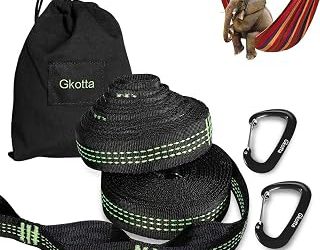
Two 10-foot straps, 38 loops, and a pair of carabiners cover the vast majority of backyard setups at a friendly price. Straightforward, well-stitched, and a sensible starting point if you’re outfitting a hammock for the first time.
Kootek Camping Hammock
If you need the hammock itself, Kootek bundles 210T parachute nylon, tree-friendly straps, and D-shaped carabiners into one 400-lb-capacity kit. It reads casual rather than designed, so it earns its keep in a garden corner or on a trip more than a formal terrace.
Frequently Asked Questions
Do I still need to know how to tie a hammock knot?
One is worth learning — the becket hitch or a simple trucker’s hitch will save you if a strap fails. With daisy-chain webbing, though, you’ll rarely tie anything again.
What’s the right sag for a hammock?
Aim for straps at roughly a 30-degree angle from horizontal, with the hammock’s lowest point about 18 inches off the ground. Too taut is the most common mistake, and it’s the reason hammocks feel like hanging in a taco.
Will straps damage my trees?
Wide webbing distributes load across the bark and is the accepted low-impact standard. Skip bare rope and chain, and avoid leaving straps in place for months at a time.
Can I hang a hammock indoors with these?
Yes, provided you anchor into structural framing with rated eye bolts, never drywall. Longer straps like the Foxelli set make it easier to reach usable joists without an awkward angle.
Final Thoughts
For most homes, the MalloMe kit is the smart default: adaptable across hammocks and swings, easy to adjust, and forgiving of imperfect anchor spacing. Step up to the ENO Atlas if you want the tidiest, best-built system on a visible patio, or the Foxelli XL when distance and load demand serious reach.