Key takeaways
- Match CFM to the room, not the box: The standard rule is one CFM per square foot for baths under 100 sq ft, with a 50 CFM floor. Add capacity for a jetted tub or an enclosed shower stall, and favor a multi-speed model if you want headroom without permanent overkill.
- Read the sone rating carefully: Sones scale roughly with perceived loudness, so 1.0 sone is about the hush of a refrigerator, while 3.0 is intrusive. Anything at or under 1.5 sones reads as background air movement rather than machinery.
- Treat the light as lighting, not an afterthought: Selectable 5CCT modules let you tune between 2700K for warm evening light and 5000K for grooming, and dimmable drivers let the fixture disappear into the ceiling at night. Check that the color temperature can be matched to your vanity fixtures.
- Confirm housing depth and duct size before ordering: Shallow-profile housings suit 2×6 joists and remodels; deeper bodies need clearance above. Match the duct collar to your existing run (usually 4 in. or 6 in.) since undersized ducting will strangle a high-CFM motor.
- Look for wet-rated, ETL-listed, and sensor-equipped models: A wet rating is required over a tub or shower on a GFCI circuit. Humidity or motion sensors handle the run time for you, which matters more than raw airflow for controlling mold.
What's inside
A bathroom fan is the one fixture nobody shops for until something goes wrong: a mirror that stays fogged twenty minutes after a shower, paint blistering along the ceiling line, or a grille that groans like a small aircraft every time the light switch flips. Because the fan lives overhead, it also occupies what designers treat as the fifth surface of a room, competing for attention with the very ceiling plane you spent time getting smooth and bright. The result is a purchase driven by panic rather than intent, and a spec sheet full of acronyms that do a poor job of explaining what you will actually hear and see.
This guide untangles the three numbers that matter most (CFM for airflow, sones for noise, and Kelvin for light color), then walks through the models worth installing in 2026. Every pick below is a ceiling-mount fan-and-light combination, chosen for a mix of genuinely quiet operation, light quality that flatters tile and skin tones, and retrofit-friendly housings that fit standard joist bays without a full ceiling rebuild.
As an Amazon Associate we earn from qualifying purchases.




How to Choose a Bathroom Ceiling Fan (2026)
- Match CFM to the room, not the box: The standard rule is one CFM per square foot for baths under 100 sq ft, with a 50 CFM floor. Add capacity for a jetted tub or an enclosed shower stall, and favor a multi-speed model if you want headroom without permanent overkill.
- Read the sone rating carefully: Sones scale roughly with perceived loudness, so 1.0 sone is about the hush of a refrigerator, while 3.0 is intrusive. Anything at or under 1.5 sones reads as background air movement rather than machinery.
- Treat the light as lighting, not an afterthought: Selectable 5CCT modules let you tune between 2700K for warm evening light and 5000K for grooming, and dimmable drivers let the fixture disappear into the ceiling at night. Check that the color temperature can be matched to your vanity fixtures.
- Confirm housing depth and duct size before ordering: Shallow-profile housings suit 2×6 joists and remodels; deeper bodies need clearance above. Match the duct collar to your existing run (usually 4 in. or 6 in.) since undersized ducting will strangle a high-CFM motor.
- Look for wet-rated, ETL-listed, and sensor-equipped models: A wet rating is required over a tub or shower on a GFCI circuit. Humidity or motion sensors handle the run time for you, which matters more than raw airflow for controlling mold.
The Best Bathroom Ceiling Fans (2026), Reviewed
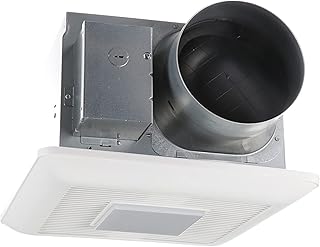
Panasonic WhisperCeiling DC FV-1115VQL1
The DC motor is the reason to spend here: it holds its rated airflow against real-world duct resistance instead of collapsing in a long run, and it does so almost silently. Pick-a-Flow speed selection means one unit covers a powder room or a primary bath, making it the most flexible choice for whole-house consistency.
Panasonic WhisperGreen Select FV-0511VKSL3K
Built for people who want the fan to manage itself, with dual speeds, a 5CCT selectable LED, and a modular bay for condensation or motion sensing. It runs continuously at low speed for background ventilation and steps up when the room needs it, which is the most reliable defense against grout mildew.
Panasonic WhisperFit FV-0511VFL1
The low-profile housing is the hero, dropping into shallow joist bays where a standard fan body simply will not fit. You still get 50/80/110 CFM selection and a dimmable LED, so retrofits do not have to mean a compromise on performance.
130 CFM Humidity-Sensing Exhaust Fan with 5CCT Light
At 130 CFM and 1.0 sone, this is the pick for larger or steam-heavy bathrooms where a 110 CFM unit is working at its limit. The built-in humidity sensor triggers on moisture rather than a timer, and the adjustable mounting brackets simplify placement between joists.
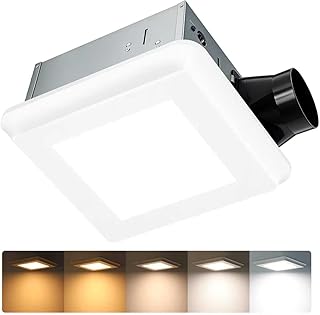
Akicon 80 CFM Square Fan with 3CCT Light and Nightlight
The black square trim is the rare bath fan that reads as a deliberate design choice, pairing well with matte black fixtures and dark grout. At 2.0 sones it is not the quietest here, but the dimmable 3CCT light plus a separate 3.5W nightlight makes it a smart single-fixture solution for a guest bath.
Frequently Asked Questions
What size fan do I need for my bathroom?
Multiply length by width for rooms up to 100 sq ft and use that number as your CFM minimum, never going below 50 CFM. Larger or enclosed layouts benefit from a 110 to 130 CFM unit, or a selectable model you can dial in after installation.
Can a fan and light combo be installed over the shower?
Only if the unit is wet-rated and connected to a GFCI-protected circuit, which the 100 CFM round wet-rated model and most Panasonic units support. Always confirm the specific listing before placing a fixture inside a shower enclosure.
How long should the fan run after a shower?
Twenty minutes past the end of the shower is the working benchmark for clearing residual humidity from walls and ceilings. A humidity-sensing or timer-equipped fan handles this automatically, which is why sensor models outperform manual switches in practice.
Can I replace an old fan without attic access?
Often yes, if you choose a housing designed for retrofit and can reuse the existing duct and wiring from below. Shallow-profile units like the WhisperFit are built for exactly this scenario, though electrical work should be verified against local code.
Final Thoughts
For most homes, the Panasonic WhisperCeiling DC FV-1115VQL1 is the safest investment, delivering quiet, duct-tolerant airflow that holds up over years of daily use. Step up to the WhisperGreen Select if you want sensor-driven automation and tunable light color, or choose the Akicon square model when the ceiling detail matters as much as the ventilation.