Key takeaways
- Wet vs. damp rating: Damp-rated fans belong under a fully covered ceiling with generous overhangs. If rain blows sideways onto your porch or the fan sits near an open edge, insist on a wet-rated, IP65-sealed housing — it is the single spec that most often gets ignored and most often causes failure.
- Blade span to porch footprint: Rooms up to about 100 square feet do well with 20–30 inches of sweep; 100–225 square feet suits 44–52 inches. Leave at least 18 inches between blade tips and any railing, post, or wall so airflow is not choked.
- Motor type: DC and BLDC motors draw markedly less power, run quieter, and offer six speeds instead of three. On a porch where you are trying to hear conversation over cicadas, the noise floor matters more than raw wattage.
- Mounting and clearance: Keep blades at least seven feet above the deck. Sloped porch ceilings need an angled canopy and a downrod; low ceilings need a flush or standard mount. Plug-in caged fans skip the junction box entirely — useful for pergolas and leases.
- Lighting strategy: Integrated LEDs simplify wiring, but if you already have sconces or string lights, a no-light fan gives cleaner lines and one less component to weather.
What's inside
Porches sit in an awkward middle ground. They are outdoors enough to collect humidity, pollen, and wind-driven rain, but sheltered enough that air goes stagnant on a still August evening. Most shoppers discover the mismatch after the fact: an indoor-rated fan starts to rust at the blade collars, or a 52-inch sweep gets ordered for a nine-foot-deep balcony where it has nowhere to hang. The listing photos rarely tell you which problem you are buying into.
This guide sorts porch fans by the two things that actually determine whether one survives and performs — moisture rating and mounting reality. We cover full-size wet and damp-rated models for covered verandas and deep wraparound porches, plus compact plug-in caged fans built for pergolas, canopies, and rentals where hardwiring is off the table. Below are the models worth shortlisting in 2026, followed by the specs that separate a five-year fan from a one-season one.
As an Amazon Associate we earn from qualifying purchases.


How to Choose a Ceiling Fan For Porch (2026)
- Wet vs. damp rating: Damp-rated fans belong under a fully covered ceiling with generous overhangs. If rain blows sideways onto your porch or the fan sits near an open edge, insist on a wet-rated, IP65-sealed housing — it is the single spec that most often gets ignored and most often causes failure.
- Blade span to porch footprint: Rooms up to about 100 square feet do well with 20–30 inches of sweep; 100–225 square feet suits 44–52 inches. Leave at least 18 inches between blade tips and any railing, post, or wall so airflow is not choked.
- Motor type: DC and BLDC motors draw markedly less power, run quieter, and offer six speeds instead of three. On a porch where you are trying to hear conversation over cicadas, the noise floor matters more than raw wattage.
- Mounting and clearance: Keep blades at least seven feet above the deck. Sloped porch ceilings need an angled canopy and a downrod; low ceilings need a flush or standard mount. Plug-in caged fans skip the junction box entirely — useful for pergolas and leases.
- Lighting strategy: Integrated LEDs simplify wiring, but if you already have sconces or string lights, a no-light fan gives cleaner lines and one less component to weather.
The Best Ceiling Fan For Porch (2026)s Reviewed
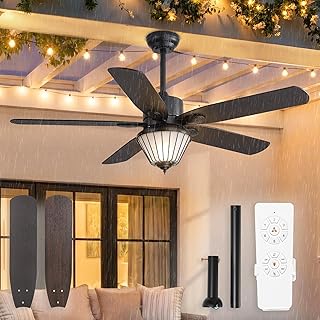
52″ IP65 Waterproof Outdoor Ceiling Fan with Lights, Black
This is the most complete package here: a wet-rated IP65 housing, reversible DC motor with six speeds, remote, and dual-finish blades that read farmhouse without looking costumed. It is the right answer for exposed porches and gazebos where the fan will genuinely get wet.
52″ Solid Wood Outdoor Ceiling Fan, No Light, Dark Walnut
A three-blade propeller with a high-CFM BLDC motor moves serious air while staying remarkably quiet, and the dark walnut finish flatters cedar ceilings and painted beadboard alike. Damp rated, so keep it under solid cover.
ABZ 52″ Solid Wood Ceiling Fan, Walnut
Water-resistant and light-free, this one leans further into furniture territory — the wood grain and slim profile make it a rare fan that works on a screened porch and again in a bedroom. Remote control is included, which is welcome given there is no pull-chain fussing over a light kit.
Hunter Cassius 44″ Matte Black
Hunter’s Cassius is the pragmatist’s pick: a 44-inch damp-rated fan with pull-chain control, a standard mount, and a matte black finish that hides pollen and dust between cleanings. No remote, no app, no light — just a well-built motor from a brand with a long warranty record, sized for smaller porches and garages.
Orison 24″ Caged Plug-In Gazebo Fan
A weatherproof caged fan that hangs from a hook and plugs into an outlet, with app and remote control plus 3CCT dimmable light. For pergolas, canopies, and rented balconies, it delivers real breeze and ambient light without touching the wiring.
Frequently Asked Questions
Do I need a wet-rated fan on a covered porch?
If your porch is deep, fully roofed, and the fan stays dry in a storm, damp rated is sufficient. Near open edges, coastal air, or anywhere rain reaches the ceiling, choose wet rated.
Can a porch fan run on a standard outlet?
Yes — caged plug-in models like the addlon 20″ and Orison 24″ hang from a hook and use a normal exterior outlet, which makes them ideal for pergolas and rentals.
Which direction should the blades turn in summer?
Counterclockwise, pushing air down for a direct cooling breeze. Reversible DC models let you flip to clockwise in cooler months to gently circulate warm air on enclosed porches.
How much maintenance do outdoor fans need?
Wipe blades and the motor housing two or three times a season to clear pollen and salt film, and check the downrod set screws once a year. Sealed DC motors need no lubrication.
Final Thoughts
For an exposed porch, the 52″ IP65 waterproof fan with lights is the safest long-term investment thanks to its wet rating and DC motor. If your ceiling is fully covered and you want the fan to look like part of the architecture, the 52″ solid wood BLDC model in dark walnut is the more refined choice — and for pergolas or rentals, the addlon 20″ caged plug-in solves the problem without a single wire.