Key takeaways
- Material and breathability: Woven polypropylene, often labeled plastic straw, is the standard for good reason. It sheds water instead of absorbing it, rinses clean with a hose, and its open weave lets grass breathe underneath rather than yellowing it over a long stay.
- Size relative to your setup: Measure your awning span before anything else. A 5×8 handles a two-chair vignette, a 9×12 covers a typical RV patio zone, and 9×18 is for full outdoor rooms with a table and seating. Compact 4×6 mats, like the popular blue and white plastic straw option, work well as an entry pad at the door.
- Reversible pattern: Two-sided designs are not just a value add. Flipping the rug hides accumulated wear, evens out UV fading, and gives you a second palette when a site’s surroundings call for something quieter.
- Packability and stakes: Look for a carrying bag and corner grommets or included stakes. A rug that folds tight and anchors properly is one you will actually bring; a bulky one stays in the garage.
- UV resistance: Sun does more damage than rain. UV-stabilized fibers hold color through repeated seasons, which matters if your rug lives outdoors for months rather than weekends.
What's inside
Anyone who has spent a weekend at a campsite knows the transition zone is the hardest part of outdoor living to solve. The tent is handled. The chairs are handled. But the ground between them — that shifting mix of dust, pine needles, damp grass and tracked-in sand — quietly undoes everything else. A camping rug is the piece that draws a boundary, turning an anonymous patch of dirt into a room with edges. It is the outdoor equivalent of defining a living space with a large area rug, just built to survive weather that would destroy anything woven from wool.
This guide looks at outdoor camping rugs the way we look at any furnishing: material honesty, proportion, how it wears over a season, and whether it earns the space it takes up in your vehicle. Below are the models worth considering in 2026, spanning compact 4×6 pads for a single chair setup up to 9×18 mats that cover a full RV awning footprint. We cover the specs that matter, the ones that do not, and which rug suits which kind of camper.
As an Amazon Associate we earn from qualifying purchases.


How to Choose an Outdoor Camping Rug (2026)
- Material and breathability: Woven polypropylene, often labeled plastic straw, is the standard for good reason. It sheds water instead of absorbing it, rinses clean with a hose, and its open weave lets grass breathe underneath rather than yellowing it over a long stay.
- Size relative to your setup: Measure your awning span before anything else. A 5×8 handles a two-chair vignette, a 9×12 covers a typical RV patio zone, and 9×18 is for full outdoor rooms with a table and seating. Compact 4×6 mats, like the popular blue and white plastic straw option, work well as an entry pad at the door.
- Reversible pattern: Two-sided designs are not just a value add. Flipping the rug hides accumulated wear, evens out UV fading, and gives you a second palette when a site’s surroundings call for something quieter.
- Packability and stakes: Look for a carrying bag and corner grommets or included stakes. A rug that folds tight and anchors properly is one you will actually bring; a bulky one stays in the garage.
- UV resistance: Sun does more damage than rain. UV-stabilized fibers hold color through repeated seasons, which matters if your rug lives outdoors for months rather than weekends.
The Best Outdoor Camping Rugs (2026), Reviewed
MontVoo Reversible Outdoor Rug, 5×8
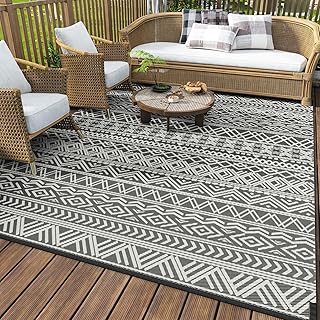
A restrained boho grey that reads as intentional rather than campsite-generic, and the reversible plastic straw weave keeps it looking presentable after a wet weekend. The 5×8 footprint is our default recommendation for tent campers and small balconies alike.
Pauwer Waterproof Outdoor Rug, 5×8
The leaf brown colorway is the most forgiving option here, hiding dust in a way lighter mats cannot, and the UV-resistant construction holds its tone through a full summer of exposure. Genuinely comfortable indoors too, which makes it easy to justify off-season.
fifame 9×18 Outdoor Patio Mat
This is the large-format choice, sized to define an entire outdoor room under an RV awning rather than just a seating pocket. The woven plastic construction stays flat and rinses down quickly, though at this scale you will want stakes at every corner.
9×12 RV Outdoor Rug with Carrying Bag
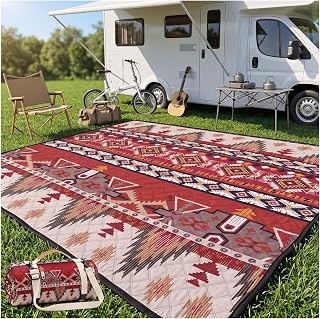
The included bag is the detail that matters: it turns a large mat into something you unpack without dread. Waterproof, quick to sweep, and well proportioned for the standard RV patio zone.
Waterproof Picnic Blanket and Camping Mat
Not a rug in the architectural sense, but the extra-large sandproof mat folds to almost nothing and lives permanently in a trunk. Best as a companion to a proper woven rug rather than a replacement.
Frequently Asked Questions
Will an outdoor camping rug kill the grass underneath?
Open-weave polypropylene rugs let light and air through, so short stays are fine. For anything beyond a week, lift and move the rug periodically.
How do you clean one?
Shake it out, sweep or hose it down, then hang it to dry before folding. Skip pressure washers, which can loosen the weave.
Can these be used on a deck or patio year-round?
Yes, provided the fibers are UV stabilized. Lift the rug occasionally so trapped moisture does not mark wood or composite decking.
Are reversible rugs worth paying more for?
Usually. You effectively get two design options and double the wear surface, which extends the useful life of the rug considerably.
Final Thoughts
For most campers, the MontVoo 5×8 is the right balance of scale, looks and durability, while the Pauwer leaf brown is the smarter pick if your site is dusty or your rug lives outside for months. Step up to the fifame 9×18 only if you are furnishing a full outdoor room and want the ground plane to match that ambition.