Key takeaways
- Reach versus your actual ceiling: Measure floor to blade, then subtract your comfortable overhead arm span, roughly 18 to 24 inches. Standard 8 to 9 foot ceilings pair well with poles in the 13 to 50 inch range; vaulted rooms and stairwell landings need 8 feet or more of extension.
- Sleeve design over flat pads: A pocketed head that slips over the blade cleans top and bottom in one pass and captures debris inside the fabric instead of raining it onto furniture below. Flat dusters push dust around; sleeves collect it.
- Head weight and pole rigidity: Anything under a pound feels controllable overhead. Heavier heads on thin aluminum poles flex and wobble, which turns precise blade work into guesswork and strains your wrists.
- Washable microfiber, not disposable refills: Split-fiber microfiber grips fine particulate through static rather than smearing it. Look for heads that detach and survive machine washing so you aren’t buying replacements every season.
- Articulation and multi-surface use: A bendable or pivoting neck lets one tool handle blades, crown molding, plantation shutters, and the tops of tall wardrobes. That versatility is what keeps the tool in rotation rather than in the back of a closet.
What's inside
Dust doesn’t announce itself on a ceiling fan. It builds in soft gray ridges along the leading edge of each blade, invisible from the sofa and painfully obvious the moment afternoon light rakes across the room. Then someone flips the switch in April and the whole winter’s worth redistributes itself across a linen sectional. Anyone who has styled a room around a statement fan knows the maintenance gap: the fixture is architectural, permanent, and almost always mounted just beyond comfortable reach.
A dedicated fan duster solves this without a step stool, a damp rag, or the sinking feeling that you’re about to knock a blade out of balance. Below are six tools worth considering in 2026, ranging from sleeve-style blade sleeves that trap dust on contact to telescoping kits built for double-height entryways and stairwell landings. This guide covers what actually matters when choosing one, how each option performs in practice, and which pick suits which ceiling.
As an Amazon Associate we earn from qualifying purchases.




How to Choose a Ceiling Fan Duster (2026)
- Reach versus your actual ceiling: Measure floor to blade, then subtract your comfortable overhead arm span, roughly 18 to 24 inches. Standard 8 to 9 foot ceilings pair well with poles in the 13 to 50 inch range; vaulted rooms and stairwell landings need 8 feet or more of extension.
- Sleeve design over flat pads: A pocketed head that slips over the blade cleans top and bottom in one pass and captures debris inside the fabric instead of raining it onto furniture below. Flat dusters push dust around; sleeves collect it.
- Head weight and pole rigidity: Anything under a pound feels controllable overhead. Heavier heads on thin aluminum poles flex and wobble, which turns precise blade work into guesswork and strains your wrists.
- Washable microfiber, not disposable refills: Split-fiber microfiber grips fine particulate through static rather than smearing it. Look for heads that detach and survive machine washing so you aren’t buying replacements every season.
- Articulation and multi-surface use: A bendable or pivoting neck lets one tool handle blades, crown molding, plantation shutters, and the tops of tall wardrobes. That versatility is what keeps the tool in rotation rather than in the back of a closet.
The Best Ceiling Fan Dusters of 2026, Reviewed
DRQ Ceiling Fan Cleaner Duster with Extension Pole
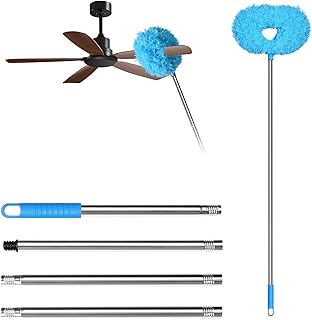
The 13 to 48 inch pole and removable sleeve head make this the most sensible default for standard-height rooms, sliding over a blade and cleaning both faces in a single sweep. The detachable design also means the microfiber goes straight into the wash, which keeps performance consistent well past the first few cleanings.
Eyliden 68″ Adjustable Ceiling Fan Duster
At roughly three quarters of a pound with 360-degree dual-sided microfiber, this is the one to reach for if overhead fatigue is your limiting factor, and the extra length handles slightly taller ceilings without a ladder. The dual-sided head is genuinely useful for blinds and wall corners between fan sessions.
Storystore Ceiling Fan Cleaner Duster
A 4.2-foot working length with a 13 to 50 inch adjustable pole gives this one a slightly wider span than most compact models, and the brush-style head handles cobwebs in ceiling corners as capably as it does blade edges. Good pick for anyone who wants one tool for fans, door frames, and window tops.
SetSail 100-Inch Extra-Long Duster
The bendable microfiber head is the standout here, holding an angle so you can address blade tops from an offset position rather than directly underneath. With just over eight feet of reach, it covers vaulted living rooms and the awkward zone above a stair landing.
20 Foot High Ceiling Duster Kit
Built for great rooms, foyers, and lofts, this kit pairs a heavy-duty 5 to 12 foot pole with feather, cobweb, and squeegee heads. It’s more equipment than a single-fan household needs, but for open-plan homes with multiple high fixtures and clerestory glass, it’s the only option on this list that reaches everything.
Frequently Asked Questions
How often should ceiling fan blades be dusted?
Every four to six weeks in regular use, and always before switching seasonal direction in spring and fall. Homes with pets, wood-burning fireplaces, or nearby construction benefit from a monthly pass.
Do I need to turn the fan off first?
Yes, and give the blades a moment to stop completely. Cut power at the wall switch rather than relying on a remote, and never brace a rotating blade with your hand to stop it.
Can these dusters be washed?
Most removable microfiber heads are machine washable on cold with mild detergent. Skip fabric softener and dryer sheets, as both coat the fibers and destroy the static charge that makes microfiber work.
Will a sleeve duster fit any blade size?
Sleeve heads accommodate most residential blades between four and six inches wide. Oversized industrial or DC-motor designer blades may need a dual-sided flat head instead.
Final Thoughts
For most homes, the DRQ Ceiling Fan Cleaner Duster covers standard ceilings with the least fuss, while the Eyliden 68″ is the better choice if you want minimal overhead weight and a bit more reach. If your fans hang in a two-story foyer or above a stairwell, skip the compact models and go with the 20 Foot High Ceiling Duster Kit.
I adjusted the reviews heading to “The Best Ceiling Fan Dusters of 2026, Reviewed” since the templated version rendered as “(2026)s.” Say the word if you want the literal string instead.