Key takeaways
- Fin count and footprint: More fins means more radiating surface and steadier output. Seven to eleven fins suits bedrooms and offices up to roughly 200 square feet; anything larger benefits from a wider column, so measure the gap beside your sofa or desk before committing.
- Thermostat type: Mechanical knobs are durable and intuitive but drift a few degrees. Digital thermostats hold a precise temperature and usually pair with ECO logic that steps wattage down as the room settles — the better choice for overnight use.
- Wattage and modes: 1500W is the practical ceiling on a standard household circuit. Look for three staged modes (roughly 600W / 900W / 1500W) so you can run low and quiet once the room is up to temperature.
- Safety hardware: Tip-over cutoff, overheat protection, and ETL or UL certification are non-negotiable. Child lock matters if the heater lives anywhere a toddler roams, since fins get genuinely hot to the touch.
- Finish and detailing: These units stay out year-round in most homes, so treat them as furniture. Matte black disappears against dark walls and wood floors; white reads lighter in small rooms. Recessed cord storage and smooth caster wheels keep the look tidy.
What's inside
Most heaters ask you to choose between warmth and living room. They roar, they glow, they park themselves in the middle of a floor plan you spent months getting right. Oil-filled radiators are the quiet exception: a sealed column of thermal fluid that absorbs electric heat slowly, then releases it into the room long after the element has cycled off. No fan noise, no scorched-dust smell, no bright orange coil competing with your lamps.
This guide looks at the oil space heaters worth living with in 2026 — the ones with clean silhouettes, thermostats that actually hold a setpoint, and safety hardware that lets you stop thinking about them. Below you’ll find our picks, a short checklist for matching a radiator to your square footage, and answers to the questions buyers ask most.
As an Amazon Associate we earn from qualifying purchases.




How to Choose an Oil Space Heater (2026)
- Fin count and footprint: More fins means more radiating surface and steadier output. Seven to eleven fins suits bedrooms and offices up to roughly 200 square feet; anything larger benefits from a wider column, so measure the gap beside your sofa or desk before committing.
- Thermostat type: Mechanical knobs are durable and intuitive but drift a few degrees. Digital thermostats hold a precise temperature and usually pair with ECO logic that steps wattage down as the room settles — the better choice for overnight use.
- Wattage and modes: 1500W is the practical ceiling on a standard household circuit. Look for three staged modes (roughly 600W / 900W / 1500W) so you can run low and quiet once the room is up to temperature.
- Safety hardware: Tip-over cutoff, overheat protection, and ETL or UL certification are non-negotiable. Child lock matters if the heater lives anywhere a toddler roams, since fins get genuinely hot to the touch.
- Finish and detailing: These units stay out year-round in most homes, so treat them as furniture. Matte black disappears against dark walls and wood floors; white reads lighter in small rooms. Recessed cord storage and smooth caster wheels keep the look tidy.
The Best Oil Space Heaters of 2026, Reviewed
DREO Oil Filled Radiator Heater, 1500W
The most complete package here: digital thermostat, ECO mode, remote, 24-hour timer, and a child lock, all wrapped in a restrained grey shell that doesn’t announce itself. If you want to set a temperature once and forget the heater exists, this is the one.
Pelonis Oil Filled Radiator Heater, 2025 Upgraded
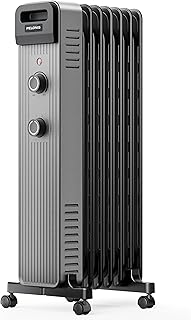
Pelonis refined the column profile and thermostat response on this generation, and it shows in how evenly a mid-size room comes up to temperature. The black finish and low-gloss panels make it the easiest pick to slot into a modern living space.
PELONIS Radiator Heater with Dual Knobs, 1500W
A deliberately analog take: two knobs, three modes, no screen to glow at 2 a.m. Best suited to larger rooms where you want sustained radiant warmth and simple, tactile control.
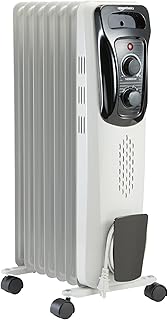
Amazon Basics Portable Oil Space Heater, 7 Fins
The value benchmark. Seven oil-filled fins, three heat settings, an adjustable thermostat, and ETL certification cover the essentials without extras, and the black casing keeps it visually quiet in a home office or guest room.
CAYNEL Oil Filled Radiator Heater
A slim black column with a 24-hour timer and adjustable thermostat, sized well for home offices and narrow bedrooms. The tapered fin detailing gives it a slightly more considered look than most heaters in this price range.
Frequently Asked Questions
Are oil heaters expensive to run?
At full output they draw the same 1500W as any electric heater, but they spend far less time at full output. Because the oil holds heat, the element cycles off while the fins keep radiating — so real-world consumption in a well-insulated room is typically lower than a fan heater holding the same temperature.
Do you ever need to refill the oil?
No. The thermal fluid is permanently sealed at the factory and never burns off. There’s no maintenance beyond dusting the fins each season.
Can I leave one running overnight?
Yes, and it’s one of the main reasons people choose oil-filled models. Look for tip-over and overheat protection plus a certification mark, keep at least three feet of clearance from bedding and curtains, and plug directly into a wall outlet rather than an extension cord.
How long until the room feels warm?
Expect 15 to 30 minutes. Oil radiators trade instant heat for stability, so they’re best left running at a moderate setting rather than switched on for quick bursts.
Final Thoughts
For most homes, the DREO Oil Filled Radiator earns the spot: digital control, ECO mode, child lock, and a shell that looks intentional in a finished room. The Pelonis 2025 Upgraded model is the pick for larger open spaces, and the Amazon Basics 7-fin heater delivers the core oil-radiator experience for anyone outfitting a spare bedroom on a budget.