Key takeaways
- Check swivel range, memory return and locking separately before buying bar stools. Use a mechanism worksheet and a practical showroom comparison.
What's inside
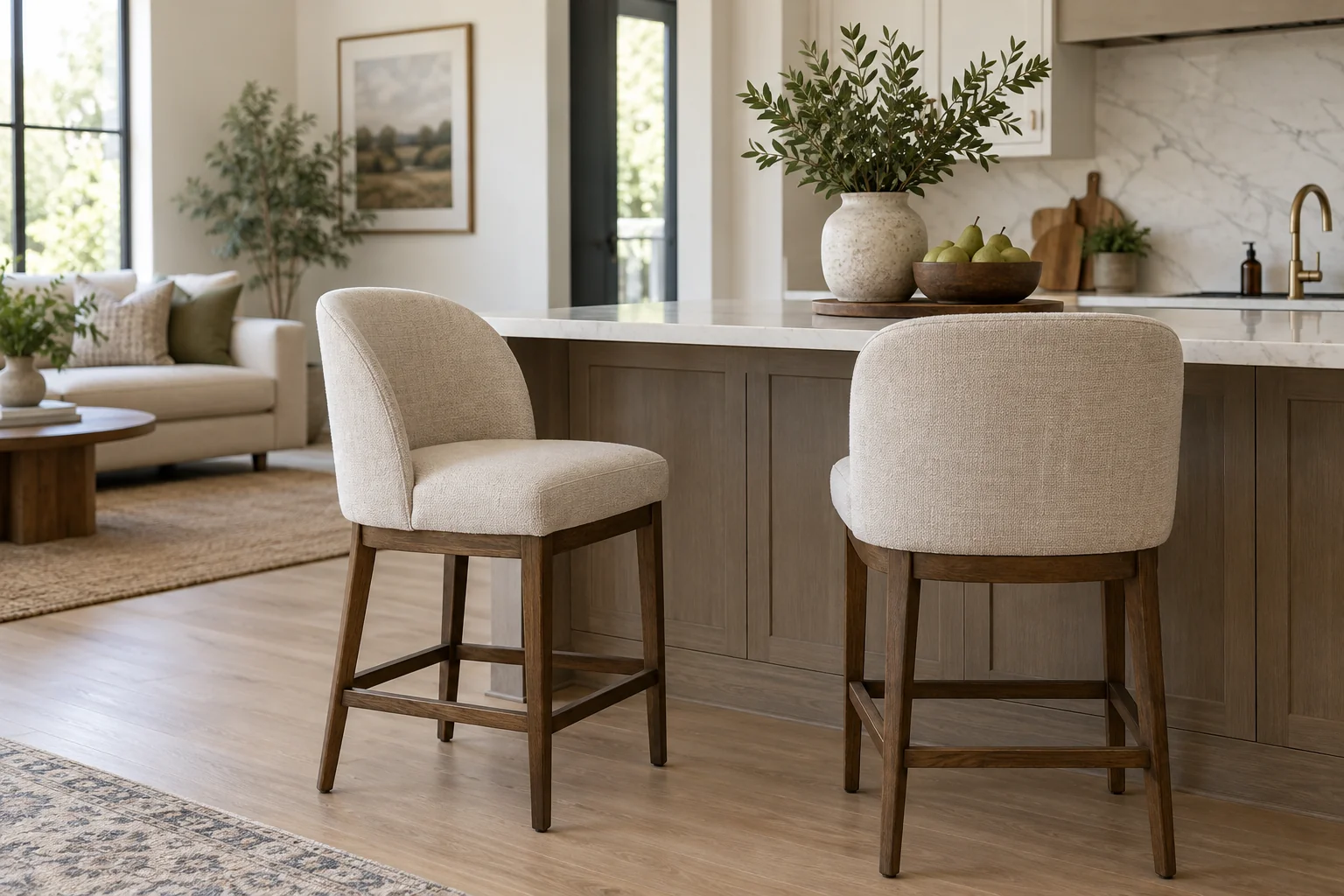
A swivel-return stool is designed to return toward a resting orientation after turning, but the exact range and behavior depend on its mechanism. Do not assume that “swivel,” “memory return” and “locking swivel” describe the same function. Verify the movement of the exact model before ordering a set.
The useful comparison covers how the seat turns, where it stops, how it returns and whether that behavior suits the intended counter. It does not require adjusting bolts or replacing a swivel plate to experiment with a mechanism.
Separate three questions about movement
First ask about rotation range: how far is the seat designed to turn? Second ask about return: does it remain where placed or return toward a defined orientation? Third ask about locking: does the manufacturer explicitly provide a way to secure a position? An answer to one question does not answer the others.
For a documented example, Amisco’s Duncan stool specifies a 180-degree swivel with memory return. That description identifies both a range and a return feature for that product. It should not be generalized to every Amisco stool or every item described simply as swiveling.
If a listing is ambiguous, obtain the current specification and operating or assembly instructions. An image of a turned seat cannot show whether it stays in that position, returns automatically or has a limited range.
Make a mechanism comparison card
| Question | Evidence to record | What not to infer |
|---|---|---|
| Exact version? | Model, height and base option | Every stool in the collection is identical |
| Rotation range? | Manufacturer’s stated range | All swivels turn continuously |
| Return behavior? | Documented resting orientation | Return means a locked seat |
| Position control? | Any actual lock or adjustment specified | Hardware may be tightened to create one |
| Ordinary operation? | Instructions and showroom demonstration | A photograph establishes the feel |
| Service route? | Model-specific support information | A universal replacement plate will fit |
Record unclear details as questions. “Ask whether the seat returns when unoccupied” is more useful than writing “probably spring loaded” based on what another stool did. Keep the seller’s answer with the order confirmation.
Observe a demonstration of the exact model
Ask the showroom to demonstrate normal movement on a correctly assembled stool. Follow the manufacturer’s intended-use instructions during any seated trial. Observe the return without forcing the seat beyond its designed range or putting fingers near the mechanism.
Notice whether the movement suits how you approach the counter and turn toward the room. A demonstration can inform your preference, but it is not a durability test or a guarantee of suitability for every user. Avoid assigning safety conclusions from the stool’s weight or a single smooth movement.
Ask whether the displayed stool uses the same height, base and mechanism as the version being ordered. A counter-height and bar-height option may look similar in a photograph. Keep each selected product code separate rather than copying a showroom observation across the collection.
Worked example: a turning seat is not a parking position
Imagine a buyer who wants to leave a stool turned toward a breakfast nook between meals. One hypothetical candidate rotates and remains where positioned. Another is documented to return toward the counter after use. Both can turn, but they answer that preference differently.
The comparison card records “stays in selected orientation” for the first only if the manufacturer confirms it, and “returns to resting orientation” for the second. The buyer does not assume the second has a lock that can defeat its return or plan to hold it sideways with another piece of furniture.
A different household may prefer the return behavior because it restores the intended orientation. Neither preference proves a general superiority. This example concerns a clearly stated use requirement, not a claim about tip resistance or child suitability.
Check the room while the seat is turned
Record the outermost positions of the seat, back and arms during permitted movement. Compare those positions with the counter edge, nearby stools and passage. Use the actual dimensions or a showroom measurement with permission; a rotation angle alone does not describe the occupied floor space.
Keep height and reach separate from the mechanism decision. A return feature does not make the seat height appropriate for the counter, and it does not establish that the footrest works for the intended user. Consider these ordinary fit questions on the same visit without reducing them to a universal clearance number.
Do not tune the mechanism by guesswork
Do not tighten mounting bolts to add friction unless the exact product instructions explicitly prescribe an adjustment. Hardware that attaches a mechanism has a different job from a documented movement control. Likewise, do not replace a return swivel with a fixed mount based only on apparent hole spacing.
If a delivered stool binds, wobbles, fails to return as described or produces a new unusual movement, stop using it and contact the supplier with the model and assembly record. Describe what changed instead of dismantling the assembly to find the cause.
Keep the final card with the instructions: ordered version, stated movement, observed normal behavior and service contact. That small record makes it easier to order matching stools later and prevents the word swivel from standing in for several different mechanical features.