Key takeaways
- Compare ceramic and sintered dining table tops by surface, backing, thickness and care instructions using a complete-build worksheet.
What's inside
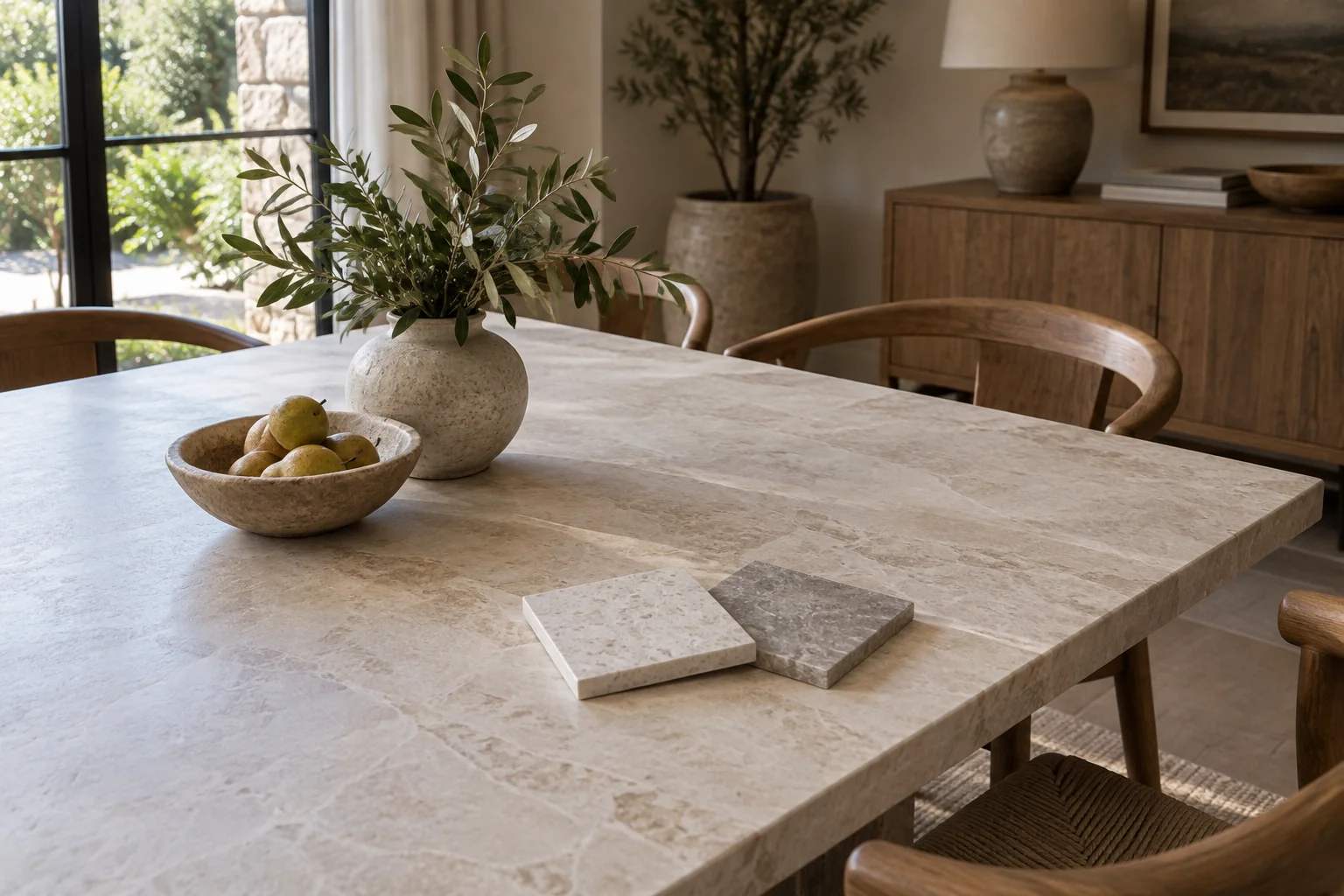
Compare ceramic and sintered-stone dining tables by the complete tabletop specification, not by the material name alone. Identify the surface product, any supporting layer, the finished edge and the table maker’s care instructions. Two tops with similar stone-look photographs can have different construction.
This comparison is a buying worksheet, not a ranking of entire material categories. It helps you obtain enough information to compare two actual tables without assuming that a surface marketing claim describes every part of the assembled furniture.
Separate the visible surface from the whole top
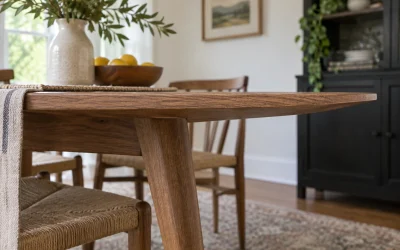
Ask whether the top is a single slab or a layered assembly, and what the seller means by its stated thickness. A number may describe the upper surface, the combined layers or the visible edge. Save a section drawing when the manufacturer provides one.
Riflessi’s Paradise table page describes a ceramic option layered on glass. This is a specific construction example: the word ceramic does not necessarily describe an unsupported slab of that material alone.
Neolith describes its sintered surface as a manufactured material formed using heat and pressure from mineral ingredients. That description helps identify the product family. It does not supply the construction, support or care specification of every dining table using a sintered surface.
Ask for the exact surface and finish code
Record the table model, size and selected top option. A collection may offer glass, ceramic and wood versions, or multiple surface finishes with different care requirements. A shared photograph of the base is not evidence that all options use the same top build.
Keep the surface maker’s name and code when available, alongside the furniture maker’s specification. If the listing gives only “marble effect,” ask what the material actually is. A pattern name describes appearance; it does not distinguish natural marble, a manufactured slab or a decorative surface over another core.
| Comparison field | Table A | Table B |
|---|---|---|
| Exact top option | Model, finish and product code | Model, finish and product code |
| Surface material | Manufacturer’s wording | Manufacturer’s wording |
| Supporting layer | Type or confirmed absence | Type or confirmed absence |
| Thickness description | Surface, total build and edge separately | Surface, total build and edge separately |
| Support and attachment | Complete-table instructions | Complete-table instructions |
| Care and service | Exact finish guidance and contact | Exact finish guidance and contact |
Compare instructions before comparing adjectives
Terms such as heat resistant, scratch resistant and stain resistant need a defined scope. Ask whether the statement concerns a material sample, a particular finish or the complete table. A supplier may have useful technical data, but its meaning depends on the stated method and application.
Do not turn resistance into permission to cut directly on the table, set down hot cookware or strike an edge. Use the furniture maker’s directions for mats, cleaning and handling. If those directions differ from general advice for the surface material, ask the table maker to resolve the conflict for the assembled product.
Separate routine care from damage assessment. An approved cleaner for a mark is not necessarily a repair for a chipped edge or a separation between layers. Obtain the appropriate service route rather than experimenting with polish, filler or adhesive on an expensive new top.
Worked example: a thickness comparison with missing information
Imagine two hypothetical listings. Table A identifies a 12 mm combined top made from two specified layers. Table B advertises a 12 mm sintered surface but says nothing about backing or the finished assembly. Both show a thin edge in their photographs.
The worksheet records A’s combined build and B’s stated surface thickness in different fields. It does not declare them identical or assume B has no backing. The buyer asks B’s seller for a section drawing and the total assembled-top specification before comparing delivery weight and handling requirements.
Once the missing information arrives, the buyer can compare the actual products. The shared 12 mm number was useful only after its meaning was established. This example is illustrative and makes no claim that one layer arrangement is stronger than another.
Evaluate the edge and sample without destructive tests
Inspect a showroom example or an approved sample for color, sheen, texture and edge appearance. Note whether the sample shows the finished edge or only the upper surface. View it beside the room’s existing materials in ordinary light when possible.
A small sample cannot demonstrate the behavior of a full supported tabletop. Do not scratch it with keys, heat it with cookware or apply household chemicals as a substitute for documentation. Keep your observations limited to what you actually saw and felt.
Finish with complete-table ownership questions
Confirm the delivery arrangement, assembled dimensions and manufacturer handling instructions. Ask which component a replacement or service request would cover if the top is damaged. For an extending design, obtain instructions for both the main top and its leaves rather than assuming identical construction.
Your final decision should name the exact top option and the evidence behind it: documented build, acceptable appearance, practical care and suitable complete-table dimensions. Choosing from that record is more reliable than deciding that every ceramic top or every sintered-stone top belongs above the other in a universal quality ranking.