Key takeaways
- Match BTU to the room’s worst hour: 8,000 BTU comfortably handles 300 to 350 sq ft, but a room with large south or west windows, a vaulted ceiling, or a top-floor position behaves like a space 20 to 30 percent larger. Measure, then round up your assumptions rather than your BTUs.
- Plan the hose before you plan the corner: Every portable unit needs a window vent, and exhaust hoses are typically four to five feet. Position the unit within that radius of a suitable window, and confirm your sash type — most included kits fit single-hung and horizontal sliders, not casement or awning windows.
- Look for genuine dehumidification, not just a mode label: A dry mode that pulls moisture without over-cooling is what makes shoulder seasons and humid basements livable. Self-evaporating designs that recycle condensate into the exhaust stream mean far fewer trips to empty a tray.
- Treat sleep mode and the timer as core features: A 24-hour timer plus a sleep cycle that eases the setpoint and dims the display is the difference between cooling a room and being woken by a compressor at 3 a.m. Check whether the panel light can be turned off entirely.
- Decide how much control you actually want: A remote covers most needs; Wi-Fi and app control earn their keep if you want the room pre-cooled before you get home or prefer voice commands. Both add cost, so choose deliberately rather than defaulting to the smart model.
What's inside
Cooling a single room is one of the last unsolved problems in modern interiors. Central air treats a house as one undifferentiated volume, window units block the light you paid a premium for, and mini-splits mean drilling through exterior walls and negotiating with a landlord or an HOA. Meanwhile the room that actually needs help is usually the one with the most glass, the west-facing exposure, or the desk where you sit for nine hours a day. That mismatch is why the portable AC category keeps growing even as whole-home systems get smarter.
The 8,000 BTU class has become the sweet spot for design-conscious homes: enough capacity for a bedroom, home office, studio, or bonus room up to roughly 350 square feet, without the bulk and noise floor of a 14,000 BTU tower. This guide looks at six current 8,000 BTU units, what separates them in real rooms, and how to read the spec sheets so you buy once. We weigh footprint and finish alongside performance, because a machine that lives in your bedroom is a piece of furniture whether you like it or not.
As an Amazon Associate we earn from qualifying purchases.


How to Choose a/an 8 000 Btu Portable Air Conditioner (2026)
- Match BTU to the room’s worst hour: 8,000 BTU comfortably handles 300 to 350 sq ft, but a room with large south or west windows, a vaulted ceiling, or a top-floor position behaves like a space 20 to 30 percent larger. Measure, then round up your assumptions rather than your BTUs.
- Plan the hose before you plan the corner: Every portable unit needs a window vent, and exhaust hoses are typically four to five feet. Position the unit within that radius of a suitable window, and confirm your sash type — most included kits fit single-hung and horizontal sliders, not casement or awning windows.
- Look for genuine dehumidification, not just a mode label: A dry mode that pulls moisture without over-cooling is what makes shoulder seasons and humid basements livable. Self-evaporating designs that recycle condensate into the exhaust stream mean far fewer trips to empty a tray.
- Treat sleep mode and the timer as core features: A 24-hour timer plus a sleep cycle that eases the setpoint and dims the display is the difference between cooling a room and being woken by a compressor at 3 a.m. Check whether the panel light can be turned off entirely.
- Decide how much control you actually want: A remote covers most needs; Wi-Fi and app control earn their keep if you want the room pre-cooled before you get home or prefer voice commands. Both add cost, so choose deliberately rather than defaulting to the smart model.
The Best 8 000 Btu Portable Air Conditioner (2026)s Reviewed
AKIRES 8,000 BTU Portable Air Conditioner
A well-rounded bedroom choice that bundles cooling, fan, and dehumidifier with a 24-hour timer and a proper sleep mode, so overnight temperature drift stays gentle. The remote and clean front panel keep it visually quiet in a room where you would rather not look at a control cluster.
GarveeLife Smart Compact 8,000 BTU AC
The most compact-feeling unit in this group, with a narrow footprint that tucks beside a nightstand or under a window without dominating the wall. Cooling, dry, and fan modes plus the included window kit make it a straightforward single-room solution for renters.
SereneLife 8,000 BTU Portable Air Conditioner
SereneLife’s standard model is the pragmatist’s pick: three functions, a 24-hour timer, and a window mount kit in the box, with 350 sq ft of rated coverage. Nothing here is flashy, which is exactly why it suits a guest room or home office.
SereneLife 8,000 BTU with Wi-Fi
The same core platform with app control added, worth the step up if you want the room cooled before you walk in or prefer scheduling from your phone rather than a handset. Remote included, so you are not dependent on connectivity.
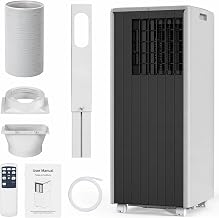
8,000 BTU Portable Air Conditioner in Black
A three-mode unit in a matte black finish, which reads far better than white plastic in darker rooms and modern interiors. The installation kit is included and the setup is genuinely quick, making this the styling-first option in the lineup.
Frequently Asked Questions
Will 8,000 BTU cool an open-plan space?
Not reliably. These units are rated to about 350 sq ft of enclosed space; in an open plan, cool air migrates and the compressor runs continuously. Use it to condition a defined zone, ideally with a doorway or partial partition.
Do I have to empty a water tank?
It depends on humidity. Most modern units are partly self-evaporating and vent moisture through the exhaust, but in very humid conditions or heavy dry-mode use you will need to drain the reservoir or attach a continuous drain hose.
How noisy are they in a bedroom?
Expect a steady 50 to 55 dB, comparable to a window unit but closer to you. Sleep mode reduces fan speed, and placing the unit on a hard floor rather than a hollow platform meaningfully reduces resonance.
Can I skip venting out a window?
No. A portable AC moves heat rather than destroying it, so the exhaust must leave the room. Venting into the same space produces a net temperature increase.
Final Thoughts
For most rooms, the AKIRES 8,000 BTU is the balanced default, with strong overnight behavior and a discreet presence. Choose the GarveeLife if floor space is the binding constraint, or the Wi-Fi SereneLife if you want scheduling and app control built in from day one.