Key takeaways
- Match coverage to your pool, not the box: Manufacturer square-footage ratings assume clean water and a clear floor. Give yourself margin — if your pool is 800 sq ft, a unit rated to 960 sq ft will finish, but one rated to 2,000 sq ft will finish with charge to spare and handle a heavy debris week without a second pass.
- Runtime over raw wattage: A 250-minute battery that cleans slowly often beats a 100-minute sprint. Look for 100 minutes minimum on small round pools, 150 minutes or more if you have a large oval or want wall coverage included in the same cycle.
- Floor-only versus wall climbing: Floor-only units are cheaper, lighter, and fine for pools where you brush the walls yourself. Wall and waterline climbing costs more but keeps that visible ring at the water’s edge from forming — worth it if your pool sits in view of a deck or seating area.
- Filtration you’ll actually clean: Dual-layer or dual-stage baskets catch fine silt that single mesh screens push straight back into the water. Equally important: check that the basket pops out from the top without tools, or you’ll stop emptying it.
- Retrieval and parking: Self-parking brings the robot to the edge when the cycle ends instead of leaving it dead center. Pair that with an included hook and you skip the wet-arm fishing expedition entirely.
What's inside
An above-ground pool is one of the few backyard features that earns its footprint every single summer, but it comes with an unglamorous truth: the water only looks good if someone keeps the floor clean. Skimming handles what floats. What settles — pollen, silt, the fine grit that blows in off the patio — sinks to the liner and dulls the whole surface, turning a crisp blue focal point into something cloudy and neglected. Manual vacuum heads and hose systems technically solve this, but they tether you to a pump, snag on ladder legs, and generally undo the low-maintenance appeal that sold you on an above-ground setup in the first place.
Cordless robotic cleaners have quietly become the sensible answer. Drop one in, let it run, pull it out, rinse the basket. This guide covers what actually separates a capable unit from a novelty: runtime relative to your pool’s square footage, suction strength, filtration quality, and whether the drive system can handle a soft vinyl liner and rounded cove without stalling. Below, the models worth considering in 2026, plus the specs that matter when you compare them.
As an Amazon Associate we earn from qualifying purchases.




How to Choose an Above-Ground Pool Robot Vacuum (2026)
- Match coverage to your pool, not the box: Manufacturer square-footage ratings assume clean water and a clear floor. Give yourself margin — if your pool is 800 sq ft, a unit rated to 960 sq ft will finish, but one rated to 2,000 sq ft will finish with charge to spare and handle a heavy debris week without a second pass.
- Runtime over raw wattage: A 250-minute battery that cleans slowly often beats a 100-minute sprint. Look for 100 minutes minimum on small round pools, 150 minutes or more if you have a large oval or want wall coverage included in the same cycle.
- Floor-only versus wall climbing: Floor-only units are cheaper, lighter, and fine for pools where you brush the walls yourself. Wall and waterline climbing costs more but keeps that visible ring at the water’s edge from forming — worth it if your pool sits in view of a deck or seating area.
- Filtration you’ll actually clean: Dual-layer or dual-stage baskets catch fine silt that single mesh screens push straight back into the water. Equally important: check that the basket pops out from the top without tools, or you’ll stop emptying it.
- Retrieval and parking: Self-parking brings the robot to the edge when the cycle ends instead of leaving it dead center. Pair that with an included hook and you skip the wet-arm fishing expedition entirely.
The Best Above-Ground Pool Robot Vacuums (2026) Reviewed
Cordless Robotic Pool Vacuum with Track Drive & Dual 180W Brushless Motors
The track drive is the differentiator here — continuous treads grip vinyl and fiberglass far more reliably than wheels, which is what makes the wall and waterline climbing believable rather than aspirational. With dual 180W brushless motors, 150 minutes of runtime, and coverage to 2,150 sq ft, it’s the most complete option on this list and the one to pick if you want floor, wall, and waterline handled in a single cycle.
2026 Upgrade Robotic Pool Cleaner, 250-Min Runtime
Two hundred fifty minutes is the longest runtime in this group, and it changes how you use the machine: instead of timing cycles around pool parties, you simply run it overnight. Rated to 2,200 sq ft with self-parking and a matte black shell that disappears against a dark liner, it suits large above-ground and inground pools alike.
SAT20 Cordless Robotic Pool Cleaner
A clean-spec middle option: 180 minutes, 2,000 sq ft, IPX8 sealing, and floor-plus-wall cleaning with a simple LED status indicator instead of an app you’d rather not install. Note the manufacturer’s own caveat — it isn’t built for sharp steps or raised drains, so confirm your pool floor is uninterrupted before ordering.
Cordless Robotic Pool Cleaner, 40W Dual Cleaning System
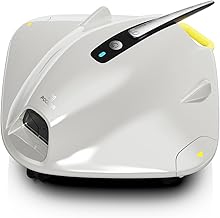
This is the practical mid-size pick, pairing 40W suction with a dual cleaning system and barrier-crossing ability that lets it climb over seams and small obstructions rather than getting pinned against them. At 120 minutes and 1,614 sq ft, it covers most standard round and oval pools, and the grayish-white housing reads as an appliance rather than a pool toy.
Winny Cordless Pool Vacuum Robot
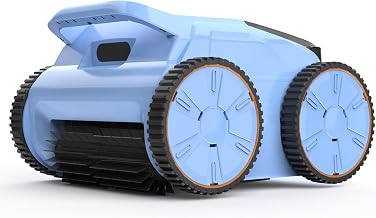
Built for smaller pools and priced accordingly, the Winny covers up to 650 sq ft in 80 minutes with dual-layer filtration that catches finer sediment than its size suggests. Self-parking and an included retrieval hook make the end of each cycle genuinely effortless, and the ocean blue finish is a nice touch if you like your gear to look intentional.
Frequently Asked Questions
Do cordless pool robots work on soft vinyl liners?
Yes, and they’re gentler than manual vacuum heads dragged across the same surface. Every model here is designed for above-ground pools with vinyl liners. Just avoid units with aggressive scrubbing brushes if your liner is aging or patched.
How often should I run it?
Two to three cycles a week during peak season keeps a pool visibly clear. Bump that to daily during pollen season or after a windstorm, and drop to weekly in shoulder months when debris slows down.
Does a robot vacuum replace my filter and chemicals?
No. It handles settled debris so your filter isn’t overloaded and your sanitizer isn’t fighting organic matter. Water chemistry and filtration still do their own jobs.
Why does my robot keep stopping in one spot?
Usually a full basket, a low charge, or a raised drain cover interrupting the drive path. Empty the filter first, then check for obstructions before assuming a fault.
Final Thoughts
For most above-ground pools, the Track Drive model with dual 180W brushless motors is the strongest all-around choice — climbing ability plus 150 minutes of runtime covers nearly every scenario without fuss. If your pool is large or you’d rather run cleaning cycles overnight, the 2026 Upgrade cleaner’s 250-minute battery is the better fit, while the Winny remains the sensible pick for compact pools where a smaller, simpler machine is genuinely enough.