Key takeaways
- Stable bases: A recessed or rubberized underside helps prevent sliding on polished wood, glass and stone tables.
- Usable rims: A low 0.5–1-inch rim contains juices while preserving serving access. Tall rims are more useful for saucy foods than for crackers.
- Comfortable handling: Cutout handles or a gently curved underside are valuable on platters longer than 16 inches.
- Stacking design: Nested pieces should leave enough clearance that rims do not scrape one another. Felt or silicone separators can protect decorative finishes.
- Clear care instructions: “Food-safe” does not automatically mean oven-safe, microwave-safe or dishwasher-safe.
Best Appetizer Serving Platter Sets for Easy Entertaining
The best appetizer serving platter set is the one whose shapes match your menu, whose total footprint fits your table, and whose material can handle the way you host—not simply the set with the most pieces.
For most homes, a coordinated set of three platters in different sizes is the most useful configuration: one large platter for sandwiches or roasted vegetables, one medium platter for cheese and fruit, and one smaller dish for dips or nuts. If you mainly serve bite-sized foods, a set of individual plates or divided trays may work better than one oversized serving board.
Our top picks



As an Amazon Associate we earn from qualifying purchases at no extra cost to you. Ratings are shown as listed on Amazon.
Compare the Main Platter Shapes
| Shape | Useful dimensions | Best for | Space consideration |
|---|---|---|---|
| Rectangular | 12–18 in. long by 5–8 in. wide | Sandwiches, crostini, skewers, crackers and sliced vegetables | Uses table length efficiently and can sit along a centerpiece |
| Round | 12–16 in. diameter | Cheese, fruit, pastries and foods guests reach for from all sides | Needs roughly 18–22 in. of table width including hand clearance |
| Oval | 14–20 in. long by 8–11 in. wide | Roasted appetizers, whole baked brie and family-style snacks | Offers generous capacity without the sharp corners of a rectangle |
| Square | 10–14 in. per side | Small groups of coordinated appetizers and modern table settings | Stacks and groups neatly, but corners occupy more usable space |
| Divided tray | 12–15 in. long by 8–12 in. wide | Crudités, snacks, sauces and foods that should not touch | More efficient than separate bowls, but fixed compartments limit flexibility |
Choose rectangular platters for linear menus
A rectangular set is usually the safest choice when your menu includes foods arranged in rows: pinwheels, tea sandwiches, spring rolls, asparagus, or crostini. A narrow 14-by-6-inch platter can share a crowded dining table with glasses and plates. Look for gently raised edges of about 0.5 to 1 inch; they help contain crumbs and sauces without making the piece difficult to serve from.
Choose round or oval platters for communal grazing
Round platters make sense when guests will approach from several directions. They are particularly useful for cheese, grapes, cookies, and other foods that do not need a strict arrangement. An oval platter offers similar visual softness while taking less width than a large round piece. For a table that is only 30–36 inches wide, an oval platter around 16 by 9 inches is often easier to place than a 16-inch round one.
Choose divided sets only for repeatable menus
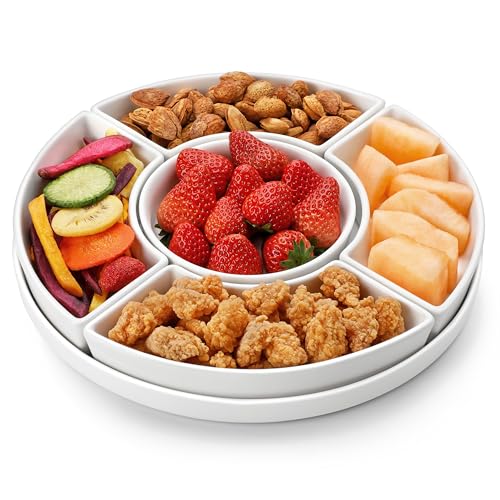
Divided trays are convenient for chips with salsa, vegetables with dip, or mixed nuts and dried fruit. However, compartments reduce the usable surface area and can make large foods awkward to arrange. They are best when you serve the same categories of snacks regularly, rather than when you want one set to handle everything from baked appetizers to desserts.
Best Set Configurations by Hosting Situation
| Your situation | Most practical configuration | Why it works |
|---|---|---|
| Small apartment or 2–4 guests | Two platters, 10–14 in., plus one 4–6 in. dip bowl | Provides variety without consuming the entire table |
| Family buffet for 5–8 guests | Three platters, 12–18 in., in rectangular and oval shapes | Separates hot foods, dry snacks and fresh foods |
| Large gathering | Four or more matching platters, including at least one 18–20 in. piece | Creates multiple serving stations and reduces crowding |
| Children and pets | Low-profile, rounded-edge melamine or lightweight metal | Reduces breakage and is easier to move out of reach |
| Frequent hot appetizers | Oven-safe stoneware or tempered glass, ideally 12–16 in. | Handles heat and gives enough surface area for one recipe |
| Limited cabinet space | Nesting set with three sizes and stackable bowls | Stores in one vertical stack instead of several separate piles |
For a small apartment, do not judge capacity by platter length alone. Leave at least 4 inches between a platter’s edge and the table edge so guests can set down utensils and avoid bumping food. On a 36-inch-wide table, two 14-inch round platters placed side by side will leave little room for plates; two narrow rectangular platters placed lengthwise may be much more practical.
Material Trade-Offs That Affect Everyday Use
| Material | Advantages | Limitations | Best match |
|---|---|---|---|
| Porcelain or ceramic | Attractive, nonporous, often dishwasher-safe and suitable for formal settings | Can chip; heavier pieces are harder to carry when full | Cheese, desserts and plated hot appetizers |
| Stoneware | Substantial, heat-retaining and often oven-safe | Usually heavier and may show utensil marks or edge chips | Baked dips, roasted vegetables and winter entertaining |
| Tempered glass | Nonporous, visually light and easy to inspect for cleanliness | Can break if dropped or exposed to sudden temperature changes | Fresh foods and compact kitchens |
| Acacia or bamboo | Warm appearance, light enough to carry and useful for dry foods | Generally unsuitable for soaking, dishwashers and very wet foods | Charcuterie, crackers, bread and fruit |
| Melamine | Lightweight, durable and suitable for outdoor or child-friendly use | Usually not microwave-safe and should not be used for oven cooking | Patios, children’s parties and casual buffets |
| Stainless steel | Durable, nonporous and resistant to stains and odors | Can show fingerprints and may look less warm than ceramic or wood | High-use entertaining and outdoor serving |
Material also changes the practical weight of a full platter. A large stoneware piece can weigh 4–6 pounds before food is added, while a melamine or bamboo platter of similar size may weigh closer to 1–2 pounds. If you regularly carry food from the kitchen to a patio or upstairs room, lighter construction is a meaningful advantage.
Dimensions, Capacity and Table Fit
A 12-inch platter is generally suitable for appetizers for two to four people, while a 16-inch platter can accommodate a larger arrangement for approximately six to eight people, depending on the food. Dense items such as stuffed mushrooms take more surface area than crackers or grapes. Rather than filling one platter to its edges, aim to leave about 1 inch of visible rim for picking up the piece and for a cleaner presentation.
Measure the storage location before choosing a large set. A platter measuring 18 inches may fit on the dining table but fail to fit upright in a 16-inch cabinet opening. Also check dishwasher dimensions: a wide round platter may need to be hand-washed even when the manufacturer labels the material dishwasher-safe.
For buffet service, allow approximately 24 inches of linear table space per major serving dish, including room for tongs or a serving spoon. A 60-inch table can therefore hold two large platters comfortably, or three narrower platters if drinks and plates are placed elsewhere. Keep hot dishes at least 2 inches from table edges and use trivets beneath pieces that are not explicitly rated for heat.
What to Look For in Construction
- Stable bases: A recessed or rubberized underside helps prevent sliding on polished wood, glass and stone tables.
- Usable rims: A low 0.5–1-inch rim contains juices while preserving serving access. Tall rims are more useful for saucy foods than for crackers.
- Comfortable handling: Cutout handles or a gently curved underside are valuable on platters longer than 16 inches.
- Stacking design: Nested pieces should leave enough clearance that rims do not scrape one another. Felt or silicone separators can protect decorative finishes.
- Clear care instructions: “Food-safe” does not automatically mean oven-safe, microwave-safe or dishwasher-safe.
Decorative wood handles, painted surfaces and metallic trim often wear before the serving surface does. Frequent soaking can swell wood, while abrasive cleaners may dull glaze or scratch metal. If a set will be used weekly, simple shapes with replaceable or minimal decorative parts are generally more durable than elaborate designs.
When One Set Is Better Than Multiple Specialized Pieces
Buy one nesting three-piece set when your menus vary and cabinet space is limited. Choose a set with one rectangular, one oval and one small round piece for the broadest coverage. Buy separate specialized pieces when you entertain in distinct ways—for example, a wooden board for dry grazing foods and an oven-safe ceramic platter for baked appetizers. Combining materials can be more useful than buying a large matching collection that all has the same shape.
For renters or anyone who moves often, prioritize lightweight pieces that fit through a standard 30-inch doorway and can be packed without excessive padding. A 16-inch melamine or tempered-glass set is easier to transport than a collection of thick stoneware. Keep the original dividers or wrap each piece in towels; platter corners and rims are the areas most likely to chip during a move.
Bottom Line
Choose a narrow rectangular set for efficient table layouts, an oval or round set for communal grazing, and divided trays only when compartmented snacks are a regular part of your menu. For the most flexible purchase, look for three nesting pieces—roughly 12, 15 and 18 inches—with one heat-capable serving piece, one lightweight everyday piece and a design that leaves at least 4 inches of clearance around the food on your table.