Key takeaways
- Best all-purpose choice: a 12-inch clear glass dome with 4 to 6 inches of clearance, a flat 12- to 13-inch base, and a gently seated rim.
- Best for transport: a polycarbonate or thick acrylic carrier with locking clips, a handle, and a non-slip base.
- Best for tall decoration: a high-clearance dome measuring at least 6 inches inside, preferably with a wide, low center of gravity.
- Best for small counters: an 8- to 10-inch compact dome with a removable stand or reversible base.
- Best for pastries: a ventilated cover with enough width for air circulation and no tight gasket that traps steam.
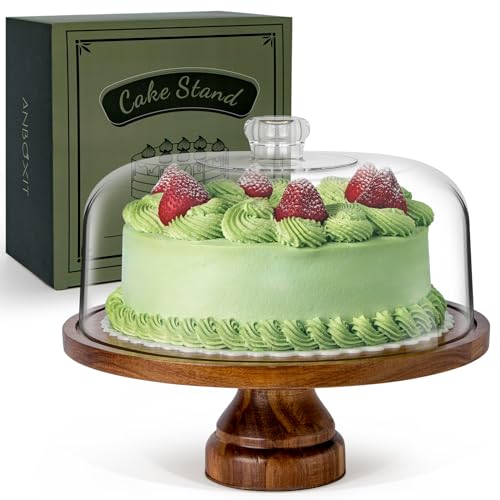
The best cake dome with stand is one with at least 4 inches of interior clearance, a stand diameter close to your cake board, a stable non-slip base, and a lid that seats evenly without relying on a fragile decorative knob.
For most homes, a 12-inch glass dome on a 12- to 13-inch stand is the most versatile choice: it fits a standard layer cake, leaves room for candles or modest decoration, and still works for muffins, pastries, fruit, and everyday countertop storage. Choose a taller 14- to 16-inch dome for tiered cakes or large decorations, or a compact 8- to 10-inch model when cabinet and counter space matter more than capacity.
Our top picks


As an Amazon Associate we earn from qualifying purchases at no extra cost to you. Ratings are shown as listed on Amazon.
Best cake dome with stand by situation
| Situation | Best specification | Why it works | Watch for |
|---|---|---|---|
| Typical 8- or 9-inch layer cake | 11–12 inch dome, 4–5 inch clearance | Good fit for cakes, cupcakes, and pastries without excessive footprint | A low dome may touch frosting or decorations |
| Decorated or tiered cake | 12–14 inch dome, 6–8 inch clearance | Protects piped tops, fruit, and tall cake toppers | Check cabinet shelves before buying |
| Small apartment or narrow counter | 8–10 inch dome, removable or reversible stand | Uses less counter and storage space | May not accept a full-size celebration cake |
| Kids and pets | Thick acrylic or polycarbonate, broad weighted base, locking lid | More resistant to impact and accidental movement than thin glass | Plastic can scratch and retain odors over time |
| Frequent transport | Integrated handle, locking clips, and a base at least 1.5 inches wider than the dome | Reduces sliding and makes carrying more controlled | Decorative pedestal stands are often less secure |
| Everyday bread and pastry storage | Ventilated or loosely seated lid, 10–12 inch diameter | Balances protection with reduced condensation | An airtight seal can soften crisp pastry |
What to compare before choosing
Dome height and usable clearance
Measure from the top surface of the stand to the lowest point inside the lid, not the outside height. An 8-inch cake can require a dome with 5 inches of clearance if it has a thick frosting layer, fruit, or a topper. A standard 8- or 9-inch layer cake is usually comfortable under 4 to 5 inches of clear space, while a tall buttercream cake or small tiered cake needs approximately 6 to 8 inches.
Leave at least 1 inch between the decoration and the dome. Contact can smear frosting, trap moisture, and make the lid difficult to remove. If you mainly store flat pastries, extra height is less useful than a wide opening and a well-fitting base.
Stand diameter and countertop footprint
The stand should support the cake board fully, with roughly 1 to 2 inches of visible rim around a cake. For an 8-inch cake, an 11- or 12-inch stand is generally balanced. A 14-inch pedestal can be more stable for large cakes, but it may occupy nearly 1 square foot of counter space.
Use the footprint rather than the advertised dome diameter when planning space. A 12-inch round dome needs about 452 square inches of clear counter area if you want a 2-inch handling margin on every side. It also needs vertical clearance: allow the product height plus at least 2 inches for lifting the lid straight up. On a 24-inch-deep counter, a 14-inch base can leave limited room for appliances or food preparation.
Material: glass, acrylic, polycarbonate, or wood
| Material | Advantages | Trade-offs | Best use |
|---|---|---|---|
| Glass | Clear, odor-resistant, scratch-resistant, and attractive for serving | Heavy and breakable; may have sharp chips after impact | Dining tables and careful everyday display |
| Acrylic | Lightweight, affordable, and less likely to shatter | Scratches more easily and can become cloudy with abrasive cleaning | Frequent handling and homes with children |
| Polycarbonate | More impact-resistant than ordinary acrylic and usually clearer over time | Often costs more; still requires gentle cleaning | Transport and high-use kitchens |
| Wood or engineered-wood stand | Warm appearance and good visual weight | Can absorb moisture; should not be soaked or placed in a dishwasher | Decorative serving and dry baked goods |
| Stainless steel or coated metal | Durable, slim, and easy to wipe clean | Can slide on smooth counters unless the base has rubber feet | Modern kitchens and commercial-style use |
Glass is usually the strongest visual choice for a dining-room centerpiece, but its weight matters. A large glass dome may be awkward to lift with one hand, particularly when the rim is smooth. Acrylic or polycarbonate is more practical for carrying food to a car, picnic, or party. Look for food-safe materials and avoid domes with a strong plastic odor, uneven seams, or a stand finish that flakes when rubbed.
Seal quality and ventilation
A cake dome is not automatically an airtight container. Many simply rest on a groove or raised rim. That is often preferable for cake because a completely tight seal can trap humidity and make crisp pastry soft. For sliced cake, brownies, and bread, a close-fitting lid helps slow drying. For croissants, cookies, and puff pastry, a lightly seated lid or small ventilation gap is usually better.
Check whether the seal is made by a continuous rim, silicone gasket, or several small contact points. A continuous gasket provides the best protection from air and household odors, but it can also increase condensation. If the lid has clips, make sure they close evenly without forcing the dome sideways. A lid that rocks on the stand is more likely to spill when carried.
Stability matters more than decoration
Pedestal stands look elegant, but a narrow stem raises the center of gravity. For a heavy glass lid or a tall cake, a broad flat base is safer than a delicate high pedestal. The base should be at least 1.5 inches wider than the dome, and rubber or silicone feet are valuable on polished stone, glass, and laminate.
For carrying, prioritize a locking dome, a molded handle, or a stand designed to grip the cake board. Never lift a cake dome by a small lid knob unless the manufacturer specifically designed it as a handle. Keep both hands under the base when transporting a glass model. Before buying, check the assembled weight; a roughly 5- to 8-pound glass dome and stand can become difficult to control when one hand is holding a serving plate or opening a door.
How to match the dome to your cake
- Measure the cake board, including any board edge that must sit on the stand.
- Measure from the stand surface to the highest decoration.
- Add 1 to 2 inches of side clearance and at least 1 inch of top clearance.
- Compare the assembled footprint with the space available on your counter or table.
- Decide whether you need a seal for moisture control or ventilation for crisp textures.
- Check cleaning instructions, carrying features, and whether the dome can be stored upside down.
For example, a cake on a 9-inch board that is 4 inches tall with a 1-inch topper needs more than a basic low cover. A 12-inch stand with at least 6 inches of interior height gives useful side and top clearance. A 10-inch dome may fit the cake width but leave no safe margin around the frosting.
Cleaning, storage, and durability realities
Wash glass, acrylic, and polycarbonate with warm water, mild dish soap, and a soft cloth. Abrasive powders, scouring pads, and rough paper towels can produce fine scratches, especially on plastic. Let the dome dry completely before placing it over cake. If the stand is wooden, wipe it rather than soaking it, and dry it promptly.
The parts most likely to wear are silicone feet, hinge pins, locking clips, and painted or plated finishes. A removable gasket is easier to clean and replace than one permanently bonded into the lid. Store the dome where it will not be struck by pots or cabinet doors; a protective cloth between stacked pieces can prevent scratches.
Our practical picks by design type
- Best all-purpose choice: a 12-inch clear glass dome with 4 to 6 inches of clearance, a flat 12- to 13-inch base, and a gently seated rim.
- Best for transport: a polycarbonate or thick acrylic carrier with locking clips, a handle, and a non-slip base.
- Best for tall decoration: a high-clearance dome measuring at least 6 inches inside, preferably with a wide, low center of gravity.
- Best for small counters: an 8- to 10-inch compact dome with a removable stand or reversible base.
- Best for pastries: a ventilated cover with enough width for air circulation and no tight gasket that traps steam.
Final buying recommendation
Choose the largest dome that fits your real storage space without making carrying awkward. For most households in 2026, that means a 12-inch glass model for attractive display or a 12-inch polycarbonate model for safer transport. Prioritize measured interior clearance, a broad non-slip stand, and an even lid fit over ornate handles or an unusually tall pedestal. The right dome protects the cake while remaining easy enough to lift, clean, store, and use for more than one special occasion.