Key takeaways
- Start with your wines: For Pinot Noir and other aromatic reds, prioritize a broad bowl and slightly narrowed rim. For one glass to cover several wine styles, choose a moderate capacity rather than the largest available.
- Set a handling standard: If glasses will be washed often or used at crowded gatherings, favor a sturdier machine-made design over an ultra-thin stem.
- Verify fit: Check the listed height and bowl width against your cupboard and dishwasher measurements. A large bowl that cannot be stored safely is not a practical upgrade.
- Confirm care and composition: Look for explicit lead-free or material information and clear dishwasher instructions. When buying a set, consider whether replacement glasses are available individually.
- Buy for your usual pour: A modest pour benefits from aroma space, but an oversized glass is not necessary for good service. A 600–800 ml bowl is often sufficient for regular dinners.
Best Burgundy Wine Glasses: Quick Picks by Situation
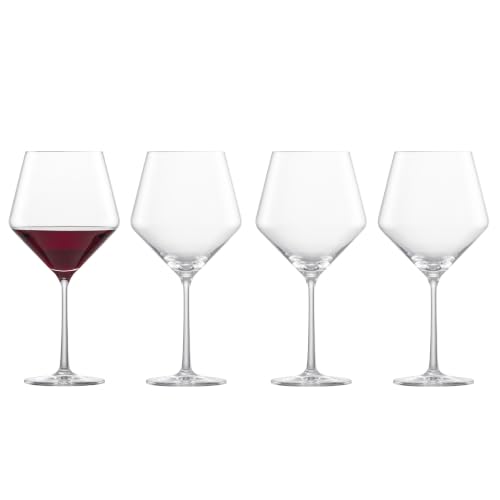
The best Burgundy wine glasses for most people have a broad bowl of about 700–1,000 ml (24–34 oz), a rim that narrows slightly from the bowl, and a stem sturdy enough for everyday handling. Choose lead-free crystal for a lighter, finer-rimmed glass; choose machine-made glass when durability and easy replacement matter more.
Burgundy glasses are oversized by design: the wide bowl gives aromatic reds such as Pinot Noir room to release their scents, while the inward-curving rim helps direct them toward the nose. Capacity is not the same as a serving size. A typical pour is about 150 ml (5 oz), leaving ample room to swirl without splashing.
Our top picks


As an Amazon Associate we earn from qualifying purchases at no extra cost to you. Ratings are shown as listed on Amazon.
Choose by Your Priorities
| Situation | Look for | Useful specification | Main trade-off |
|---|---|---|---|
| Formal dinners and aromatic reds | Thin-rimmed crystal, broad bowl, tapered opening | 700–1,000 ml (24–34 oz) | Elegant, but usually needs careful handling |
| Regular weeknight use | Machine-made, lead-free glass or crystal with a reinforced stem | 600–800 ml (20–27 oz) | More robust feel; rim may be thicker |
| Dishwasher-first households | Clearly labeled dishwasher-safe glassware | Check the maker’s instructions and rack clearance | Safe machine washing does not prevent chips from contact |
| Limited cabinet space | Moderate bowl size and a stable, compact foot | Measure glass height and bowl width before buying | Less dramatic aroma space than an extra-large bowl |
| Mixed wine menu | Versatile Burgundy-shaped bowl rather than an unusually large one | About 600–800 ml (20–27 oz) | Works across styles, but is not a specialist glass for every wine |
What Matters Most in a Burgundy Glass
Bowl capacity and shape
A bowl of roughly 700–1,000 ml suits Pinot Noir, Nebbiolo, and other aromatic reds well. Its broad lower section provides air space above a modest pour; the narrowing rim concentrates delicate aromas. An especially large bowl can be enjoyable at a tasting table, but it takes more cabinet and dishwasher space and is easier to knock over. For everyday use or a mixed collection, 600–800 ml is a practical compromise.
Capacity alone does not determine performance. A tall, narrow bowl with the same stated volume will not offer the same broad surface area as a rounded Burgundy shape. Compare the bowl’s width and profile, not just the number printed on the box.
Rim shape and thickness
A gently tapered rim suits fragrant reds by directing aromas toward the drinker. A thin, cleanly finished rim feels less intrusive when sipping, but it can be more vulnerable to chips. A rolled or noticeably thick rim is often less delicate in use, though some drinkers find it less refined. Choose the thinnest rim that fits how carefully the glasses will be handled.
Crystal versus ordinary glass
| Construction | Typical advantages | Typical drawbacks | Best fit |
|---|---|---|---|
| Lead-free crystal | Can be made thin and clear while retaining a refined feel | Often costs more; thin bowls and stems still need careful handling | Formal entertaining and people who value a light rim |
| Traditional lead crystal | Known for brilliance and weight | Heavier; care and suitability for food use depend on the maker’s guidance | Buy only when composition and care instructions are clearly stated |
| Standard soda-lime glass | Usually affordable and easy to replace | Often thicker or heavier than fine crystal | Everyday use, larger households, and casual gatherings |
“Crystal” is not a guarantee of durability or dishwasher safety. Lead-free crystal can still be fragile if its stem is slender, and a well-designed machine-made glass may be more practical than a delicate hand-finished one. Check the stated composition rather than relying on the label alone.
Stem strength and stability
The stem is a common failure point because it is narrow and can be twisted or struck during washing, storage, or serving. A slightly thicker stem and a well-balanced foot are useful for busy dinners, children at the table, or frequent handwashing. For formal service, a slimmer stem may look more delicate, but handle the glass by the stem without gripping or twisting the bowl.
Also check the glass’s height and widest diameter against your storage. Measure the dishwasher rack, cupboard shelf, and any glassware cabinet before ordering. Large Burgundy bowls may not fit standard upper racks, and forcing them into a crowded rack increases the chance of impact damage.
Dishwasher Safety: Read the Fine Print
Follow the manufacturer’s care label; “crystal” does not automatically mean hand-wash only, and “dishwasher safe” does not mean chip-proof. If machine washing is permitted, space glasses apart so bowls and stems cannot touch, use a gentle cycle, and avoid high-heat drying if the maker advises against it. Hard water can leave spots, while sudden temperature changes may stress glass.
If instructions are unclear, handwash in warm—not hot—water with mild detergent. Support the bowl and stem rather than twisting one against the other, then dry with a lint-free cloth. Do not stack wine glasses unless they are specifically designed for stacking.
How to Buy Without a Mismatch
- Start with your wines: For Pinot Noir and other aromatic reds, prioritize a broad bowl and slightly narrowed rim. For one glass to cover several wine styles, choose a moderate capacity rather than the largest available.
- Set a handling standard: If glasses will be washed often or used at crowded gatherings, favor a sturdier machine-made design over an ultra-thin stem.
- Verify fit: Check the listed height and bowl width against your cupboard and dishwasher measurements. A large bowl that cannot be stored safely is not a practical upgrade.
- Confirm care and composition: Look for explicit lead-free or material information and clear dishwasher instructions. When buying a set, consider whether replacement glasses are available individually.
- Buy for your usual pour: A modest pour benefits from aroma space, but an oversized glass is not necessary for good service. A 600–800 ml bowl is often sufficient for regular dinners.
Bottom Line
For elegant entertaining, choose a lead-free crystal Burgundy glass with a broad 700–1,000 ml bowl, a subtly tapered thin rim, and a stem proportioned for secure handling. For frequent use, households with limited storage, or dishwasher convenience, prioritize a machine-made glass with a sturdier stem and explicit care instructions—even if its rim is a little thicker. The right choice is the one that suits your wine, washing routine, and storage space, not simply the glass with the biggest bowl.