Key takeaways
- Measure the opening first, twice: Casement units are vertical, typically around 14.75 inches wide by 23.5 inches tall. Record your sash width, height, and depth before you shop, and note whether the crank arm swings into the AC’s path.
- Match BTUs to square footage, not ambition: 8,000 BTU handles roughly 350 sq ft, 10,000 BTU covers about 450 sq ft, and 12,000 BTU reaches 550 sq ft. Oversizing cools fast, then short-cycles and leaves the room clammy.
- Check the seal kit, not just the unit: Casement installs rely on side panels, foam, and a bracket that carries weight the sash can’t. Confirm what’s included and budget for a custom infill panel if your opening is unusually tall.
- Prioritize decibels in bedrooms: Inverter compressors and U-shaped designs run dramatically quieter than fixed-speed rotary units. If the AC sits within eight feet of a bed, quiet operation matters more than the last thousand BTUs.
- Decide on smart controls honestly: Wi-Fi and voice control genuinely help with scheduling and remote pre-cooling. A follow-me remote that reads temperature at your chair, not at the chassis, is often the more useful upgrade.
What's inside
Casement windows are a design win and a cooling headache. Those tall, narrow crank-outs and vertical sliders were never sized for the wide, squat box that most window air conditioners still ship in, which is why so many homeowners discover the mismatch only after the carton is open and the return window is closing. The gap is real: standard units need roughly 22 inches of horizontal opening, while a typical casement sash gives you 14 to 16.
This guide sorts through the options that actually work in a crank-out or vertical-slider opening: purpose-built vertical casement units, low-profile alternatives worth considering if your window style allows, and the portable route that sidesteps the sash issue entirely. We look at BTU-to-room fit, install hardware, noise, and how each unit reads in a room you care about aesthetically.
As an Amazon Associate we earn from qualifying purchases.



How to Choose a Casement Window Air Conditioner (2026)
- Measure the opening first, twice: Casement units are vertical, typically around 14.75 inches wide by 23.5 inches tall. Record your sash width, height, and depth before you shop, and note whether the crank arm swings into the AC’s path.
- Match BTUs to square footage, not ambition: 8,000 BTU handles roughly 350 sq ft, 10,000 BTU covers about 450 sq ft, and 12,000 BTU reaches 550 sq ft. Oversizing cools fast, then short-cycles and leaves the room clammy.
- Check the seal kit, not just the unit: Casement installs rely on side panels, foam, and a bracket that carries weight the sash can’t. Confirm what’s included and budget for a custom infill panel if your opening is unusually tall.
- Prioritize decibels in bedrooms: Inverter compressors and U-shaped designs run dramatically quieter than fixed-speed rotary units. If the AC sits within eight feet of a bed, quiet operation matters more than the last thousand BTUs.
- Decide on smart controls honestly: Wi-Fi and voice control genuinely help with scheduling and remote pre-cooling. A follow-me remote that reads temperature at your chair, not at the chassis, is often the more useful upgrade.
The Best Casement Window Air Conditioners (2026) Reviewed
Perfect Aire 10,000 BTU Casement Window Air Conditioner
This is the reference point for the category: a genuinely vertical 23.5 x 14.75-inch chassis built for sliding and crank-out sashes, with a digital LED display, 24-hour timer, and a follow-me remote that senses temperature where you actually sit. For a 450 sq ft bedroom or converted study, it’s the most direct answer to the casement problem.
Element ESC10BE 10,000 BTU Window Casement Unit
A no-drama vertical unit that covers the same 10,000 BTU territory with a simpler feature set and a clean, low-gloss front that disappears into a white or off-white frame. Worth a look if you want casement-native fit without paying for connectivity you won’t use.
Midea 10,000 BTU U Shaped Smart Inverter
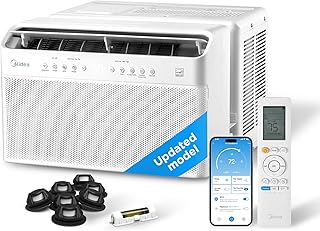
The U-shape saddles the sash so the window closes through the middle of the unit, cutting street noise to a reported 42 dB and delivering roughly 35% energy savings via inverter control. It needs a double-hung or horizontal-sliding opening rather than a crank-out, but for anyone with a mix of window types it’s the best-sounding and best-looking window AC available.
BLACK+DECKER 12,000 BTU Window Air Conditioner
The pick when the room is larger than the window style suggests, covering up to 550 sq ft with three cooling speeds and a fan-only mode for shoulder-season days. A conventional horizontal chassis, so verify your opening width before committing.
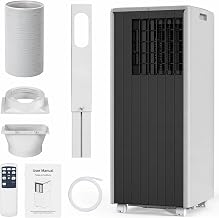
Air Choice 10,000 BTU Portable Air Conditioner
The pragmatic workaround for casements that simply won’t accept a chassis: the exhaust hose vents through a narrow gap with the included kit, and the unit doubles as a dehumidifier and fan. Sleep mode and a 24-hour timer make it credible in a bedroom, though it occupies floor space a window unit wouldn’t.
Frequently Asked Questions
Can I put a regular window AC in a casement window?
Not safely without modification. Standard units are wider than tall and depend on a sash closing down onto the chassis, which a crank-out window can’t do. Use a vertical casement unit, a portable with a vent kit, or a custom-cut infill panel installed by a pro.
How many BTUs do I need?
Roughly 20 BTU per square foot, adjusted up for sun-facing rooms, high ceilings, or kitchens. A 400 sq ft bedroom lands comfortably on a 10,000 BTU unit.
Are casement air conditioners noisier than standard ones?
Slightly, on average, because the narrow chassis limits fan and insulation design. Choosing a model with multiple fan speeds and running it on low overnight closes most of the gap.
Do these units drain water?
Most self-evaporate condensate in normal humidity, but during humid stretches you may see drip from the exterior side. Portables typically need occasional manual draining unless set to continuous drain.
Final Thoughts
For a true crank-out or vertical slider, the Perfect Aire 10,000 BTU casement unit is the most reliable fit, with the Element ESC10BE as a leaner alternative at the same capacity. If your window style gives you flexibility, the Midea U-Shaped inverter is worth the stretch for its quiet operation and energy savings, and the Air Choice portable remains the fallback when no chassis will fit at all.