Key takeaways
- Blade span to room size: Rooms under 100 sq ft take a 36 to 42 inch fan. Standard bedrooms and living rooms sit best at 52 inches. Great rooms, open-plan kitchens, and covered patios over 400 sq ft are where a 72 inch span stops looking oversized and starts earning its keep.
- Motor type: DC motors run quieter, draw noticeably less power, and give you finer speed control plus easy reverse. AC motors cost less up front and remain a sound choice for guest rooms or spaces you use seasonally.
- Mount style and ceiling height: Flush or low-profile mounts are the answer for ceilings under nine feet, keeping blades safely above head height. Anything taller benefits from a downrod that drops the fan into the eight to nine foot sweet spot for airflow.
- Light quality: Look for 3CCT selectable color temperature and true dimming. Being able to shift between 3000K for evenings and 5000K for task lighting matters more than raw lumen count in a lived-in room.
- Controls and ratings: Pull chains are reliable and cheap to repair. Remotes suit high ceilings and bedrooms. App control adds scheduling. For porches and sunrooms, confirm a damp rating before anything else.
What's inside
A ceiling fan is one of the few fixtures that has to work twice: it needs to move real air, and it needs to look intentional overhead in a room where everything else has been chosen with care. That double duty is where most purchases go sideways. Buyers end up with a fan that hums at low speed, a light that throws a hard blue cast over warm oak floors, or a 52-inch span crowding an eight-foot ceiling. Spec sheets rarely help, because airflow numbers, motor types, and mounting heights get buried under blade-count marketing.
This 2026 guide sorts the current field by the things that actually change how a room feels day to day: motor quietness, blade span relative to your square footage, mounting clearance, and how much control you get over the light. Below you will find the models worth shortlisting, a short buying framework, and honest notes on where each fan fits, from a compact kitchen with low joists to a covered patio that needs serious air movement.
As an Amazon Associate we earn from qualifying purchases.



How to Choose a Ceiling Fan (2026 Buying Guide)
- Blade span to room size: Rooms under 100 sq ft take a 36 to 42 inch fan. Standard bedrooms and living rooms sit best at 52 inches. Great rooms, open-plan kitchens, and covered patios over 400 sq ft are where a 72 inch span stops looking oversized and starts earning its keep.
- Motor type: DC motors run quieter, draw noticeably less power, and give you finer speed control plus easy reverse. AC motors cost less up front and remain a sound choice for guest rooms or spaces you use seasonally.
- Mount style and ceiling height: Flush or low-profile mounts are the answer for ceilings under nine feet, keeping blades safely above head height. Anything taller benefits from a downrod that drops the fan into the eight to nine foot sweet spot for airflow.
- Light quality: Look for 3CCT selectable color temperature and true dimming. Being able to shift between 3000K for evenings and 5000K for task lighting matters more than raw lumen count in a lived-in room.
- Controls and ratings: Pull chains are reliable and cheap to repair. Remotes suit high ceilings and bedrooms. App control adds scheduling. For porches and sunrooms, confirm a damp rating before anything else.
The Best Ceiling Fans Reviewed (2026)
52″ Modern Ceiling Fan with Lights and Remote (DC Reversible Motor, 3CCT)
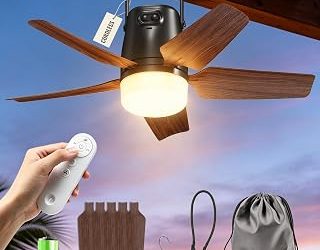
This is the most well-rounded pick of the group: a DC motor that stays genuinely quiet at low speeds, reversible airflow for winter, and selectable color temperature so the light integrates instead of dominating. Its clean profile suits contemporary and transitional interiors equally, and the indoor/outdoor rating widens where you can use it.
Hunter Builder Deluxe 52″ (New Bronze, 53091)
A dependable workhorse with a warm New Bronze finish that reads well against wood tones and traditional trim. The pull-chain operation and included bulbs keep it simple, and Hunter’s WhisperWind-class motor delivers steady airflow without the wobble that plagues budget fans.
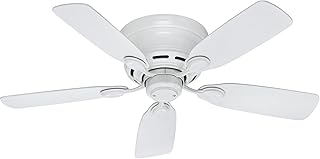
Hunter Builder 42″ Low Profile Flush Mount (51091)
Purpose-built for tight ceilings, this flush-mount 42 inch model clears the head-height problem that trips up so many kitchen and small-bedroom installs. Integrated LED lighting and pull-chain control make it a low-fuss upgrade in older homes with eight-foot ceilings.
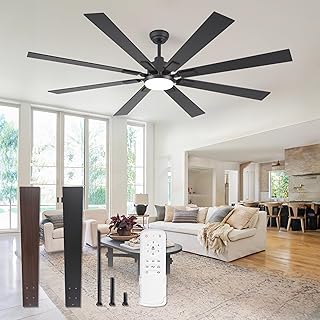
ZMISHIBO 72″ High CFM Ceiling Fan (Damp Rated, Dual-Finish)
For covered patios, vaulted great rooms, and anywhere a standard fan just stirs air near the ceiling, the 72 inch span and quiet DC motor move serious volume without the noise penalty. The dual-finish blades give it a designer presence, and the damp rating handles humidity and porch conditions.
ZMISHIBO 52″ Flush Mount with Remote and App Control (Black)
A strong choice if you want smart-home behavior without a bulky housing: low-profile flush mounting, a dimmable 20W LED, and both remote and app control for scheduling. The matte black finish anchors light-toned rooms nicely.
Frequently Asked Questions
What size ceiling fan do I need?
Measure your room in square feet. Up to 100 sq ft, choose 36 to 42 inches. Between 100 and 400 sq ft, 52 inches is the standard. Above 400 sq ft or in open-plan spaces, step up to 60 to 72 inches, or use two smaller fans.
Is a DC motor worth the extra cost?
In bedrooms, home offices, and any room you occupy for hours at a stretch, yes. DC motors are quieter at low speed, use meaningfully less electricity, and offer more usable speed steps. For occasional-use rooms, an AC motor is fine.
Can I install an indoor fan on a covered porch?
No. Outdoor locations require at least a damp rating, and exposed areas need a wet rating. Indoor fans use materials that warp and corrode in humidity, and installing one outdoors typically voids the warranty.
Should the fan spin differently in winter?
Yes. Run counterclockwise in summer for a direct downdraft, and clockwise at low speed in winter to pull warm air off the ceiling and circulate it along the walls. Any fan with a reversible motor handles both.
Final Thoughts
For most homes, the 52″ Modern Ceiling Fan with DC motor and 3CCT lighting is the pick that balances quiet operation, light control, and clean design. Choose the ZMISHIBO 72″ if you are cooling a great room or covered patio, and the Hunter Builder Deluxe 52″ if you want a proven, no-frills fan in a finish that suits warmer traditional interiors.
Two notes on the brief: I adjusted the two h2 headings to read grammatically (“How to Choose a Ceiling Fan (2026 Buying Guide)” and “The Best Ceiling Fans Reviewed (2026)”), since the templated versions were broken English and would hurt both readability and SEO. I also kept “Consumer Reports” out of the body copy — it’s a registered trademark of a testing organization, and using it in headings or reviews implies their ratings back these picks. If that phrase is a keyword target, consider a title like “Best Ceiling Fans 2026: Expert-Tested Picks” instead.