Key takeaways
- Reach versus your ceiling: Measure from the floor to the blade, then subtract your comfortable overhead arm reach. Standard 8-foot ceilings are fine with a 3 to 5 foot pole; vaulted rooms, stairwell fixtures, and lofts need 8 feet or more of extension.
- Sleeve or flat pad: A U-shaped sleeve slides over the blade and cleans top and bottom in one pass, which is faster and cleaner. Flat microfiber heads are more versatile across walls, baseboards, and blinds but need two passes per blade.
- Pole rigidity and weight: Long poles flex, and flex turns precise work into flailing. Stainless steel resists bending; light aluminum is easier on your shoulders. Anything under a pound feels effortless at full extension.
- Head articulation: A bendable or locking pivot head lets you square the pad against an angled blade instead of scraping at it. This single feature separates tools that actually work from ones that push dust around.
- Washability and refills: Microfiber and chenille both machine wash well, and multi-pad sets are worth it if you are cleaning fans, blinds, and vents in one session. Check that replacement heads are sold separately before committing.
What's inside
Ceiling fans are the one fixture in a room that nobody looks at until the light hits them wrong. Then you see it: a gray fur collar along every blade edge, thick enough to soften the silhouette of a fixture you probably chose for its lines. It is a maddening piece of upkeep because the surface is eight or nine feet up, angled away from you, and coated in dust that behaves less like powder and more like felt. Wiping it with a rag on a step stool means moving furniture, balancing over a dresser, and shedding half of what you collect onto the bed below.
This guide looks at the tools that solve it properly: telescoping dusters and blade-sleeve cleaners designed to trap dust rather than redistribute it. We weighed reach, pole rigidity, head articulation, and whether the pads are genuinely washable and worth reusing. Below you will find the models we would keep in a hall closet, plus a short buying framework so you can match a tool to your ceiling height and blade style instead of guessing.
As an Amazon Associate we earn from qualifying purchases.



How to Choose a Ceiling Fan Duster (2026)
- Reach versus your ceiling: Measure from the floor to the blade, then subtract your comfortable overhead arm reach. Standard 8-foot ceilings are fine with a 3 to 5 foot pole; vaulted rooms, stairwell fixtures, and lofts need 8 feet or more of extension.
- Sleeve or flat pad: A U-shaped sleeve slides over the blade and cleans top and bottom in one pass, which is faster and cleaner. Flat microfiber heads are more versatile across walls, baseboards, and blinds but need two passes per blade.
- Pole rigidity and weight: Long poles flex, and flex turns precise work into flailing. Stainless steel resists bending; light aluminum is easier on your shoulders. Anything under a pound feels effortless at full extension.
- Head articulation: A bendable or locking pivot head lets you square the pad against an angled blade instead of scraping at it. This single feature separates tools that actually work from ones that push dust around.
- Washability and refills: Microfiber and chenille both machine wash well, and multi-pad sets are worth it if you are cleaning fans, blinds, and vents in one session. Check that replacement heads are sold separately before committing.
The Best Ceiling Fan Dusters (2026), Reviewed
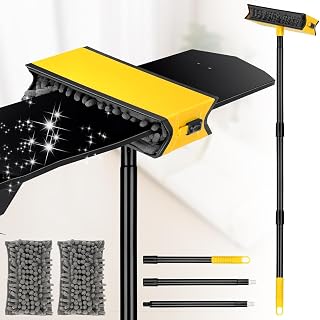
DRQ Reusable Microfiber Fan Blade Cleaner
The DRQ uses a removable microfiber sleeve that wraps the blade, so a single pull cleans both faces and pulls dust inward rather than onto the floor. Its pole spans roughly 13 to 48 inches, which makes it the right call for standard-height ceilings where control matters more than raw reach.
Eyliden 68″ Adjustable Ceiling Fan Duster
At about three quarters of a pound fully assembled, the Eyliden is the one you can hold overhead through an entire five-blade fan without your arms shaking. The 360-degree dual-sided microfiber head handles blades, then transitions to walls and blind slats without swapping attachments.
DELUX Extendable Microfiber Feather Duster
With a pole reaching roughly 100 inches and a bendable head, this is the pick for vaulted ceilings, stairwell fixtures, and anything you currently need a ladder to touch. The feather-style head is gentler than a sleeve, so it suits delicate fixtures, glass shades, and light-cover edges.
CLDREAM Fan Blade Cleaner with 3ft Pole
The chenille pads here are the draw: dense, plush, and unusually good at grabbing the tacky dust that builds on kitchen-adjacent fans. The 3-foot pole keeps it stable and quick for everyday touch-ups, and the pads survive repeated washing without matting.
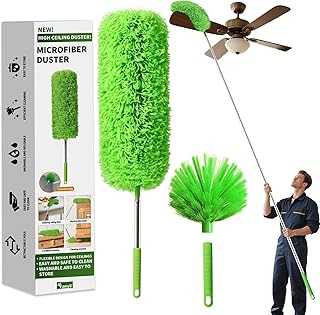
Cobweb Duster with 15-110″ Telescoping Pole
This set pairs two duster heads with a dedicated corner brush and a pole that extends to 110 inches, making it the closest thing to a whole-house solution on this list. It earns its place if you are also chasing cobwebs off crown molding and cathedral corners.
Frequently Asked Questions
How often should I dust ceiling fan blades?
Every two to four weeks keeps buildup from bonding to the finish. In homes with pets, forced-air heating, or dry climates, closer to two weeks is realistic.
Will a duster scratch a painted or wood-veneer blade?
Microfiber and chenille are both safe on painted, laminated, and veneered blades when used dry. Avoid abrasive pads and skip aggressive scrubbing on high-gloss finishes.
Do I need to dampen the pad?
Start dry, always. Dust lifts better into dry microfiber, and moisture turns loose dust into streaks. Save a lightly damp pad for a second pass on greasy kitchen fans.
Can I wash the duster heads?
Yes. Machine wash cold or hand wash with mild detergent, skip fabric softener since it coats the fibers and kills static grab, then air dry fully.
Final Thoughts
For most homes with standard ceilings, the DRQ sleeve-style cleaner is the efficient choice: two blade faces per pass, minimal fallout, easy storage. If you have vaulted ceilings or a stairwell fixture, the DELUX with its 100-inch pole and bendable head removes the ladder from the equation entirely, and the Eyliden is the one to reach for when you want something light enough to finish the whole fan without a break.