Key takeaways
- Blade span scaled to the room: Vaulted spaces almost always need more sweep than the square footage suggests. Rooms over 400 square feet do best with 65 to 72 inches; great rooms, lofts, and covered patios with tall peaks benefit from an 84-inch span, which moves a large volume of air at low, quiet speeds instead of forcing a small fan to work hard.
- Downrod length and sloped-ceiling compatibility: Aim for the blades to sit eight to nine feet off the floor, which frequently means a 24- to 72-inch rod. Confirm the canopy is rated for your pitch, and remember that many kits handle a modest slope out of the box but need an angled-mount adapter beyond roughly 30 degrees.
- DC motor over AC: A DC motor runs noticeably quieter, uses a fraction of the wattage, and typically offers six speeds plus reverse. In a cathedral room, reverse mode is not a nicety: winter downdraft is how you recover the heat pooling at the peak.
- Airflow you can verify: Look for a published CFM figure rather than marketing language about “powerful airflow.” High-CFM propeller and eight-blade designs both work; what matters is that the number is stated and matched to your volume.
- Light kit and control from a distance: If the fan is your primary fixture, a dimmable LED with selectable color temperature (3CCT or 6CCT) lets you tune the room without a bulb swap you’d need a ladder for. A remote is essential at this height, and damp-rated construction is non-negotiable on covered porches or anywhere near a kitchen.
What's inside
Cathedral ceilings deliver the drama every open-plan living room wants, and then quietly sabotage the airflow. All that vertical volume traps warm air ten feet above head height, so the room reads stuffy in July and drafty in January while a standard 52-inch fan on a stubby downrod spins away, moving air nowhere useful. Add a sloped mount, a two-story sightline, and a light kit that has to double as the room’s ambient source, and the choice stops being a hardware decision and becomes a proportion problem.
This guide approaches it the way a designer would: match the blade span to the room’s footprint, drop the fan into the occupied zone with the right downrod, and choose a finish that holds up when it’s the largest object in the sightline. Below are the models worth specifying in 2026, plus the specs that actually determine whether a vaulted room feels comfortable or just looks good.
As an Amazon Associate we earn from qualifying purchases.



How to Choose a Ceiling Fan For Cathedral Ceiling (2026)
- Blade span scaled to the room: Vaulted spaces almost always need more sweep than the square footage suggests. Rooms over 400 square feet do best with 65 to 72 inches; great rooms, lofts, and covered patios with tall peaks benefit from an 84-inch span, which moves a large volume of air at low, quiet speeds instead of forcing a small fan to work hard.
- Downrod length and sloped-ceiling compatibility: Aim for the blades to sit eight to nine feet off the floor, which frequently means a 24- to 72-inch rod. Confirm the canopy is rated for your pitch, and remember that many kits handle a modest slope out of the box but need an angled-mount adapter beyond roughly 30 degrees.
- DC motor over AC: A DC motor runs noticeably quieter, uses a fraction of the wattage, and typically offers six speeds plus reverse. In a cathedral room, reverse mode is not a nicety: winter downdraft is how you recover the heat pooling at the peak.
- Airflow you can verify: Look for a published CFM figure rather than marketing language about “powerful airflow.” High-CFM propeller and eight-blade designs both work; what matters is that the number is stated and matched to your volume.
- Light kit and control from a distance: If the fan is your primary fixture, a dimmable LED with selectable color temperature (3CCT or 6CCT) lets you tune the room without a bulb swap you’d need a ladder for. A remote is essential at this height, and damp-rated construction is non-negotiable on covered porches or anywhere near a kitchen.
The Best Ceiling Fan For Cathedral Ceiling (2026)s Reviewed
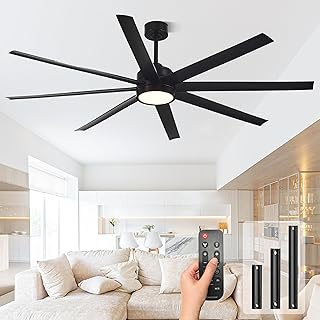
Modern 72-Inch Ceiling Fan with Light and Remote, 8 Blades, Black
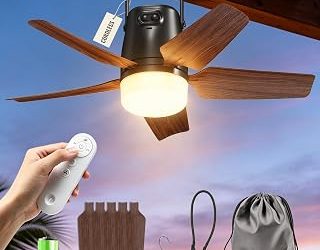
The eight-blade layout gives this one a dense, sculptural profile that reads intentional from two stories down, and the 6CCT dimmable LED means it can shift from warm evening light to task-bright without touching the fixture. A strong all-rounder for black-accent interiors that need one fan to cover a wide great room.
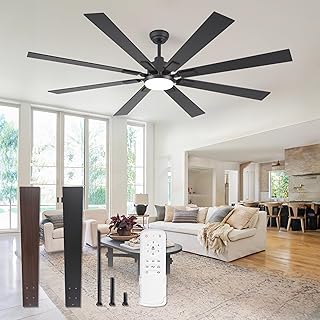
ZMISHIBO 84-Inch Ceiling Fan with Lights
Eight aluminum reversible blades and an industrial-grade DC motor make this the pick for genuinely oversized volume, from double-height living rooms to shops and gazebos. Damp rated with 3CCT lighting and six speeds, it pushes serious air on setting two or three, which is where the quiet lives.
84-Inch Extra Large Propeller Fan, Deep Walnut
Three wide wood blades in deep walnut give a warm, aeronautical silhouette that suits timber-frame and Southwest-leaning rooms, and skipping the light kit keeps the sightline clean if you already have pendants or recessed cans. High CFM at low speed makes it a strong patio and bedroom choice.
72-Inch Modern Farmhouse Fan with Six Solid Wood Blades
Real wood blades and a dimmable integrated light land this squarely in transitional and modern-farmhouse territory, where a painted metal fan would feel too cold. Damp rated for covered porches, energy efficient, and quiet enough to leave running through a dinner party.
ZMISHIBO 72-Inch Dual-Finish Fan in Black
The dual-finish blades add depth that photographs well against white vaulted drywall, and the 24W 3CCT LED covers a mid-size great room on its own. A well-balanced indoor-outdoor option if you want 84-inch performance characteristics in a slightly tighter footprint.
Frequently Asked Questions
How long a downrod do I need for a cathedral ceiling?
Measure your ceiling height at the mounting point, then subtract the fixture height and your target blade height of eight to nine feet. A 14-foot peak typically calls for a 36- to 48-inch rod. Buy the rod separately if the included one is short.
Will one large fan cool a two-story great room?
Often yes, if the span is right. A single 72- or 84-inch fan positioned over the main seating area generally outperforms two smaller fans, which can compete with each other and create uneven airflow.
Do I need a sloped ceiling adapter?
Check the maximum pitch in the manual. Many canopies accommodate up to about 30 degrees natively; steeper vaults require an angled mount kit, which is inexpensive and widely available.
Should the fan run in reverse during winter?
Yes. On low speed in reverse, the fan gently pulls warm air down from the peak without creating a wind-chill effect, which meaningfully improves comfort in tall rooms.
Final Thoughts
For most vaulted great rooms, the ZMISHIBO 84-Inch is the safest specification: enough sweep to stay quiet while doing real work. Choose the 72-Inch Modern Farmhouse with solid wood blades if warmth and material honesty matter more than raw span, or the Fanbulous 65-Inch if your room is closer to 350 square feet and you want the same DC-motor refinement at a friendlier footprint.