Key takeaways
- Wet vs. damp rating: A deep, fully covered porch can take a damp-rated fan, but anything within reach of driven rain, pool spray, or open sky needs a wet rating. IP65 and IP66 designations are the clearest signal a manufacturer has actually sealed the housing and light module.
- Power and mounting reality: Hardwired fans give you a cleaner ceiling and no visible cord, while plug-in caged models hang from a standard hook and need only a nearby GFCI outlet. Renters and anyone without existing wiring should filter for the hook-and-plug design first.
- Airflow matched to the space: Sweep and CFM matter more outdoors, where there are no walls to contain the air. Compact 20 to 24 inch fans handle a seating nook or a 10 by 12 foot gazebo; a 52 or 56 inch fan is what you want for a full outdoor dining setup or a long covered veranda.
- Motor type and noise: DC motors draw less power, run quieter, and offer six or more speeds instead of the traditional three, which means you can find a whisper-level setting for conversation. Reversible operation also lets the fan push warm air down under a heated pergola in cooler months.
- Lighting flexibility: Look for dimmable 3CCT modules so you can shift from bright task light to a warm 3000K glow after dinner. App or remote control is worth prioritizing outdoors, where wall switches are often awkwardly placed or nonexistent.
What's inside
Outdoor ceilings are unforgiving. A patio fan lives with humidity swings, blowing rain, pollen, salt air, and the kind of temperature cycling that warps particleboard blades and corrodes cheap hardware within a season. The result is a familiar pattern: a fan that looked sharp in the listing photos develops a wobble by August, then a rattling downrod, then a light kit that flickers whenever the sprinklers run. Add the fact that many covered porches were never wired for a fixture, and the decision stops being about style and becomes a question of ratings, mounting, and motor quality.
This guide narrows the field to fans built for genuine exposure. We looked at wet and damp ratings, blade materials and coatings, airflow relative to the square footage a fan can actually move, and the practical difference between hardwired installations and plug-in models that hang from an existing hook. Below you will find our current picks, followed by the specifications worth checking before you commit, honest notes on each fan, and answers to the questions readers ask most.
As an Amazon Associate we earn from qualifying purchases.


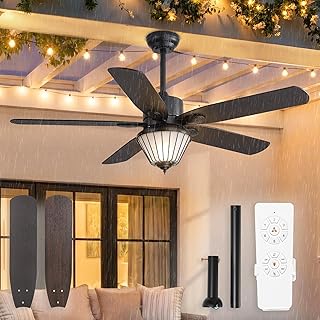

How to Choose a Ceiling Fan For Patio (2026)
- Wet vs. damp rating: A deep, fully covered porch can take a damp-rated fan, but anything within reach of driven rain, pool spray, or open sky needs a wet rating. IP65 and IP66 designations are the clearest signal a manufacturer has actually sealed the housing and light module.
- Power and mounting reality: Hardwired fans give you a cleaner ceiling and no visible cord, while plug-in caged models hang from a standard hook and need only a nearby GFCI outlet. Renters and anyone without existing wiring should filter for the hook-and-plug design first.
- Airflow matched to the space: Sweep and CFM matter more outdoors, where there are no walls to contain the air. Compact 20 to 24 inch fans handle a seating nook or a 10 by 12 foot gazebo; a 52 or 56 inch fan is what you want for a full outdoor dining setup or a long covered veranda.
- Motor type and noise: DC motors draw less power, run quieter, and offer six or more speeds instead of the traditional three, which means you can find a whisper-level setting for conversation. Reversible operation also lets the fan push warm air down under a heated pergola in cooler months.
- Lighting flexibility: Look for dimmable 3CCT modules so you can shift from bright task light to a warm 3000K glow after dinner. App or remote control is worth prioritizing outdoors, where wall switches are often awkwardly placed or nonexistent.
The Best Ceiling Fan For Patio (2026)s Reviewed
addlon 20″ Caged Outdoor Ceiling Fan with Light
The most straightforward solution for a porch with no ceiling wiring: it hangs from a hook, plugs into an outlet, and delivers IP65 protection with six DC speeds and a timer. The caged form factor reads industrial-modern rather than utilitarian, which makes it an easy fit above a bistro table or a hanging chair.
LEDIARY 20″ Waterproof Black Outdoor Fan
A refined take on the same plug-in concept, with app control layered on top of the remote and a 3CCT dimmable light that genuinely changes the mood of a small space. LEDIARY rates it for roughly a 10 by 12 foot area, making it a precise match for standard gazebos and screened side porches.
56″ Wet-Rated High-CFM Outdoor Fan
This is the airflow choice, pairing a large sweep with seven UV-coated blades that resist the chalky sun fade that ruins darker finishes. The quiet DC motor keeps it civilized at high speed, which matters when you are running it over a dining table for hours.
56″ IP66 Outdoor Ceiling Fan with App Control
The IP66 rating is the strongest weather sealing in this roundup, and auto memory means the fan resumes your last speed and color temperature without fiddling. Choose it for exposed edges of a patio, pergolas with slatted tops, or coastal installations.
52″ Dual-Finish Outdoor Ceiling Fan
The five dual-finish blades give this one a farmhouse-leaning look that sits well with wood ceilings and rattan furniture, without sacrificing the IP65 wet rating. At 52 inches it is the sensible middle ground for mid-size covered patios where a 56 inch sweep would crowd the space.
Frequently Asked Questions
Can I use an indoor ceiling fan on a covered patio?
Not reliably. Indoor fans use unsealed motor housings and untreated blades that absorb moisture, leading to wobble, rust, and electrical faults. Building codes generally require a damp or wet-rated fixture in these locations.
What size fan do I need for my patio?
Measure your covered area. Up to about 120 square feet is comfortable with a 20 to 24 inch fan; 200 to 300 square feet suits a 52 inch fan; anything larger benefits from a 56 inch sweep or two smaller fans spaced apart.
Are plug-in patio fans safe outdoors?
Yes, when the fan carries a wet or IP65 rating and plugs into a GFCI-protected exterior outlet. Keep the cord secured and out of standing water, and avoid running it through an indoor extension cord.
How much clearance does a patio fan need?
Aim for at least seven feet from the floor to the blades and eighteen inches from the blade tips to any wall, post, or beam. Low porch ceilings call for a flush or low-profile mount rather than a downrod.
Final Thoughts
For most covered patios, the 56″ IP66 outdoor fan is the safest long-term investment thanks to its stronger weather sealing and app control, while the 56″ wet-rated high-CFM model is the better pick if raw airflow over a dining area is your priority. If your ceiling has no wiring, the LEDIARY 20″ plug-in fan solves the problem elegantly and looks intentional doing it.