Key takeaways
- Motor type: DC motors run quieter, draw roughly 60–70% less power, and offer more speed steps than AC. If the fan sits in a bedroom or a room where you watch anything with dialogue, DC is worth the premium.
- Ceiling height and mount style: Under 8 feet, go flush mount or low profile. Above 9 feet, a downrod brings the blades into the airflow zone where you’ll actually feel them. Getting this wrong is the most common source of buyer’s remorse.
- Light temperature control: 3CCT (typically 3000K/4000K/5000K) lets one fixture serve a bright morning kitchen and a warm evening living room. Check that dimming works independently of color switching — on cheaper units they’re linked.
- Blade span versus room size: 52 inches suits rooms from roughly 225 to 400 square feet. A 44-inch fan is right for bedrooms, offices, and apartments where a larger span would visually crowd the ceiling.
- Damp versus wet rating: “Indoor/outdoor” usually means damp-rated: covered porches and sunrooms only. Direct exposure to rain requires a wet rating, which is rarer and stated explicitly.
What's inside
Ceiling fans occupy an awkward spot in home design: they hang at eye level in the most-looked-at plane of a room, yet most shoppers pick one in under ten minutes based on blade count alone. The result is a fixture that either disappears into the ceiling or fights the room for attention — and a motor that hums through every quiet evening. The 2026 crop has largely solved the noise problem thanks to DC motors, but it has introduced new decisions: color temperature switching, app ecosystems, flush-mount geometry, and outdoor ratings that vary more than the listings suggest.
This guide looks at six of the most consistently well-rated ceiling fans available right now, judged on the criteria that actually matter after installation day: airflow at low speeds, light quality across color modes, how much the housing reads as intentional design rather than hardware-store default, and whether the remote or app is something you’ll still use in month six. We’ve included both modern minimalist profiles and one traditional workhorse, because not every room wants a matte black disc on the ceiling.
As an Amazon Associate we earn from qualifying purchases.


How to Choose a Ceiling Fan Ratings (2026)
- Motor type: DC motors run quieter, draw roughly 60–70% less power, and offer more speed steps than AC. If the fan sits in a bedroom or a room where you watch anything with dialogue, DC is worth the premium.
- Ceiling height and mount style: Under 8 feet, go flush mount or low profile. Above 9 feet, a downrod brings the blades into the airflow zone where you’ll actually feel them. Getting this wrong is the most common source of buyer’s remorse.
- Light temperature control: 3CCT (typically 3000K/4000K/5000K) lets one fixture serve a bright morning kitchen and a warm evening living room. Check that dimming works independently of color switching — on cheaper units they’re linked.
- Blade span versus room size: 52 inches suits rooms from roughly 225 to 400 square feet. A 44-inch fan is right for bedrooms, offices, and apartments where a larger span would visually crowd the ceiling.
- Damp versus wet rating: “Indoor/outdoor” usually means damp-rated: covered porches and sunrooms only. Direct exposure to rain requires a wet rating, which is rarer and stated explicitly.
The Best Ceiling Fan Ratings (2026)s Reviewed
Passky 52″ Black Ceiling Fan with Light
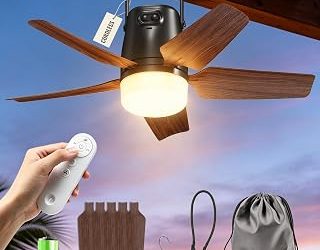
This is the pick for anyone who wants the full modern feature set without the smart-home commitment: 3-color dimmable LED, reversible DC motor, timer, app control, and memory that recalls your last settings after a power cut. The matte black finish and slim blade profile read as deliberate in contemporary rooms, and it’s damp-rated for covered outdoor areas.
52″ Modern Ceiling Fan with Lights and Remote
A well-balanced generalist that hits the essentials — DC reversible motor, genuinely low noise, 3CCT lighting — without decorative flourishes that date quickly. Its restraint makes it the safest choice for open-plan spaces where the fan needs to coexist with several other design decisions.
Hunter Builder Deluxe 52″ in New Bronze
The traditionalist in this group and the only one here with pull-chain operation, which some households genuinely prefer over hunting for a remote. Hunter’s WhisperWind-class motor and the New Bronze finish suit transitional and craftsman interiors where a black minimalist fan would look imported from a different house.
DREO 44″ Flush Mount Smart Ceiling Fan
The strongest option for low ceilings and smaller rooms, with a flush-mount body that sits tight against the plaster and smart control that’s actually well-implemented rather than bolted on. At 44 inches it’s proportioned for bedrooms and home offices where a 52-inch span would dominate.
OJX 52″ Ceiling Fan with Remote and App Control
OJX pairs a quiet DC reversible motor with both remote and app control, plus 3CCT dimmable lighting — a specification sheet close to the Passky, with a slightly different blade geometry that suits kitchens and dining areas. Good airflow at the lowest speed setting, which is where most fans disappoint.
ZMISHIBO 52″ Low Profile Flush Mount
A low-profile 52-inch design is an unusual combination, and it makes this the answer for larger rooms with eight-foot ceilings. The 20W dimmable LED is brighter than the flush housing suggests, and airflow holds up well despite the reduced blade pitch clearance.
Frequently Asked Questions
Do ceiling fans help in winter?
Yes, if the motor reverses. Running clockwise at low speed pulls warm air down from the ceiling without creating a draft, which can make a heated room feel usable at a lower thermostat setting. Every DC fan on this list reverses.
Is a flush mount fan less effective?
Slightly, because the blades sit closer to the ceiling and have less air to draw from. The tradeoff is worth it under 8 feet, where a downrod fan becomes a head-height hazard and a visual obstruction.
How loud is a quiet ceiling fan, really?
A good DC fan produces almost no motor noise; what you hear is air movement across the blades at higher speeds. Persistent clicking or wobble is nearly always an installation issue — usually an unbalanced blade or a loose canopy screw.
Can I install one myself?
If you’re replacing an existing fixture on a fan-rated electrical box, yes, and most of these ship with tool-free blade attachment. If there’s no box, or the existing one is light-fixture-rated only, hire an electrician — fan boxes carry a dynamic load that standard boxes aren’t built for.
Final Thoughts
For most rooms, the Passky 52″ is the best-rounded choice in 2026: quiet DC motor, flexible 3CCT lighting, and a finish that flatters modern interiors. If your ceilings are low, the DREO 44″ flush mount solves the proportion problem more elegantly than anything else here, and the ZMISHIBO covers the same need at a larger span. And if your home leans traditional, the Hunter Builder Deluxe remains the sensible, well-built default.