Key takeaways
- Lumens over wattage: Wattage tells you power draw, not brightness. Aim for roughly 2,000–3,000 lumens for a bedroom and 3,000+ for a living room or kitchen where the fan is the primary light source. A stated figure like 3200LM is far more useful than “super bright LED.”
- Color temperature range: A 3CCT or full 3000K–6500K span lets one fixture serve two moods: warm and low for evenings, cool and crisp for cooking or working. Pair it with true dimming rather than fixed brightness steps if you’re sensitive to glare.
- Diffuser quality: Frosted, edge-lit panels spread light evenly across a ceiling. Exposed LED arrays behind clear covers read brighter on paper but create harsh shadows and visible dots, which flattens a room’s atmosphere.
- Profile and clearance: Standard ceilings under 8 feet call for flush-mount or bladeless designs. Rooms with 9-foot ceilings and up can take a 52-inch bladed fan on a downrod, which moves noticeably more air.
- Motor type and controls: A DC motor runs quieter, uses less energy, and gives you more speed increments than an AC motor. Look for reversible operation for winter circulation, plus remote or app control with memory so you’re not resetting your preferences nightly.
What's inside
Ceiling fans have quietly become the hardest-working fixture in a modern home, which is exactly why so many of them disappoint. Most are engineered around airflow first and light second, so you end up with a room that moves air beautifully at 3pm and turns murky by 8pm. If a fan is the only thing hanging from your ceiling, it has to carry the whole lighting load for that room, and a lot of models simply don’t produce enough lumens to do it.
This guide focuses on ceiling fans that genuinely light a room: high-output LED panels, wide 3000K–6500K color temperature ranges, real dimming control, and diffusers that spread light instead of punching a hotspot into your ceiling. Below you’ll find the models worth shortlisting in 2026, followed by a practical buying framework, honest notes on each pick, and answers to the questions that come up most once you start comparing spec sheets.
As an Amazon Associate we earn from qualifying purchases.


How to Choose a Ceiling Fan With Brightest Light (2026)
- Lumens over wattage: Wattage tells you power draw, not brightness. Aim for roughly 2,000–3,000 lumens for a bedroom and 3,000+ for a living room or kitchen where the fan is the primary light source. A stated figure like 3200LM is far more useful than “super bright LED.”
- Color temperature range: A 3CCT or full 3000K–6500K span lets one fixture serve two moods: warm and low for evenings, cool and crisp for cooking or working. Pair it with true dimming rather than fixed brightness steps if you’re sensitive to glare.
- Diffuser quality: Frosted, edge-lit panels spread light evenly across a ceiling. Exposed LED arrays behind clear covers read brighter on paper but create harsh shadows and visible dots, which flattens a room’s atmosphere.
- Profile and clearance: Standard ceilings under 8 feet call for flush-mount or bladeless designs. Rooms with 9-foot ceilings and up can take a 52-inch bladed fan on a downrod, which moves noticeably more air.
- Motor type and controls: A DC motor runs quieter, uses less energy, and gives you more speed increments than an AC motor. Look for reversible operation for winter circulation, plus remote or app control with memory so you’re not resetting your preferences nightly.
The Best Ceiling Fan With Brightest Light (2026)s Reviewed
52″ Modern Ceiling Fan with 3CCT Light and Remote
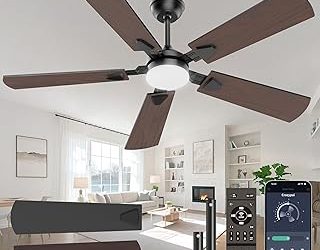
This is the sensible default for a main living space: a 52-inch sweep on a reversible DC motor, three color temperatures, and enough output to serve as a room’s only fixture. It’s genuinely quiet at low speeds, which matters more than most buyers expect in an open-plan layout.
PACOVY 20″ Flush Fandelier
At 3200 lumens from a 20-inch flush body, this is the brightest-per-inch option here and the one I’d specify for a low ceiling that still needs real illumination. The 3000K–6500K dimmable range and app control make it flexible, and the copper motor keeps noise low despite the compact housing.
VOLISUN 27.6″ Bladeless Fandelier, Black
The bladeless form reads as a modern light fixture first and a fan second, which is ideal in rooms where a traditional fan would feel visually heavy. Black finish grounds a pale ceiling nicely, and the flush mount clears low headroom without sacrificing brightness.
VOLISUN 27.6″ Flush Mount Fandelier, White
Identical performance to its black sibling with a white body that all but disappears into the ceiling plane, making it the better choice for minimalist and coastal interiors. The full 3000K–6500K dimmable range gives it the versatility to work in a bedroom or a home office.
Passky 52″ Black Sleek Ceiling Fan
A cleanly detailed 52-inch fan with three-color dimmable light, timer, memory function, and app support, rated for covered outdoor use. If you want one fan for a porch or a sunroom that doesn’t look like patio hardware, this is the pick.
Frequently Asked Questions
How many lumens do I actually need?
Multiply your room’s square footage by 20 for a rough baseline in living areas, or by 10–15 for bedrooms. A 200-square-foot living room wants around 3,000–4,000 lumens if the fan is the only fixture.
Are bladeless fandeliers as effective at cooling?
They move less air than a 52-inch bladed fan, so treat them as a strong choice for bedrooms, hallways, and small rooms rather than large open spaces. Their advantage is clearance and a cleaner silhouette.
Does a DC motor make a real difference?
Yes, on two fronts: it’s meaningfully quieter and uses roughly 60–70% less energy than a comparable AC motor. It also enables finer speed control, often six speeds instead of three.
Can I install one of these myself?
If you have an existing fan-rated ceiling box and are comfortable working with the breaker off, most of these are one-person jobs. If your box is only rated for a light fixture, hire an electrician; fan weight and vibration require proper bracing.
Final Thoughts
For the brightest light in the smallest footprint, the PACOVY 20″ flush fandelier is hard to beat at 3200 lumens. If you have the ceiling height for it, the 52″ 3CCT modern fan delivers the best balance of airflow and illumination for a main living space, while the VOLISUN 27.6″ bladeless fandelier is the one to choose when the fixture needs to look like considered design rather than an appliance.