Key takeaways
- Color temperature: Stay at 2700K for living and dining spaces. It flatters wood, brass, plaster, and skin tones. Anything at 3000K or above starts reading commercial in a decorative fixture, and 2500K skews amber for a deliberately vintage mood.
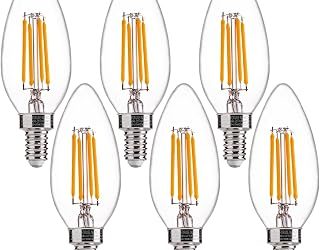
- Bulb shape and tip: B10 and B11 are straight-sided torpedoes; CA10 flame tips have a bent, candle-like point. Exposed sockets show the silhouette, so match all bulbs in a fixture and orient flame tips the same direction.
- Dimming quality: A chandelier lives on a dimmer. Look for bulbs explicitly rated dimmable, and expect smooth low-end fade rather than a hard cutoff. Older triac dimmers paired with low-wattage LEDs are the usual culprit behind buzz and flicker.
- CRI and filament design: Color rendering above 90 is the difference between light that looks convincing and light that looks synthetic. Clear glass with visible filament strips mimics an incandescent coil and keeps the sparkle in cut-glass or crystal arms.
- Lumens per socket: Multiply, do not guess. Six 450-lumen bulbs land near 2,700 lumens, which is plenty for a dining room. A twelve-arm fixture at 600 lumens each will be too bright unless it is on a dimmer.
What's inside
A chandelier is usually the most decisive object in a room, and yet the thing that makes or breaks it costs a few dollars and screws in from below. Swap in the wrong candelabra bulb and the whole fixture reads cheap: cool blue light flattening a warm brass finish, mismatched tips poking out at different heights, a flicker on the dimmer that pulls your eye every time someone walks past. Most people shop for a chandelier for weeks and then buy the bulbs in thirty seconds.
This guide fixes that. Below are the candelabra bulbs worth putting in a fixture you actually care about, spanning classic incandescent for people who want that unmistakable glow and modern LED filament for people who want the same look without the heat, the wattage, or the annual replacement ritual. We look at color temperature, dimming behavior, color rendering, bulb shape, and how each one reads in an open, exposed socket where there is nowhere to hide.
As an Amazon Associate we earn from qualifying purchases.



How to Choose a Light Bulb For Chandelier (2026)
- Color temperature: Stay at 2700K for living and dining spaces. It flatters wood, brass, plaster, and skin tones. Anything at 3000K or above starts reading commercial in a decorative fixture, and 2500K skews amber for a deliberately vintage mood.
- Bulb shape and tip: B10 and B11 are straight-sided torpedoes; CA10 flame tips have a bent, candle-like point. Exposed sockets show the silhouette, so match all bulbs in a fixture and orient flame tips the same direction.
- Dimming quality: A chandelier lives on a dimmer. Look for bulbs explicitly rated dimmable, and expect smooth low-end fade rather than a hard cutoff. Older triac dimmers paired with low-wattage LEDs are the usual culprit behind buzz and flicker.
- CRI and filament design: Color rendering above 90 is the difference between light that looks convincing and light that looks synthetic. Clear glass with visible filament strips mimics an incandescent coil and keeps the sparkle in cut-glass or crystal arms.
- Lumens per socket: Multiply, do not guess. Six 450-lumen bulbs land near 2,700 lumens, which is plenty for a dining room. A twelve-arm fixture at 600 lumens each will be too bright unless it is on a dimmer.
The Best Light Bulb For Chandelier (2026)s Reviewed
Hizashi 90+ CRI LED Candelabra Bulb, 12-Pack
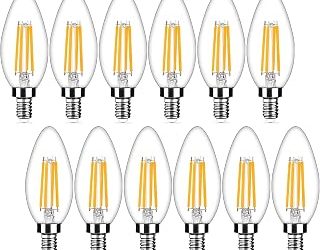
The best all-around pick here, largely because of the 90+ CRI rating, which keeps warm metals and painted finishes looking true instead of washed out. The CA10 flame tip and 450-lumen output at 4W make it a clean one-for-one replacement for a 40W incandescent, and the UL listing is reassuring in a fixture that stays on for hours.
60W Equivalent LED Chandelier Bulbs, Clear B11, 6-Pack
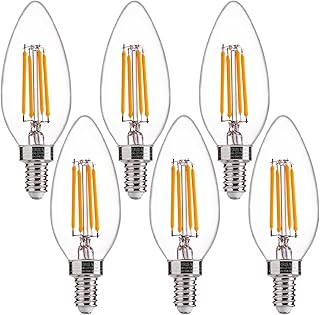
Choose this one when your chandelier is the room’s primary light source rather than an accent. The clear B11 glass and visible filament read almost identically to incandescent when dimmed low, and the 60W-equivalent output covers larger dining rooms and entryways without adding a second fixture.
E12 Flame Tip LED Candle Bulbs, 4W, 12-Pack
A sensible bulk buy for multi-arm fixtures or homes with several chandeliers and sconces on the same dimmer circuit. At 460 lumens and 2700K, it delivers a soft, even wash that pairs well with fabric shades and candle sleeves.
60W Candelabra Incandescent Bulbs, Clear B10, 12-Pack
For purists. Nothing in the LED category quite replicates the deep amber roll-off of a real incandescent filament at 10 percent brightness, and at 600 lumens with true 2700K warmth it is still the reference standard. Accept the heat and shorter lifespan as the trade.
12-Pack Dimmable E12 LED Candelabra Bulbs, Vintage B11
The value play, with clear glass and a vintage filament layout that photographs well in exposed sockets. Output sits at 450 lumens, so plan on six or more sockets if this is your only light in the room.
Frequently Asked Questions
What is the difference between E12 and E26 bases?
E12 is the narrow candelabra screw base used in nearly all chandeliers, sconces, and small pendants. E26 is the standard household size. They are not interchangeable without an adapter, which is rarely worth it in a decorative fixture.
Should I use LED or incandescent in a chandelier?
LED for almost every situation: less heat near the ceiling, far longer life, and lower load on old wiring. Incandescent still wins on dimming character, so keep a pack on hand if you have a fixture you dim very low regularly.
Why do my LED chandelier bulbs flicker?
Usually a dimmer mismatch. Legacy dimmers were designed for higher electrical loads than a set of 4W LEDs draws. Swapping to an LED-compatible dimmer resolves it in most homes.
Can I mix bulb styles in one fixture?
Not if the sockets are exposed. Mixing flame tips with torpedo shapes or different color temperatures immediately looks unintentional. Buy one multi-pack and replace the whole set at once.
Final Thoughts
For most homes, the Hizashi 90+ CRI candelabra bulbs are the pick that requires the least compromise, delivering accurate color and clean dimming in a twelve-pack that covers a full fixture. If your chandelier carries the whole room, step up to the 60W Equivalent Clear B11 LED bulbs, and if you want the true old-world glow on a low dimmer, the 60W Clear B10 incandescents remain worth their inefficiency.