Key takeaways
- Match CFM to cubic feet, not square feet: Ceiling height is the variable most buyers ignore. A 12×14 bedroom with 8-foot ceilings is well served by 5,000–6,000 CFM, while the same footprint under a vaulted 16-foot ceiling needs closer to double that to move air down where people are.
- Insist on a DC motor: DC motors draw roughly 60–70% less power than AC equivalents, run measurably quieter, and unlock six or more speeds instead of three. For any fan you will sit beneath for hours, this is the single highest-value upgrade.
- Read the blade material and pitch: Aluminum blades stay rigid at high RPM, which is why every serious high-CFM fan uses them. Steeper pitch moves more air per rotation, so a three-blade fan with aggressive pitch often outperforms a five-blade fan with flat, decorative blades.
- Confirm the wet or damp rating: Covered patios and gazebos need damp-rated housings at minimum; anything exposed to blowing rain requires wet-rated. Installing an indoor fan outdoors voids the warranty and corrodes the motor housing within a season.
- Check downrod length and reversibility: Blades belong 8–9 feet off the floor for optimal circulation, so tall ceilings need included or purchasable downrods. Reversible motors let the same fixture pull warm air down in winter, which materially lowers heating bills in double-height spaces.
What's inside
Airflow is the one ceiling fan spec almost nobody checks before buying, and it is the only one that determines whether a room actually feels cooler. CFM (cubic feet per minute) measures how much air a fan moves, and the gap between models is enormous: a decorative flush-mount might push 2,000 CFM, while an HVLS industrial fan clears 28,000. Blade count, finish, and light temperature all matter to how a room reads, but if the airflow is wrong, you have installed a sculpture.
This guide approaches high-CFM fans the way a designer would specify them: matching sweep and output to ceiling volume, then filtering for motor quality, noise, and whether the fixture belongs in a living room or a 30-foot shop bay. Below you will find picks spanning 52 inches to 120 inches, from a gold-accented bedroom fan to warehouse-grade movers, plus the buying criteria that separate genuinely powerful fans from ones that simply spin fast.
As an Amazon Associate we earn from qualifying purchases.




How to Choose a/an Cfm Ceiling Fan (2026)
- Match CFM to cubic feet, not square feet: Ceiling height is the variable most buyers ignore. A 12×14 bedroom with 8-foot ceilings is well served by 5,000–6,000 CFM, while the same footprint under a vaulted 16-foot ceiling needs closer to double that to move air down where people are.
- Insist on a DC motor: DC motors draw roughly 60–70% less power than AC equivalents, run measurably quieter, and unlock six or more speeds instead of three. For any fan you will sit beneath for hours, this is the single highest-value upgrade.
- Read the blade material and pitch: Aluminum blades stay rigid at high RPM, which is why every serious high-CFM fan uses them. Steeper pitch moves more air per rotation, so a three-blade fan with aggressive pitch often outperforms a five-blade fan with flat, decorative blades.
- Confirm the wet or damp rating: Covered patios and gazebos need damp-rated housings at minimum; anything exposed to blowing rain requires wet-rated. Installing an indoor fan outdoors voids the warranty and corrodes the motor housing within a season.
- Check downrod length and reversibility: Blades belong 8–9 feet off the floor for optimal circulation, so tall ceilings need included or purchasable downrods. Reversible motors let the same fixture pull warm air down in winter, which materially lowers heating bills in double-height spaces.
The Best Cfm Ceiling Fan (2026)s Reviewed
AA-Orion 120″ HVLS Industrial Ceiling Fan
At over 28,000 CFM from a PMSM motor, this is the fan you specify when a warehouse, gym, or barn needs genuine air replacement rather than a breeze. The permanent-magnet motor runs remarkably composed for its scale, and reversibility makes it a year-round destratification tool in tall buildings.
120 Inch Extra Large Industrial Ceiling Fan
Six silver aluminum blades and three included downrods make this the more flexible of the two 120-inch options, particularly for shop or garage ceilings where mounting height varies. The quiet DC motor and six-speed remote mean you can dial it back to a low hum for detail work instead of choosing between off and gale.
ZMISHIBO 96 Inch Ceiling Fans with Lights
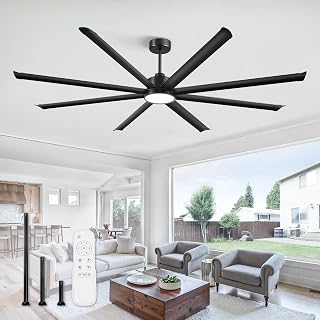
This is the rare industrial-grade fan that does not look industrial once installed: eight reversible aluminum blades, integrated 3CCT lighting, and a damp rating that suits gazebos and covered patios as readily as a shop. It is the best bridge between commercial airflow and residential aesthetics on this list.
60 in Ceiling Fan with 7,400+ CFM
Three steeply pitched blades and a noiseless DC motor deliver output well beyond what a 60-inch fan typically manages, making this a strong pick for great rooms and large patios. The timer and 3 CCT lighting add genuine daily utility rather than spec-sheet filler.
ZMISHIBO 72″ Ceiling Fans with Lights
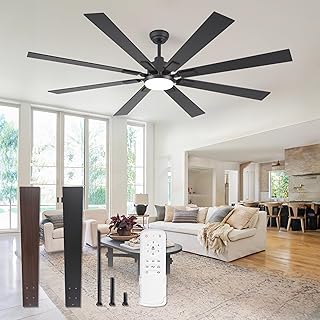
The dual-finish black housing gives this fan a tailored, almost architectural presence over a seating group or dining table. Powerful airflow, a 24W 3 CCT LED, and damp rating make it my default recommendation for covered outdoor rooms that need to look designed.
Frequently Asked Questions
How much CFM do I actually need?
For standard 8-foot ceilings, target roughly 4,000–6,000 CFM in bedrooms and 6,000–8,000 in living rooms. Vaulted ceilings, open-plan spaces, and garages benefit from 10,000 CFM or more, and commercial spaces move into HVLS territory above 20,000.
Do more blades mean more airflow?
No. Blade pitch, motor torque, and RPM drive CFM; additional blades add drag and often reduce output. Three- and six-blade aluminum designs consistently outperform decorative five-blade fans.
Are high-CFM fans loud?
Not inherently. Noise comes from cheap AC motors and flexing blades, not airflow itself. A well-balanced DC motor with rigid aluminum blades stays quiet even at higher speeds.
What does 3 CCT lighting mean?
It lets you switch the integrated LED between three color temperatures, typically warm, neutral, and daylight, without changing bulbs. Warm suits bedrooms and patios; daylight suits garages and workspaces.
Final Thoughts
If you need maximum air movement in a large commercial space, the AA-Orion 120″ HVLS fan is the clear specification. For homes, the ZMISHIABO 96 Inch delivers industrial output without visual compromise, while the ZMISHIBO 72″ remains the most design-forward choice for covered patios and open living rooms.