Key takeaways
- Match pints to volume, not square footage: Basements have low ceilings but high moisture loads from soil contact. A 70-pint unit handles a dry-ish 1,000 sq ft; a damp 2,000 sq ft space with a sump wants 155 pints or more. Oversizing costs less than running an undersized unit at 100% duty cycle.
- Insist on an internal pump, not just a gravity hose: Gravity drainage only works if you have a floor drain below the outlet port. A built-in condensate pump lifts water up to a utility sink or window, which is what most finished basements actually need.
- Auto-defrost is non-negotiable below 65°F: Cold coils ice over and extraction stops. Genuine auto-defrost lets the compressor keep cycling in unconditioned crawl spaces and garages through shoulder seasons.
- Weigh noise and visual footprint for living space: Commercial units run 50 to 60 dB. If the basement doubles as a den or guest room, favor a compact chassis you can tuck behind a console or into a mechanical closet with clearance on the intake side.
- Check the humidistat and restart behavior: A digital set point with memory restart means the unit resumes your target after a power blip instead of sitting idle for a week while you are away. Energy Star certification is worth seeking on anything running continuously.
What's inside
A basement is the last room in the house to get design attention and the first to sabotage it. You finish the walls, lay down a wool rug, move in the mid-century credenza you found at an estate sale, and three humid weeks later the room smells like a wet paperback. Moisture in below-grade space is not a housekeeping failure; it is physics. Cool masonry meets warm summer air, condensation forms on every cold surface, and the relative humidity climbs past 60% where mold spores, dust mites, and cupping hardwood all start to thrive. Consumer dehumidifiers are built for a bedroom’s worth of air. A finished or semi-finished basement, a crawl space, or a 1,500-square-foot open plan with a laundry area is a different assignment entirely.
This guide looks at commercial-grade units through a furnishing lens: what actually protects veneer, upholstery, leather, and engineered flooring in a below-grade room, and what it costs you in noise, footprint, and electricity. We cover pint capacities from 70 up to 305, why an internal condensate pump matters more than raw extraction numbers, how auto-defrost keeps a unit working in an unheated slab space in February, and which models suit a living area versus a utility zone or an active water-damage job. Every pick below is a real, currently available unit, ranked by how well it holds a stable humidity target without dominating the room.
As an Amazon Associate we earn from qualifying purchases.


How to Choose a Commercial Dehumidifier For Basement (2026)
- Match pints to volume, not square footage: Basements have low ceilings but high moisture loads from soil contact. A 70-pint unit handles a dry-ish 1,000 sq ft; a damp 2,000 sq ft space with a sump wants 155 pints or more. Oversizing costs less than running an undersized unit at 100% duty cycle.
- Insist on an internal pump, not just a gravity hose: Gravity drainage only works if you have a floor drain below the outlet port. A built-in condensate pump lifts water up to a utility sink or window, which is what most finished basements actually need.
- Auto-defrost is non-negotiable below 65°F: Cold coils ice over and extraction stops. Genuine auto-defrost lets the compressor keep cycling in unconditioned crawl spaces and garages through shoulder seasons.
- Weigh noise and visual footprint for living space: Commercial units run 50 to 60 dB. If the basement doubles as a den or guest room, favor a compact chassis you can tuck behind a console or into a mechanical closet with clearance on the intake side.
- Check the humidistat and restart behavior: A digital set point with memory restart means the unit resumes your target after a power blip instead of sitting idle for a week while you are away. Energy Star certification is worth seeking on anything running continuously.
The Best Commercial Dehumidifier For Basement (2026)s Reviewed
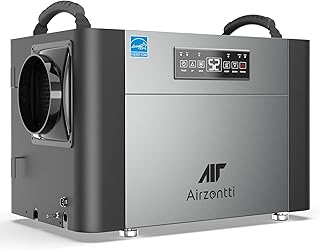
ALORAIR Sentinel HD55 113 Pint
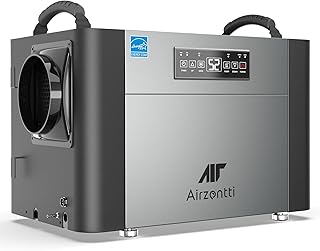
The most design-friendly pick here: a squat, stackable chassis engineered for crawl spaces and low-clearance basements where a tower unit will not fit. Auto-defrost and a long drain hose make it a genuine set-and-forget appliance, and ALORAIR’s service reputation in the restoration trade is the reason contractors keep buying it.
155 Pint Commercial Dehumidifier with Pump and Drain
Our overall value recommendation for a full-basement install, pairing Energy Star efficiency with enough capacity for attics, garages, and whole-house duty. The integrated pump plus hose combination removes the single most common installation headache, and it holds a set point tightly rather than swinging.
200 Pints Commercial Dehumidifier with Pump
Step up here when you are drying masonry, a post-flood subfloor, or a large open warehouse-style basement. Extraction is aggressive enough to pull a saturated space down in days, and auto-defrost keeps it productive in cold conditions where lighter units stall.
260 Pints Heavy Duty Commercial Dehumidifier
A true restoration-grade machine for spaces above roughly 2,500 square feet or persistent groundwater intrusion. Loud and utilitarian, so plan on a mechanical room rather than a media area, but nothing in the consumer tier competes on sheer throughput.
Aeroid 70 Pints Commercial Dehumidifier
The right call for a smaller finished basement or a moderately damp townhouse lower level. Energy Star rating, smart memory restart, and both pump and gravity drain options give you commercial reliability at a residential noise and power profile.
Frequently Asked Questions
What humidity level should I target in a basement?
Aim for 45% to 50% relative humidity. That range suppresses mold and dust mites while keeping solid-wood furniture and engineered flooring dimensionally stable. Below 35% you risk joint shrinkage in case goods and cracking in leather.
Do I need a commercial unit if my basement is finished?
Often yes. Finished walls hide the masonry but do not stop vapor diffusion through the slab and footings. A commercial unit with a proper humidistat spends most of its time cycling gently, which is quieter and cheaper than a small unit running flat out.
Can I run the drain hose into a floor drain or sump?
Yes, and gravity drainage is the most failure-resistant option when the drain sits below the outlet port. Use the pump when it does not, and secure the hose so it cannot kink behind furniture.
How much will it add to my power bill?
Expect roughly 500 to 1,200 watts while the compressor runs, depending on capacity. Energy Star models and a realistic set point matter more than nameplate wattage, since a correctly sized unit spends far less time running.
Final Thoughts
For most finished or partially finished basements, the 155 Pint Commercial Dehumidifier with pump and drain is the sweet spot of capacity, efficiency, and quiet operation. Tight crawl spaces and low-clearance rooms are better served by the ALORAIR Sentinel HD55, while anyone drying out real water damage or a warehouse-scale lower level should go straight to the 260 Pint heavy-duty unit and not look back.