Key takeaways
- Read suction claims skeptically: A 40,000Pa or 45kPa rating is measured at the motor inlet, not the floor head. Nozzle sealing, brush design, and airflow path matter more, so weigh reviews describing real pickup on your flooring type over the headline number.
- Check battery architecture, not just runtime: A 45- to 60-minute claim usually applies to eco mode. Detachable batteries are the more meaningful feature at this price, because they let you swap or replace a cell instead of replacing the whole machine in year three.
- Prioritize washable HEPA filtration: Sealed, rinsable multi-stage filters keep fine dust from venting back into the room and eliminate consumable costs. Confirm the filter dries fully between washes, which typically means 24 hours and a spare worth buying.
- Decide where it will live before you buy: Wall docks charge and store in one move but require a stud or anchor near an outlet. Self-standing designs suit renters and tight utility closets, though they take up floor space and tip more easily on rugs.
- Weigh the handheld, not the assembly: Under 3.5 pounds in stick form is comfortable overhead; what matters for stairs and car interiors is how the detached handheld unit balances in one hand with a crevice tool attached.
What's inside
The sub-$100 cordless category has quietly become the most crowded shelf in home cleaning, and it is also the hardest to shop honestly. Suction numbers are printed in Pascals that no one can visualize, runtime figures assume the lowest power setting on bare floors, and two vacuums with nearly identical spec sheets can behave completely differently on a wool rug. Meanwhile the vacuum itself has changed roles: in apartments and open-plan homes, it no longer hides in a hall closet. It hangs on a wall by the entry or stands upright beside a console, which means the thing has to look intentional as well as work.
This guide approaches the category the way a designer would specify any other visible fixture: performance first, then footprint, materials, and how it reads in a finished room. Below you will find current picks in the under-$100 range, followed by the criteria that actually separate a capable lightweight stick vacuum from a plastic disappointment, short reviews of the strongest options, and answers to the questions buyers ask most before committing.
As an Amazon Associate we earn from qualifying purchases.


How to Choose a Cordless Stick Vacuum Under $100 (2026)
- Read suction claims skeptically: A 40,000Pa or 45kPa rating is measured at the motor inlet, not the floor head. Nozzle sealing, brush design, and airflow path matter more, so weigh reviews describing real pickup on your flooring type over the headline number.
- Check battery architecture, not just runtime: A 45- to 60-minute claim usually applies to eco mode. Detachable batteries are the more meaningful feature at this price, because they let you swap or replace a cell instead of replacing the whole machine in year three.
- Prioritize washable HEPA filtration: Sealed, rinsable multi-stage filters keep fine dust from venting back into the room and eliminate consumable costs. Confirm the filter dries fully between washes, which typically means 24 hours and a spare worth buying.
- Decide where it will live before you buy: Wall docks charge and store in one move but require a stud or anchor near an outlet. Self-standing designs suit renters and tight utility closets, though they take up floor space and tip more easily on rugs.
- Weigh the handheld, not the assembly: Under 3.5 pounds in stick form is comfortable overhead; what matters for stairs and car interiors is how the detached handheld unit balances in one hand with a crevice tool attached.
The Best Cordless Stick Vacuums Under $100 (2026), Reviewed
KARDV 8-in-1 Cordless Stick Vacuum
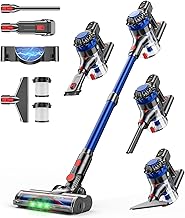
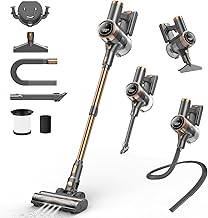
The most complete package in this price band: 500W motor, an LED display that reports mode and remaining charge instead of making you guess, and a wall-mount dock that keeps the whole system off the floor. The anti-tangle brush roll is the standout for long-hair households, and the eight-piece tool set covers upholstery, vents, and ceiling corners without add-on purchases.
Tikom V500 Cordless Stick Vacuum
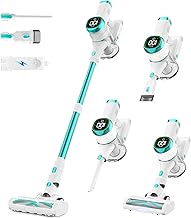
Tikom’s LED touchscreen and matte blue finish give this one the cleanest visual read of the group, which matters if it lives in view. The 450W motor handles hard floors and low-pile carpet confidently, and the included charging dock makes it a straightforward pick for an entry wall or laundry nook.
CHEBIO 6-in-1 Self-Standing Cordless Vacuum
The self-standing body is the reason to choose this over dock-dependent rivals; it parks upright in a closet without hardware, which renters will appreciate. At 45kPa with a 45-minute run and an anti-tangle brush, it covers a one-bedroom in a single charge, and the red colorway is a deliberate accent rather than an afterthought.
Detachable-Battery Stick Vacuum with HEPA Filter
The removable battery is the smartest long-term feature here, letting you charge a spare or replace a worn cell rather than the machine. A 55-minute rated runtime, sealed HEPA filtration, and an LED headlamp for baseboards round out a genuinely practical, low-drama choice.
iwoly C150 Cordless Handheld Stick Vacuum
At 18,000Pa this is the lightest-duty option, and that is precisely its purpose: a secondary vacuum for cars, entry mats, and quick kitchen passes. The cyclone bin and washable HEPA filter empty cleanly, and it is easily the most maneuverable of the group in tight spaces.
Frequently Asked Questions
Can a vacuum under $100 really manage pet hair?
Yes, provided it has an anti-tangle brush roll. Hair on hard floors and low-pile rugs is well within reach of these motors; deep-pile carpet with embedded undercoat is where budget models slow down.
How long will the battery last before it degrades?
Expect noticeable capacity loss after roughly two to three years of regular use. Models with detachable batteries extend the vacuum’s usable life considerably, which is why they are worth a small premium.
Is one of these enough to replace a full-size vacuum?
In apartments and homes with mostly hard flooring, yes. If you have wall-to-wall plush carpet or more than 1,500 square feet, treat a sub-$100 stick as your daily driver and keep a corded upright for deep cleaning.
How often should the filter be cleaned?
Rinse the filter every three to four weeks, more often in pet homes, and let it air-dry completely before reinstalling. Suction loss in these vacuums is almost always a clogged filter rather than a failing motor.
Final Thoughts
For most homes, the KARDV 8-in-1 delivers the strongest combination of power, tooling, and wall-mounted storage at this price. The Tikom V500 is the better choice if the vacuum will be visible and you want a cleaner-looking interface, while the self-standing CHEBIO suits renters who cannot drill into a wall. Any of the three will hold up as a primary cleaner in a hard-floor home.