Key takeaways
- Match wattage to volume, not square footage: A 600W utility heater handles a sealed, insulated crawl space or well house up to roughly 100–150 sq ft. Vented or leaky spaces need either air sealing first or multiple units placed near vulnerable pipe runs.
- Insist on a built-in thermostat: Freeze protection is a low-setpoint job. A heater that cycles on around 38–40°F and shuts off at 50°F costs a fraction to run compared to one you leave on continuously. Look for a stated temperature range rather than vague “low/high” dials.
- Check the housing and mounting: Crawl spaces are damp, dusty, and prone to rodents. Metal enclosures, sealed elements, and wall- or floor-mount brackets keep the unit off wet soil and away from vapor barrier plastic.
- Verify tip-over and overheat protection: These units run unsupervised for weeks. Automatic shutoff on tip-over and thermal cutoff on overheat are non-negotiable, and clearance specs (typically 12 inches minimum on all sides) must be respected.
- Confirm your circuit capacity: A 600W heater draws about 5 amps at 120V, which is manageable. A 1500W portable draws 12.5 amps and will trip a shared 15-amp circuit if anything else is plugged in. Never run either on an extension cord.
What's inside
The first hard freeze rarely announces itself. It arrives overnight, and by morning the water line running under your floor joists has become a pressurized ice plug waiting to split copper. Crawl spaces are the blind spot of an otherwise well-considered home: uninsulated, poorly sealed, and often ten to fifteen degrees colder than the rooms above them. A single burst supply line can flood subflooring, ruin cabinetry, and cost more than a decade of preventative heating.
This guide looks at the small-format utility heaters actually built for that environment, plus a couple of larger portable units worth considering for semi-conditioned basements and workshops. We cover wattage math, thermostat behavior, clearance requirements, and the safety features that matter when a heater runs unattended for months. Below are our current picks for 2026.
As an Amazon Associate we earn from qualifying purchases.


How to Choose a Crawl Space Heater To Keep Pipes From Freezing (2026)
- Match wattage to volume, not square footage: A 600W utility heater handles a sealed, insulated crawl space or well house up to roughly 100–150 sq ft. Vented or leaky spaces need either air sealing first or multiple units placed near vulnerable pipe runs.
- Insist on a built-in thermostat: Freeze protection is a low-setpoint job. A heater that cycles on around 38–40°F and shuts off at 50°F costs a fraction to run compared to one you leave on continuously. Look for a stated temperature range rather than vague “low/high” dials.
- Check the housing and mounting: Crawl spaces are damp, dusty, and prone to rodents. Metal enclosures, sealed elements, and wall- or floor-mount brackets keep the unit off wet soil and away from vapor barrier plastic.
- Verify tip-over and overheat protection: These units run unsupervised for weeks. Automatic shutoff on tip-over and thermal cutoff on overheat are non-negotiable, and clearance specs (typically 12 inches minimum on all sides) must be respected.
- Confirm your circuit capacity: A 600W heater draws about 5 amps at 120V, which is manageable. A 1500W portable draws 12.5 amps and will trip a shared 15-amp circuit if anything else is plugged in. Never run either on an extension cord.
The Best Crawl Space Heater To Keep Pipes From Freezing (2026)s Reviewed
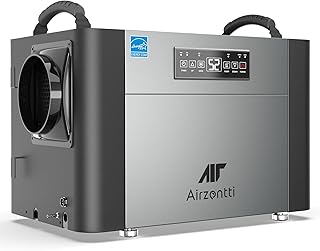
600W Utility Heater with Built-In Thermostat
This is the archetype of the category: a compact 120V, 600W metal-bodied unit designed to sit in a pump room or crawl space and do nothing but hold the space above freezing. The integrated thermostat means it idles most of the winter and only draws power when temperatures actually drop, which makes it the most sensible default choice for a single vulnerable pipe run.
600W Pump House Heater with Thermostat
Functionally close to the pick above, with a thermostat tuned for stable low-setpoint cycling rather than comfort heating. It’s a solid option for well houses and detached utility enclosures where you want a set-and-forget install, and the modest wattage makes it easy to run two units on separate circuits in a longer crawl space.
600W Utility Heater with Dual-Screen Display
The dual-screen display is the meaningful upgrade here: you can read both ambient temperature and your target setpoint without crawling in with a flashlight. For anyone who wants confirmation that the unit is actually working through a cold snap, that visibility is worth the small premium.
BREEZOME 1500W Portable Electric Heater
Not a crawl space unit, but a strong choice for conditioned basements, finished utility rooms, and workshops where pipes run along an exterior wall. The 90° oscillation and 24-hour timer give it real coverage, and at 37 dB it won’t intrude if the space is adjacent to living areas.
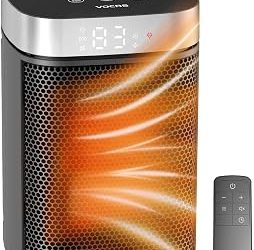
DREO Space Heater with Thermostat
A well-engineered PTC ceramic unit with 70° oscillation, ECO mode, and five heat settings, best deployed in a basement laundry or garage rather than a crawl space proper. The remote and 12-hour timer make it practical for spaces you pass through daily but don’t want to heat continuously.
Frequently Asked Questions
What temperature should I set for freeze protection?
Aim for 40–45°F. Water freezes at 32°F, but pipes near exterior walls sit colder than the room average, so a small buffer prevents surprises without wasting energy.
Can I leave a crawl space heater running all winter?
Yes, provided it’s a thermostat-controlled unit rated for unattended use, hardwired or plugged directly into a dedicated GFCI outlet, and installed with the manufacturer’s clearances. Inspect it at the start and midpoint of the season.
Is insulation a better investment than a heater?
Almost always, yes. Sealing vents, insulating rim joists, and installing a vapor barrier reduces heat loss permanently. A heater is the backstop, not the primary strategy.
Do I need a GFCI outlet?
Yes. Crawl spaces and pump houses are damp locations, and GFCI protection is required by code in most jurisdictions. Have an electrician add a dedicated circuit if one isn’t present.
Final Thoughts
For most homes, the 600W Utility Heater with Built-In Thermostat is the right tool for the job: purpose-built, low-draw, and genuinely set-and-forget. Upgrade to the 600W Utility Heater with Dual-Screen Display if you want at-a-glance confirmation it’s holding temperature, and consider the DREO Space Heater for finished basements and utility rooms where comfort and pipe protection overlap.