Key takeaways
- Wattage vs. volume: A sealed, insulated crawl space of 300 to 600 sq ft is usually held above freezing by 400 to 800W. Vented or uninsulated spaces need far more, or better still, sealing work first. Do not assume more watts is the fix for a leaky envelope.
- Built-in thermostat with a low setpoint: Freeze protection means holding roughly 38 to 45°F, not 68°F. Look for a unit that can be set that low and left alone. Models with a digital or dual-screen display let you confirm actual temperature versus target without crawling in.
- Circuit and voltage: A 1500W heater draws about 12.5A and effectively owns a 15A circuit. If you already have a 240V line down there, a 1000W/240V unit runs cooler and leaves headroom. Never chain a heater to an extension cord.
- Mounting and enclosure: Crawl spaces are damp and dusty. Prefer a metal-housed, wall- or bracket-mounted unit that keeps intake off the ground, away from vapor barrier, insulation, and stored material.
- Safety cutoffs: Overheat protection is non-negotiable in an unattended space. Tip-over shutoff matters only if the unit sits on the floor, which is worth avoiding in the first place.
What's inside
Crawl spaces are the part of a house nobody curates. They sit below the finished floor, unlined and half-forgotten, until a January cold snap splits a supply line and the water shows up in the hallway. The problem is that a crawl space is a strange thermal environment: low ceilings, moving air, vented block walls, and a dirt or vapor-barrier floor that pulls heat away all night. A heater built for a living room reads that space wrong. It cycles constantly, wastes energy, and often shuts itself down on a tip-over or overheat sensor long before the pipes are safe.
This guide narrows the field to freeze-protection heaters that actually suit sub-floor conditions in 2026: compact thermostatic utility units for tight bays, a heavy-duty 240V pump house heater for larger footprints, and a gas-fired unit heater for contractors dealing with genuinely cold, oversized voids. Below you will find how to size and place a unit, honest notes on each pick, and answers to the questions that come up most often once buyers start reading spec sheets.
As an Amazon Associate we earn from qualifying purchases.


How to Choose a Crawl Space Heater (2026)
- Wattage vs. volume: A sealed, insulated crawl space of 300 to 600 sq ft is usually held above freezing by 400 to 800W. Vented or uninsulated spaces need far more, or better still, sealing work first. Do not assume more watts is the fix for a leaky envelope.
- Built-in thermostat with a low setpoint: Freeze protection means holding roughly 38 to 45°F, not 68°F. Look for a unit that can be set that low and left alone. Models with a digital or dual-screen display let you confirm actual temperature versus target without crawling in.
- Circuit and voltage: A 1500W heater draws about 12.5A and effectively owns a 15A circuit. If you already have a 240V line down there, a 1000W/240V unit runs cooler and leaves headroom. Never chain a heater to an extension cord.
- Mounting and enclosure: Crawl spaces are damp and dusty. Prefer a metal-housed, wall- or bracket-mounted unit that keeps intake off the ground, away from vapor barrier, insulation, and stored material.
- Safety cutoffs: Overheat protection is non-negotiable in an unattended space. Tip-over shutoff matters only if the unit sits on the floor, which is worth avoiding in the first place.
The Best Crawl Space Heaters of 2026, Reviewed
600W Utility Heater with Dual-Screen Display
The most practical pick for the majority of homes: 600W is enough for a sealed crawl space or well house, and the dual-screen readout shows current and target temperature so you can verify performance from the hatch instead of on your elbows. Its thermostat holds a genuinely low setpoint, which keeps run time and energy use modest through a long winter.
KING U24100 Utility Pump House Heater
A 1000W, 240V workhorse in a steel enclosure, built for the kind of unfinished space where a plastic-bodied heater has no business. Choose this when you have a larger or poorly insulated crawl space and an existing 240V circuit, and mount it high on a joist or wall for even air movement.
Mr. Heater 125,000 BTU Forced-Air Unit Heater
This is contractor-grade equipment, propane or natural gas, and it is overkill for a typical residential crawl space. Where it earns its place is large commercial sub-floors, agricultural pump buildings, or northern climates where electric resistance simply cannot keep pace. Combustion air and venting must be handled properly, so treat this as a professionally installed solution.
BEYOND HEAT 1500W Milkhouse Heater
The classic all-metal milkhouse form factor with a dedicated anti-freeze setting, two heat levels, and both tip-over and overheat cutoffs. It is the budget-flexible option: strong output for the money, useful in a garage or utility room during the shoulder seasons, and rugged enough for occasional crawl space duty on a dedicated circuit.
600W Pump House Heater with Thermostat
A stripped-back version of the same freeze-protection idea, with a simple mechanical thermostat and no display. If you want a reliable set-and-forget unit for a small, tight crawl space or well pit, this delivers the essentials without the extra electronics.
Frequently Asked Questions
What temperature should I set a crawl space heater to?
Around 40°F is the standard target. That gives a safety margin above freezing for pipes without paying to heat unconditioned space. Insulating exposed lines first will reduce how hard the heater has to work.
Can I use a regular room heater instead?
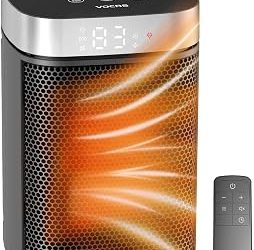
A portable unit like the DREO 1500W ceramic heater is excellent in a bedroom or office, with quiet operation, a timer, and remote control, but its features are designed for occupied rooms. For unattended freeze protection, a metal-bodied utility heater with a low-setpoint thermostat is the safer and more appropriate tool.
Is it safe to leave one running unattended?
Only with a hard-wired or dedicated outlet, adequate clearance from insulation and vapor barrier, and functioning overheat protection. Clear the area before the season starts and check the unit periodically through winter.
Should I seal my crawl space before adding heat?
Yes, whenever possible. Closing vents, sealing rim joists, and laying a proper vapor barrier can cut required wattage dramatically and often solves moisture problems at the same time.
Final Thoughts
For most homes, the 600W Utility Heater with Dual-Screen Display is the right balance of low-setpoint control, modest energy draw, and visible feedback. Step up to the KING U24100 for larger or draftier spaces on a 240V circuit, and reserve the Mr. Heater 125,000 BTU unit for oversized or commercial sub-floors where electric heat cannot keep up.