Key takeaways
- Connection hardware: Interlocking brackets and metal clips hold a line better than hook-and-loop strips or gravity alone. If the listing never shows the connector, assume the pieces will drift apart underfoot.
- True reconfigurability: Ask whether the chaise is reversible and whether the ottoman is load-bearing. A U-shape that cannot break down into an L, or into two loveseats, is a single-layout sofa in disguise.
- Cushion construction: Three-layer builds, with high-density foam under softer fill, resist the sag that pure down or single-density foam develops. Boneless “cloud” seating trades structure for depth, which suits lounging more than upright conversation.
- Cover removability: Zippered, machine-washable covers matter more than stain claims. Chenille hides wear well; velvet reads richer but shows pile marks under direct sun.
- Assembly and access: Tool-free, boxed-in-sections designs clear narrow stairwells and tight turns. Measure your doorway diagonal before your living room, not after.
What's inside
Sectionals have quietly become the most over-promised category in furniture. Every listing claims modularity, but the word covers everything from two pieces that clip together to a genuine kit of parts you can rearrange after a move, a baby, or a room swap. The gap between those two things is where buyers lose money. A sofa that only works in one orientation is a fixed sofa with extra seams, and you usually discover that after the delivery truck leaves.
This guide sorts the genuinely reconfigurable from the merely marketed. I looked at how the pieces connect, whether covers come off without a fight, how the frame handles a U-to-L conversion, and what the seat feels like on month six rather than day one. Below are six configurations worth building a room around, plus the specification details that separate a ten-year sofa from a two-year one.
As an Amazon Associate we earn from qualifying purchases.


How to Choose a Customizable Sectional Sofa (2026)
- Connection hardware: Interlocking brackets and metal clips hold a line better than hook-and-loop strips or gravity alone. If the listing never shows the connector, assume the pieces will drift apart underfoot.
- True reconfigurability: Ask whether the chaise is reversible and whether the ottoman is load-bearing. A U-shape that cannot break down into an L, or into two loveseats, is a single-layout sofa in disguise.
- Cushion construction: Three-layer builds, with high-density foam under softer fill, resist the sag that pure down or single-density foam develops. Boneless “cloud” seating trades structure for depth, which suits lounging more than upright conversation.
- Cover removability: Zippered, machine-washable covers matter more than stain claims. Chenille hides wear well; velvet reads richer but shows pile marks under direct sun.
- Assembly and access: Tool-free, boxed-in-sections designs clear narrow stairwells and tight turns. Measure your doorway diagonal before your living room, not after.
The Best Customizable Sectional Sofas of 2026, Reviewed
95″ U-Shaped Modular Chenille Sectional
The movable ottomans are the real feature here, letting you close the U for movie nights and open it to an L when guests need a path through the room. Three-layer seats give it more spine than most chenille sofas at this footprint, and the removable armrest pillows are a small mercy for anyone who naps sideways.
Cloud Modular Sectional with Reversible Chaise
Boneless construction means deep, sink-in seating with no assembly and no rigid frame to fight, and the reversible chaise makes it viable in rooms you have not decided about yet. The non-slip base keeps sections aligned on hardwood, though the green colorway is a commitment worth checking against your daylight.
M1 Sectional Sofa
The M1 is the lightest genuinely modular option in this group, which makes it the pick for renters and anyone who rearranges seasonally. Spill-resistant fabric and tool-free setup keep it practical for households with kids, and it lands closer to tailored than plush if you prefer a firmer seat.
135.5″ Velvet Modular Sectional with Storage Ottoman
At six seats and over eleven feet, this is a great-room piece rather than an apartment one, and the storage ottoman earns its keep in homes short on closets. Removable covers are the reason to trust velvet at this scale, and burnt orange works better as a considered anchor than as a neutral.
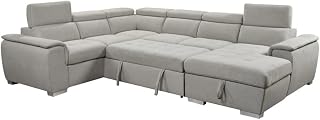
108″ U-Shaped Modular Sleeper with USB Charging
This is the most functional sleeper of the group: a pull-out bed, reclining backrests, hidden storage, and USB ports built into the frame. Seven seats in a 108-inch U-shape is dense packing, so treat the recline and bed clearances as part of your floor plan, not an afterthought.
Frequently Asked Questions
Can I add pieces to a modular sectional later?
Sometimes, but only within the same product line and often only while it remains in production. If expansion matters, buy the larger configuration now rather than counting on future availability.
Do modular sections slide apart during use?
Well-designed ones do not. Metal interlocking connectors, non-slip feet, and a rug that anchors the whole arrangement solve nearly all drift issues.
Is chenille or velvet better for pets?
Chenille is more forgiving of claws and hides hair patterns, but its loops can snag. Performance velvet resists snagging and cleans easily, though it shows pressure marks. Removable covers matter more than fiber choice either way.
How much clearance does a sleeper sectional need?
Plan on 36 to 40 inches in front of the pull-out mechanism, plus room to walk once the bed is open. Reclining backrests need four to six inches behind the frame.
Final Thoughts
For most living rooms, the 95″ U-Shaped Modular Chenille Sectional strikes the best balance of structure, layout flexibility, and everyday durability. Choose the M1 Sectional if you move often or want a firmer, lighter build, and the 108″ U-Shaped Modular Sleeper if the sofa doubles as your guest room. All three are configurations you can live with rather than around.